
Zero (zerolang.ai)
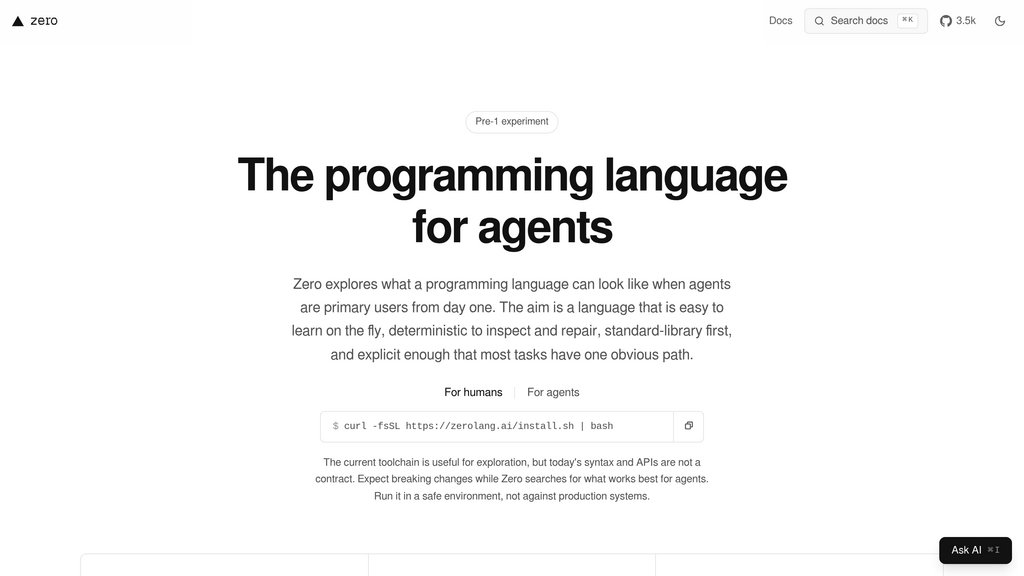
An experimental systems programming language built from the ground up for AI agents — readable, repairable, and inspectable by design.
Community:

Product Overview
What is Zero (zerolang.ai)?
Zero is an open-source, pre-1 experimental systems programming language from Vercel Labs, designed with AI agents as the primary users rather than human developers. It compiles to small native binaries and prioritizes a minimal, regular syntax that agents can learn on the fly. Rather than optimizing for human convenience, Zero makes code generation, inspection, and repair straightforward for agents — with structured JSON diagnostics, explicit effect declarations, and a standard-library-first philosophy that reduces the need for external package resolution.
Key Features
Agent-Optimized Syntax
Small surface area with regular patterns and few special cases, allowing agents to learn and navigate the language while actively working — without requiring pre-training on a large codebase.
Structured JSON Diagnostics
The compiler emits diagnostics, size reports, and repair plans as structured JSON data, giving agents machine-readable feedback they can directly act on to fix errors.
Explicit Effects System
File I/O, network access, and other external interactions are declared explicitly in function signatures, making side effects visible and predictable to both tools and human reviewers.
Standard Library First
The language is oriented toward a broad, consistent built-in standard library so most programs can be written against documented APIs without agents needing to search for or evaluate third-party packages.
Deterministic Repair Loops
The toolchain exposes graphs, explanations, and repair metadata as structured output, enabling agents to run reliable fix-and-verify loops with minimal guesswork.
Use Cases
- Agentic Code Generation : AI coding agents can generate Zero programs from scratch using the language's regular, predictable patterns — reducing hallucinations and invalid syntax that plague agents using general-purpose languages.
- Automated Code Repair : Agents can consume the compiler's structured repair metadata to iteratively fix broken programs in deterministic feedback loops without human intervention.
- Native CLI Tool Building : Developers and agents can compile small, self-contained native binaries suitable for command-line utilities and automation scripts, targeting sub-10 KiB output sizes.
- Safe Sandboxed Experimentation : Teams exploring agent-driven software development can use Zero in isolated environments to experiment with how agents read, modify, and release programs end-to-end.
FAQs
Zero (zerolang.ai) Alternatives

Aide
Open-source AI-native code editor enhancing coding productivity with integrated AI agents and advanced editing features.

1Code
Open-source client for running Claude Code agents in parallel with a calm, intuitive interface—available on Mac and web.

Chad IDE
Intelligent coding environment that integrates entertainment features directly into the development workflow, transforming AI processing downtime into productive moments.

Regex.ai
A web-based tool that streamlines the creation and understanding of regular expressions through intuitive pattern detection and visualization.

AICodeConvert
AI-powered platform for seamless code translation, generation, optimization, and debugging across 50+ programming languages.

CTOK
Cost-effective Claude Code sharing platform enabling multiple users to split premium subscription expenses through account pooling.

EasyCode
AI-powered coding assistant that understands your codebase, providing context-aware code suggestions and seamless integration within IDEs.

JS2TS
An AI-powered online tool that automates the conversion of JavaScript, JSON, and CSS into TypeScript and related formats, enhancing code quality and development efficiency.