
Pi Coding Agent
Minimal terminal-based coding harness designed for extensibility, allowing developers to customize workflows through TypeScript extensions and packages.
Community:


Product Overview
What is Pi Coding Agent?
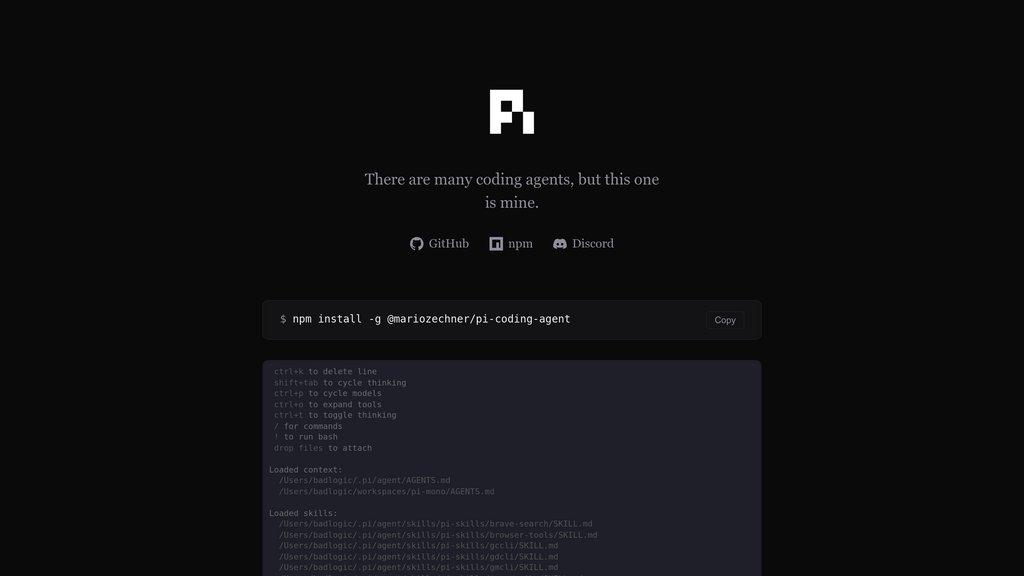
Pi Coding Agent is an open-source terminal coding tool that prioritizes minimalism and customization over bundled features. Built by Mario Zechner, it ships with only four core tools (read, write, edit, and bash) and a lean 300-word system prompt, making it one of the most lightweight coding agents available. The platform supports major LLM providers including Anthropic, OpenAI, Google, Azure, Mistral, Groq, and others. Pi's architecture deliberately omits common features like sub-agents, plan mode, and MCP support, instead encouraging users to build exactly what they need through TypeScript extensions, skills, prompt templates, and themes. Sessions are stored as navigable trees, and extensions can be bundled as packages and shared via npm or git repositories.
Key Features
Multi-Provider Model Support
Connect to Anthropic, OpenAI, Google, Azure, Bedrock, Mistral, Groq, Cerebras, xAI, Hugging Face, and more with API key or OAuth authentication. Switch models mid-session using keyboard shortcuts or commands.
Tree-Based Session Management
Sessions stored as branching trees allow navigation to any previous conversation point and continuation from there. All branches preserved in a single file with export to HTML or shareable GitHub gist URLs.
Extensible Architecture
TypeScript extensions provide full access to tools, commands, keyboard shortcuts, events, and the terminal UI. Build custom features like sub-agents, sandboxing, MCP integration, or even run Doom within the agent.
Advanced Context Engineering
Control context window management through AGENTS.md project instructions, SYSTEM.md prompt replacement, auto-summarization compaction, on-demand skills loading, and dynamic context injection via extensions.
Package Ecosystem
Bundle and share extensions, skills, prompts, and themes as installable packages via npm or git. Test packages without installation, pin specific versions, and discover community packages through npm or Discord.
Multiple Operation Modes
Run in interactive TUI mode, print/JSON mode for scripting, RPC mode for non-Node integrations via stdin/stdout, or embed as an SDK in applications for programmatic control.
Use Cases
- Custom Workflow Development : Developers who need specific coding workflows can build tailored extensions rather than adapting to opinionated agent architectures, maintaining full control over features and behavior.
- Multi-Model Development : Teams working across different LLM providers can switch between models mid-session to leverage specific model strengths for different coding tasks without managing multiple tools.
- Terminal-Native Coding : Engineers preferring terminal workflows can execute coding tasks with full observability and direct interaction without GUI dependencies or browser-based interfaces.
- AI Agent Research : Researchers exploring agent architectures can experiment with different approaches through extensions while maintaining a minimal, predictable core system for controlled testing.
- Embedded Agent Systems : Developers building applications that require embedded coding assistance can integrate Pi's SDK mode into their products, as demonstrated by real-world implementations like clawdbot.
FAQs
Pi Coding Agent Alternatives

Continue
Open-source AI code assistant that integrates with popular IDEs to enhance developer productivity through chat, autocomplete, edit, and agent capabilities.

AmpCode
Browser-based coding environment enabling instant programming across multiple languages without local setup.

Augment Code
AI-powered coding assistant that deeply understands entire codebases to help developers write better code faster and make smarter decisions.

Reasonix
Terminal-native coding agent built exclusively around DeepSeek's prefix cache to cut long-session token costs to roughly a fifth.

Trellis
All-in-one AI framework enabling Claude Code and Cursor to understand your codebase, enforce development standards, and accelerate feature delivery.

Codebuff
CLI tool that automates coding tasks by deeply understanding your entire codebase to generate precise, context-aware code changes.

GitButler
A modern Git client enabling simultaneous work on multiple branches with virtual branch management and integrated AI-assisted workflows.

Void
Open-source AI code editor based on VS Code, offering powerful AI-assisted coding with full data privacy and flexible model integration.