
OpenUI
An open standard framework for Generative UI that enables LLMs to dynamically compose and stream interactive React interfaces instead of plain text.
Community:


Product Overview
What is OpenUI?
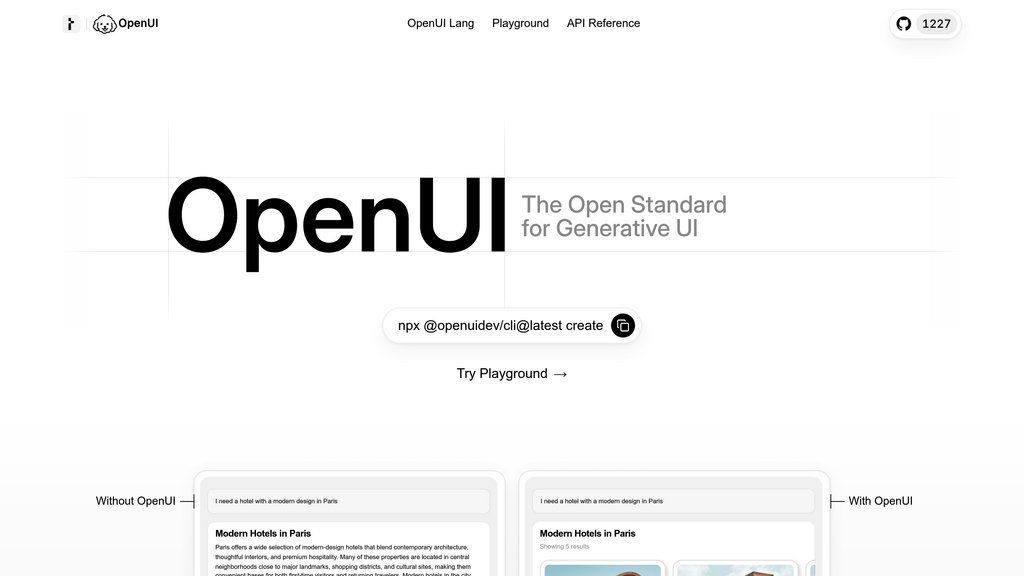
OpenUI is a full-stack Generative UI framework built around OpenUI Lang — a compact, streaming-first language purpose-built for Large Language Models to generate user interfaces. Rather than returning static text or markdown, OpenUI allows LLMs to dynamically select, configure, and compose React components into fully interactive interfaces tailored to each user's request. The framework is up to 67% more token-efficient than JSON-based alternatives, significantly reducing API costs and latency while delivering real-time, progressive UI rendering.
Key Features
OpenUI Lang
A compact, line-oriented language designed specifically for LLMs to generate UI. It is up to 67% more token-efficient than JSON, reducing API costs and speeding up streaming render times dramatically.
Streaming-First Rendering
UI components are parsed and rendered line-by-line as tokens arrive from the model, giving users a real-time assembly experience rather than waiting for a complete response payload.
Component Library Integration
Developers register their own React components via defineComponent and createLibrary APIs, giving the LLM a controlled, validated palette to compose from — preventing hallucinated or unsafe UI output.
Model-Agnostic Architecture
Works with any LLM backend — GPT-4, Claude, Gemini, or local models — making it flexible for teams regardless of their preferred AI provider.
Robustness Against Hallucination
Invalid or hallucinated component names are automatically validated and dropped at render time, ensuring the application never breaks due to unexpected LLM output.
Interactive Output Beyond Text
Enables LLMs to generate action-oriented interfaces such as editable forms, interactive charts, multi-tab dashboards, and data tables — turning AI from an answer engine into an action engine.
Use Cases
- Conversational Product Interfaces : Product teams can replace static chatbot responses with dynamic, context-aware UI components — like hotel carousels or booking forms — generated directly from user queries.
- Data Exploration Tools : Developers building analytics or BI tools can let the LLM compose live charts, filterable tables, and summary cards on demand based on user intent.
- Form and Workflow Automation : Applications that require user input collection can have the AI dynamically generate the appropriate form structure based on the task context, reducing hardcoded UI work.
- Rapid AI-Native Prototyping : Startups and indie developers can use the OpenUI playground to prototype full interactive interfaces through natural language prompts without writing layout code from scratch.
- Enterprise App Integration : Engineering teams can embed OpenUI into existing React apps to add generative interface layers on top of their own component libraries with minimal overhead.
FAQs
OpenUI Alternatives

Wonder
A design tool that generates UI, graphics, and code simultaneously on one canvas — what you design is exactly what ships.

FlowMapp
Visual UX planning platform for creating sitemaps, user flows, wireframes, and project proposals with AI-powered tools and collaboration features.

Attention Insight
AI-powered design analytics platform delivering attention heatmaps and clarity scores to optimize marketing and UX performance.

Opacity
Canvas-based development platform that unifies design, versioning, and reusable code components.

Mokkup.ai
Cloud-based dashboard wireframing tool designed for data analysts, BI developers, and business teams to quickly prototype and collaborate on business intelligence dashboards.

Components AI
An open-source platform offering parametric and generative design tools for creating responsive UI and graphic components without coding.
FF Designer
A standalone AI design tool by FlutterFlow that generates production-quality app screens from natural language prompts, with full visual editing and direct FlutterFlow integration.

InVision
Comprehensive digital product design platform enabling seamless collaboration, prototyping, and animation across teams.