
Laminar
Open-source platform for tracing, evaluating, and analyzing AI applications with seamless LLM observability and tooling.
Community:

Product Overview
What is Laminar?
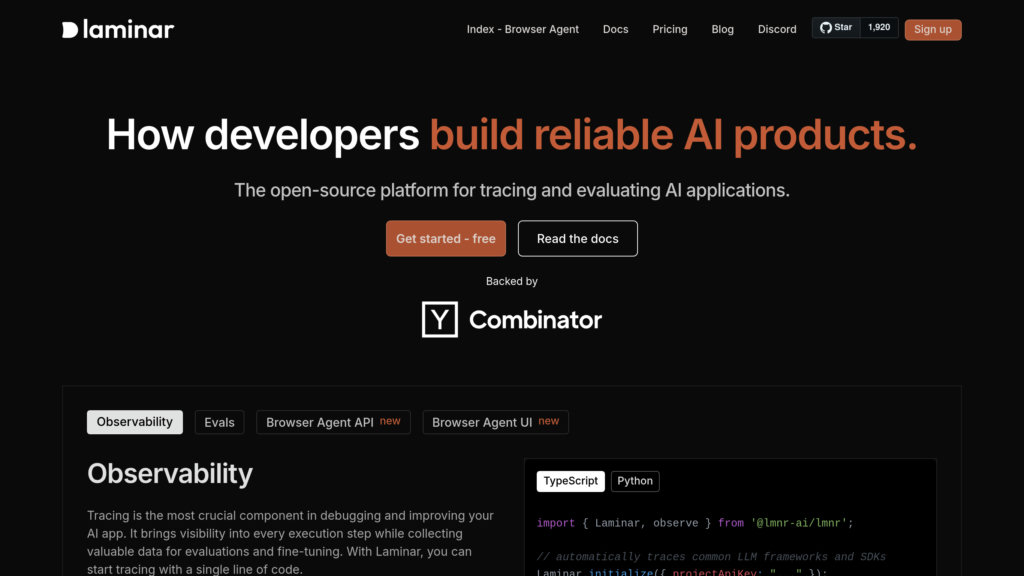
Laminar, also known as Laminar, is a comprehensive open-source platform designed to help developers build reliable AI products by providing deep observability and evaluation tools for Large Language Model (LLM) applications. It enables automatic tracing of AI frameworks and SDKs with minimal code, collects detailed execution data, and supports scalable evaluation and labeling workflows. Laminar’s high-performance Rust backend and modern architecture ensure low latency and efficient processing, while its rich UI offers trace visualization, dataset management, and advanced analytics. It is suitable for both self-hosting and managed cloud deployment.
Key Features
Automatic LLM Tracing
Instrument popular LLM SDKs and frameworks like OpenAI, Anthropic, LangChain, and more with just two lines of code to capture detailed execution traces.
Real-Time Observability
Collect and analyze trace data in real time with minimal performance overhead using a Rust-based backend and gRPC communication.
Evaluation and Labeling Automation
Run scalable automated evaluations and label spans to generate datasets for fine-tuning, prompt engineering, and quality tracking.
Comprehensive Trace Analytics
Visualize, search, and group traces and sessions via a powerful UI to gain insights into AI app behavior and performance.
Open-Source and Self-Hosting Friendly
Fully open-source with easy self-hosting options using Docker Compose, enabling customization and control over your AI observability stack.
Browser Agent Observability
Unique feature to record browser sessions synchronized with agent traces, enhancing debugging and user experience analysis.
Use Cases
- AI Application Debugging : Developers can trace and debug LLM-based features efficiently by visualizing execution flows and identifying bottlenecks.
- Performance Monitoring : Operations teams monitor latency, cost, token usage, and other metrics to optimize AI model deployments.
- Automated Model Evaluation : Data scientists automate evaluation workflows to track AI model accuracy and improve prompt engineering.
- Dataset Creation for Fine-Tuning : Generate labeled datasets from production traces to support continuous model improvement and training.
- User Interaction Analysis : Analyze user-agent interactions in browser environments to enhance AI-driven user experiences.
FAQs
Laminar Alternatives

BrowserStack
Cloud-based platform providing instant access to thousands of real browsers and devices for comprehensive web and mobile app testing.

TestMu AI
Full-stack agentic quality engineering platform that autonomously plans, authors, executes, and analyzes tests across web, mobile, and AI applications.

Jam
One-click bug reporting tool that auto-captures all technical data developers need to debug faster with instant replay and seamless integrations.

BetterBugs
A Chrome extension that streamlines bug reporting by creating detailed, visual reports enriched with technical data and AI-assisted debugging.

OpenReplay
OpenReplay is an open-source session replay and analytics platform designed for developers and product teams, offering full data control through self-hosting and advanced user behavior insights.

Braintrust
End-to-end AI development platform enabling robust, iterative building, evaluation, and monitoring of large language model applications.

Katalon
All-in-one AI-augmented test automation platform supporting web, mobile, API, and desktop testing with rich integrations and scalable execution.

TestSprite
An AI-powered autonomous testing agent that automates end-to-end software testing for frontend and backend with minimal human intervention.