
OpenBot
Desktop workspace for persistent AI agents that collaborate, use local files, and run through existing subscriptions or local models.
Community:


Product Overview
What is OpenBot?
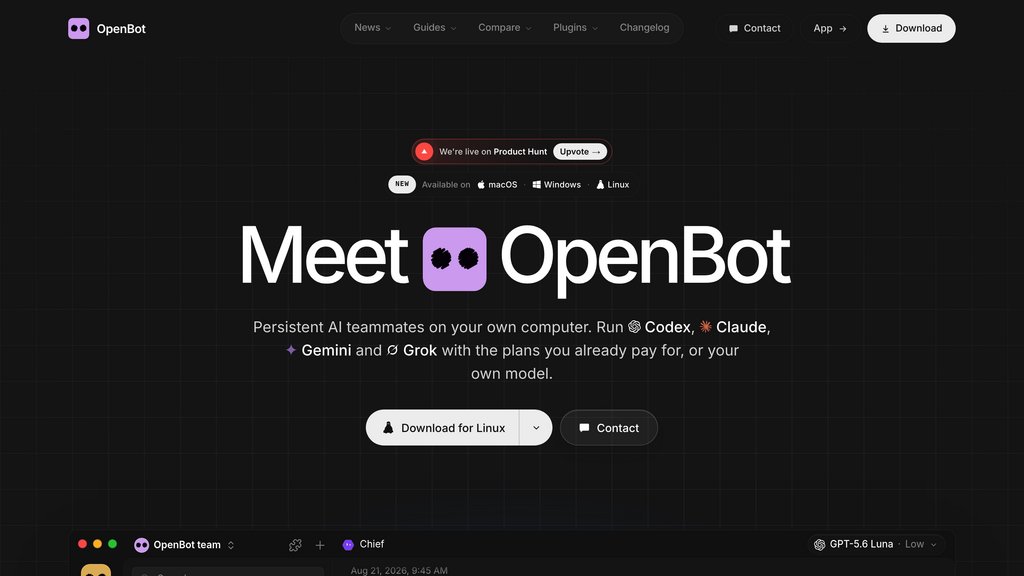
OpenBot brings multiple AI agents into one desktop workspace on macOS, Windows, and Linux. Each agent has its own instructions, workspace, and conversation history, and can exchange messages, delegate tasks, and share files with other agents. Users can connect supported coding assistants, OpenAI-compatible endpoints, or local models, then switch providers without losing the agent's context. A built-in browser and task queues support hands-on work, while workspace data remains on the user's computer.
Key Features
Collaborative Agent Teams
Create agents with distinct roles and instructions that communicate, hand off tasks, and share files.
Flexible Provider Connections
Use Codex, Claude Code, Gemini, Grok, OpenCode, Cursor, or Cline, alongside OpenAI-compatible endpoints and local models.
Persistent Agent Context
Keep each agent's workspace and conversation across app restarts and provider changes.
Local Workspace Storage
Store conversations, files, attachments, and browser data on the computer running OpenBot rather than OpenBot's servers.
Built-In Browser
Let agents open, read, and interact with web pages directly within the desktop application.
Task Queues
Send additional work to busy agents and pause, resume, or cancel queued messages.
Use Cases
- Software Development : Assign implementation, testing, and code review to separate agents that coordinate within a shared project.
- Web Research : Have agents browse sources, collect findings, and pass research to another agent for synthesis.
- Browser-Based Testing : Use agents to interact with web applications, investigate interface issues, and coordinate fixes with coding agents.
- Documentation Workflows : Delegate project summaries, release notes, and documentation drafts while queuing follow-up tasks.
FAQs
OpenBot Alternatives

Buzz
Open-source collaboration workspace where teams and agents communicate, plan, build, and review work together.

E2B
Open-source runtime enabling secure, scalable code execution in isolated cloud sandboxes for AI applications.

BrowserAct
Agent-native browser infrastructure for web automation, structured data extraction, and authenticated browsing.

Maxim AI
End-to-end AI evaluation and observability platform accelerating reliable AI agent development and deployment.

Agno
Full-stack multi-agent framework for building autonomous systems with advanced reasoning, memory management, and seamless integration across multiple AI models.

Raft
Real-time collaboration platform where humans and AI agents work together as teammates in shared channels and threads.

Respan
Proactive observability, evaluation, and gateway platform that helps engineering teams trace, debug, and continuously improve AI agents in production.

Weavy
Embeddable collaboration infrastructure that lets developers add chat, feeds, files, and AI copilots to any app as drop-in components.