
BrowserAct
Agent-native browser infrastructure for web automation, structured data extraction, and authenticated browsing.
Community:


Product Overview
What is BrowserAct?
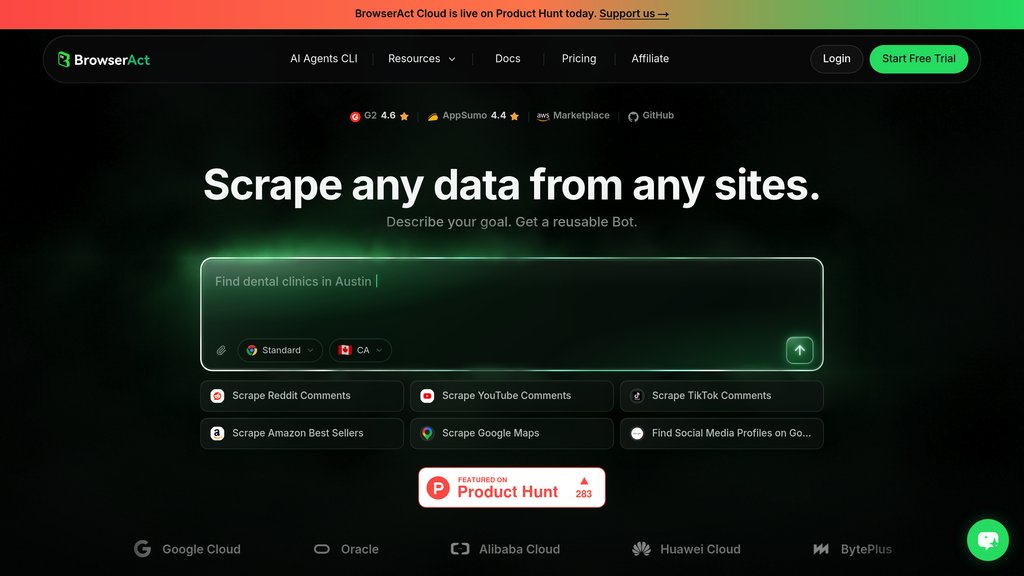
BrowserAct provides a browser layer for AI agents that need to operate on real websites reliably. It helps agents navigate pages, extract clean structured data, reuse local Chrome login sessions, and handle common web obstacles such as bot detection and CAPTCHAs. BrowserAct supports local agent integrations, cloud workflows, and API or MCP access, making it suitable for both personal automation and product-level browser capabilities.
Key Features
Anti-Blocking Browser Runtime
Uses stealth fingerprints, proxy routing, and CAPTCHA handling to help browser tasks continue on protected websites.
Clean Data for Agents
Converts web pages into indexed, low-token structured content so agents can reason about pages without relying on raw DOM output.
Local Chrome Session Reuse
Lets agents work through existing local Chrome sessions with saved cookies, SSO access, extensions, and logged-in accounts.
Isolated Browser Identities
Runs parallel browser sessions with separate fingerprints, proxies, workspaces, and account states to prevent session interference.
Agent Command Interface
Supports browser actions such as navigation, clicking, typing, waiting, uploading files, and extracting data through agent-friendly commands.
API and MCP Integration
Exposes browser tasks and workflows through APIs and MCP, enabling web automation capabilities inside agent products and automation stacks.
Use Cases
- Web Research Automation : Research agents can collect live information from websites, organize extracted content, and return data for analysis or reporting.
- E-commerce Data Collection : Teams can scrape product listings, prices, rankings, reviews, and other marketplace data without maintaining custom scraper code.
- Authenticated Workflow Automation : Users can automate tasks inside logged-in websites by allowing agents to reuse trusted Chrome sessions and SSO access.
- Multi-Account Operations : Operators can manage browser-based work across multiple accounts with persistent, isolated identities and regional proxy configurations.
- AI Agent Product Development : Developers can add real-browser navigation, interaction, and structured web extraction to their applications through API or MCP.
FAQs
BrowserAct Alternatives

TinyFish
Enterprise infrastructure for web data operations — enabling agents to navigate, authenticate, extract, and transact across hundreds of live sites simultaneously via a single API.

Browser Use
Open-source AI-driven browser automation tool enabling AI agents to interact with websites like humans for seamless web tasks.

Airtop
AI-powered cloud browser automation platform enabling natural language control of web interactions, including complex authentication and scalable session management.

Rindler
Turns any website, even ones without an API, into a structured interface AI agents can reliably call to read data and complete tasks.

Scrapybara
API-driven virtual desktop infrastructure enabling AI agents to perform scalable, secure, and automated computing tasks with browser and OS-level control.

Quaso
Turns plain English instructions into web automations, letting anyone browse live, run scheduled Functions, and connect apps without code.

Agentbase
Serverless agent platform that enables developers to build and deploy production-grade autonomous agents with built-in browser automation, tools, and persistent environments through a single API.

OpenClaw
Open-source personal AI assistant that runs on your machine with persistent memory, multi-platform messaging, and full system automation capabilities.