
Cube
Universal semantic layer platform that unifies data models and delivers consistent metrics across BI tools, APIs, and LLM applications.
Community:


Product Overview
What is Cube?
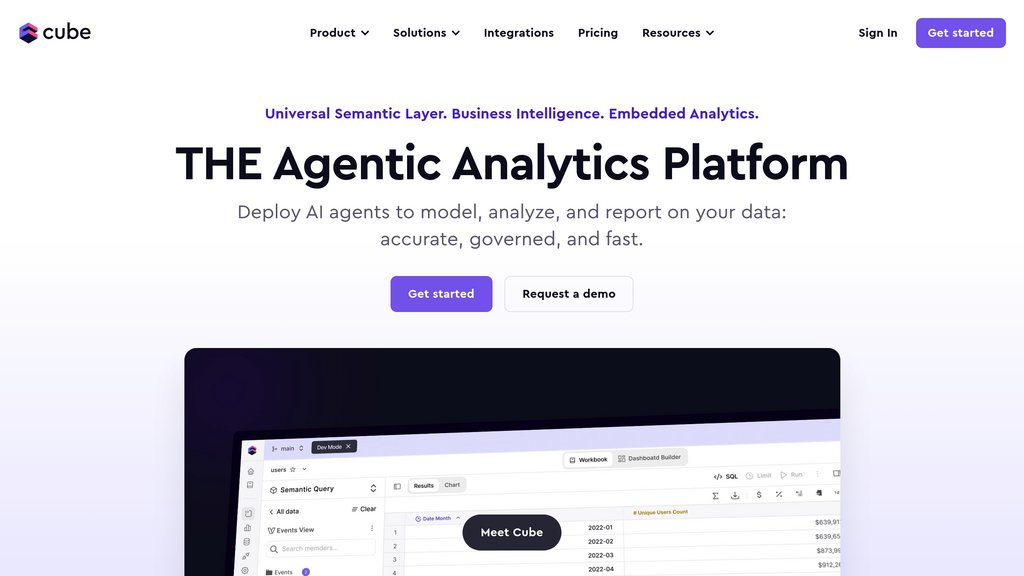
Cube is an agentic analytics platform built on a universal semantic layer that centralizes business logic and data definitions across an organization's entire data ecosystem. It allows teams to model their data once in a declarative format and deliver it consistently to any analytics tool, dashboard, or application through various APIs. The platform emphasizes four core pillars: data modeling, access control, caching and pre-aggregation, and API integration. By consolidating metric definitions into a single source of truth, Cube eliminates the need to write duplicate queries across different tools and ensures consistent data interpretation organization-wide. The platform integrates seamlessly with cloud data warehouses, supports real-time and batch data processing, and includes an AI API for natural language queries with LLMs.
Key Features
Universal Semantic Layer
Centralized data modeling layer that defines metrics and business logic once in declarative YAML format, ensuring consistent interpretation across all downstream analytics tools and applications.
Advanced Caching & Pre-Aggregation
In-memory caching system and automated pre-aggregation capabilities that accelerate query performance, reduce database load by up to 50%, and significantly lower compute costs.
Multi-API Integration
Comprehensive API suite including REST, GraphQL, SQL, Orchestration, and AI APIs that enable seamless data delivery to BI tools, embedded analytics, LLMs, and custom applications.
Granular Access Control
Row-level and column-level data security controls that ensure users only access authorized data while maintaining centralized governance and compliance.
Developer-Friendly Workflow
Software engineering best practices including Git versioning, CI/CD pipelines, isolated development environments, code review processes, and automated testing for data models.
Real-Time & Historical Analytics
Unified querying interface that seamlessly merges streaming and batch data sources, enabling analysis of both real-time and historical data within a single query.
Use Cases
- Embedded Analytics : SaaS companies can build customer-facing dashboards and reporting features with consistent metrics, fast query performance, and secure multi-tenant data access.
- Enterprise BI Standardization : Large organizations can eliminate metric discrepancies across departments by establishing a single source of truth for business definitions used by all BI tools.
- Agentic AI Applications : Development teams can integrate LLMs with structured data through Cube's AI API, enabling natural language queries that return accurate, governance-compliant results.
- Data Engineering Efficiency : Data teams can reduce repetitive SQL writing and maintenance burden by defining metrics once and reusing them across hundreds of dashboards and reports.
- Cloud Data Warehouse Optimization : Organizations can dramatically reduce cloud compute costs by leveraging pre-aggregations to minimize expensive warehouse queries while maintaining sub-second response times.
FAQs
Cube Alternatives

Drip Capital
Technology-driven trade finance platform providing working capital solutions tailored for SMEs engaged in cross-border trade.

Spartan Forge
Advanced hunting app combining high-resolution mapping, LiDAR terrain data, and predictive analytics for deer movement.

PROVEN Skincare
AI-driven personalized skincare brand using the Skin Genome Project™ to create customized routines based on extensive data analysis.

CARCO Group
Leading provider of mobile technology solutions for pre-insurance vehicle inspections and fraud prevention in the auto insurance industry.

Logcomex.ai
Foreign trade platform with specialized AI agents for import/export data analysis, cargo tracking, HS code classification, and supplier prospecting via natural language commands.

Carbonfact
Sustainability management platform tailored for apparel and footwear brands to measure, report, and reduce their environmental footprint across the supply chain.

Hawk AI
Comprehensive AML and fraud surveillance platform enhancing financial crime detection and compliance efficiency.

Cofactr
A unified supply chain execution platform that streamlines procurement, inventory, and logistics for hardware manufacturers.