
Brief
A product navigator that captures team decisions and delivers real-time context to engineers and coding agents, so nothing gets built blind.
Community:


Product Overview
What is Brief?
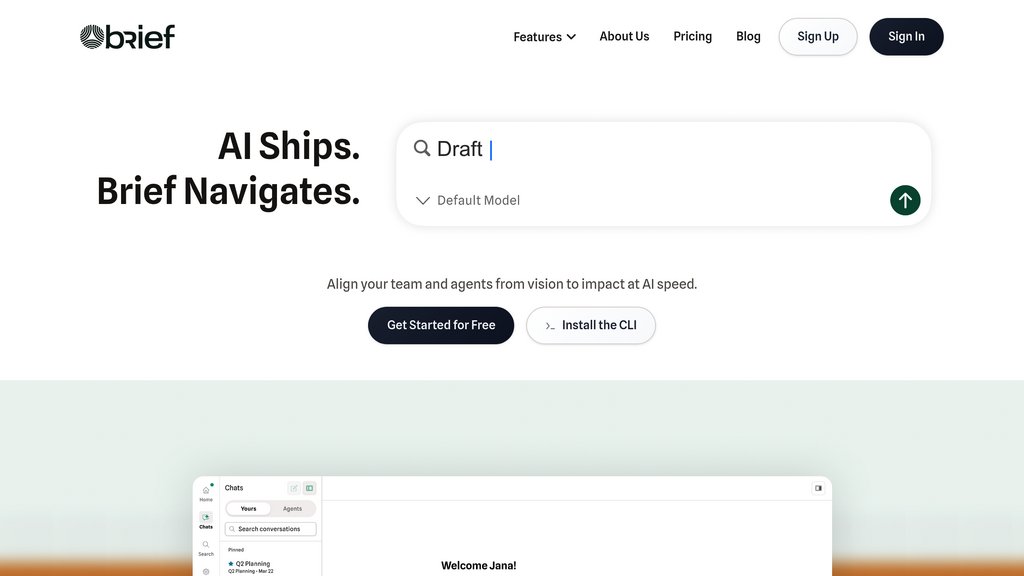
Brief is a product navigation platform built for teams shipping fast with AI coding agents. Rather than acting as a task tracker or documentation tool, Brief continuously captures product decisions from the tools teams already use — Linear, Jira, Notion, Slack, and GitHub — and organizes them into a living Product Graph. Engineers and AI agents (Cursor, Claude Code, Windsurf, and other MCP-compatible tools) can query this graph directly from their IDE, getting instant access to the reasoning, tradeoffs, and context behind every product decision. The result: fewer rewrites, better alignment, and more work that actually ships.
Key Features
Product Graph Engine
Automatically maps captured decisions into a searchable, always-current knowledge graph that reflects your product's full history of reasoning and tradeoffs.
MCP Server & CLI Integration
Connects directly to Cursor, Claude Code, Windsurf, and any MCP-compatible assistant, delivering product context to your agents right inside the IDE.
Decision Capture from Existing Tools
Integrates with Linear, Jira, Notion, Slack, and GitHub to automatically extract decisions as they happen — no workflow changes required.
Contextual Navigation for Agents
Goes beyond code syntax to give AI agents the business intent, constraints, and historical context needed to build the right thing the first time.
Team Alignment at Scale
Captures strategic priorities and technical tradeoffs from key decision-makers, making that judgment accessible to the entire team even when they're not in the room.
Use Cases
- AI-Assisted Development : Engineering teams using Cursor, Claude Code, or Windsurf can give their agents the full product context needed to reduce wrong-direction builds and costly rewrites.
- Product Decision Management : Product managers can ensure every architectural and strategic decision is recorded, searchable, and connected to the features it informs.
- Onboarding New Engineers : New team members can query the Product Graph to quickly understand why systems were built a certain way, cutting ramp-up time significantly.
- Token Budget Optimization : Engineering leads can maximize the ROI of their AI compute budget by ensuring agents build correctly on the first pass, reducing wasted tokens on rework.
- Cross-Team Alignment : Distributed or fast-scaling teams can stay aligned on decisions across Slack, Jira, GitHub, and Notion without holding extra syncs or maintaining separate wikis.
FAQs
Brief Alternatives

BirdsEyes
Interest mapping platform that analyzes your reading and media consumption to reveal patterns, break information bubbles, and connect you with compatible people.

Zep
Production-ready AI memory layer that enables agents to learn from user interactions and business data, leveraging a temporal knowledge graph for accurate, personalized, and scalable AI experiences.

Obsidian
A privacy-first note-taking application that transforms unstructured notes into an interconnected knowledge system through markdown-based linking and visualization.

Recall
A personal knowledge base that saves, summarizes, and connects everything you read, watch, or hear — then lets you chat with it using the AI model of your choice.

Capacities
A networked note-taking and knowledge management studio that integrates AI assistance, calendar syncing, and offline capabilities for seamless productivity.

DevRev
AI-native platform unifying customer support, product development, and growth teams with conversational AI and a powerful knowledge graph.

Atlas
A visual knowledge workspace that lets you chat across documents, generate mind maps, and build a connected knowledge base with cited reasoning.

Recall AI
AI-powered knowledge management tool that automatically summarizes, organizes, and links content from diverse sources to enhance learning and retention.