
Permit.io
Comprehensive authorization platform enabling developers to embed fine-grained, real-time access control with no-code and policy-as-code capabilities.
Community:

Product Overview
What is Permit.io?
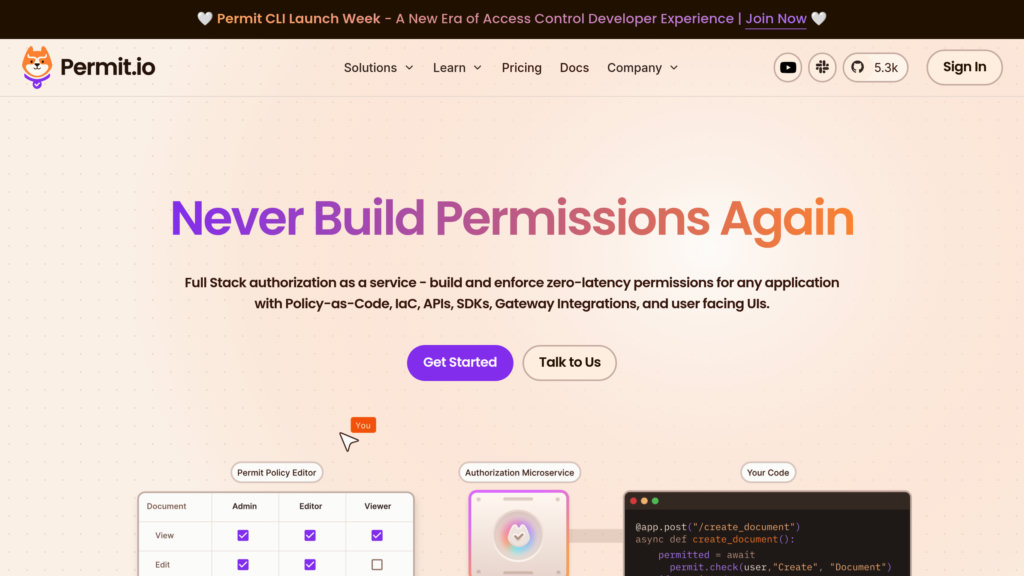
Permit.io is a full-stack authorization solution designed to simplify and secure permission management across applications. Built on open-source foundations like Open Policy Agent (OPA) and Open Policy Administration Layer (OPAL), Permit.io offers developers APIs, SDKs, and user-friendly interfaces to implement dynamic, identity-based access control quickly. Its platform supports multiple authorization models including RBAC, ABAC, and ReBAC, and provides real-time policy updates, audit logging, and compliance features. Permit.io empowers teams beyond developers—such as security and product managers—to manage permissions via low-code/no-code tools, ensuring scalable and secure authorization workflows suitable for complex environments like SaaS, FinTech, and healthcare.
Key Features
Policy-as-Code and No-Code Editor
Enables writing and managing authorization policies through both code and intuitive no-code UI, supporting various models like RBAC, ABAC, and ReBAC.
Real-Time Permission Updates
Uses OPAL’s event-driven architecture to synchronize policy changes instantly across applications, ensuring up-to-date access control.
Fine-Grained AI Access Control
Secures AI-powered applications with identity-based authorization, prompt filtering, and response enforcement through integrations with AI frameworks like LangChain and PydanticAI.
Comprehensive Audit and Compliance
Maintains detailed logs of authorization decisions and flow configurations to support regulatory compliance such as HIPAA and SOC2.
Multi-Tenancy and GitOps Support
Supports managing permissions across multiple environments and workspaces with GitOps-enabled workflows for scalable policy management.
Seamless Integration and Developer Experience
Provides SDKs, APIs, and UI components that integrate smoothly with existing systems and reduce developer overhead in building and managing permissions.
Use Cases
- Application Authorization : Developers embed fine-grained access control into applications to ensure secure, real-time permission enforcement across services.
- AI Application Security : Protect AI workflows by enforcing identity-based access and dynamic permission checks on prompts, data retrieval, and AI responses.
- Compliance-Driven Access Management : Organizations in regulated industries use Permit.io to maintain audit trails and enforce policies meeting compliance standards.
- Multi-Workspace Permission Management : SaaS companies manage permissions across development, testing, and production environments using namespaces and multi-tenancy features.
- Approval Flow Automation : Teams implement secure, customizable access approval workflows with embedded UI components for end-users and administrators.
FAQs
Permit.io Alternatives

Rowy
Open-source low-code backend platform that simplifies managing Firestore databases and building cloud functions with a spreadsheet-like interface on Google Cloud and Firebase.

Ludwig
Open-source declarative machine learning framework simplifying deep learning pipeline creation with a flexible configuration system.

Frigade
A developer-centric platform offering flexible React components and APIs to build high-quality product onboarding and user activation experiences efficiently.

SupaLaunch
A comprehensive SaaS boilerplate combining Next.js and Supabase to accelerate startup development with built-in authentication, payments, AI integration, and UI themes.

Supabase
Open source Firebase alternative offering a full Postgres backend with integrated authentication, realtime, storage, and edge functions.

Base44
All-in-one AI-powered no-code platform to build fully functional apps instantly with built-in backend services.

Pipedream
A serverless integration platform enabling fast API connections, workflow automation, and custom code execution with extensive API support.

Payload CMS
A next-generation, fully customizable headless CMS and application framework built on Node.js, React, and MongoDB.