
Ludwig
Open-source declarative machine learning framework simplifying deep learning pipeline creation with a flexible configuration system.
Community:

Product Overview
What is Ludwig?
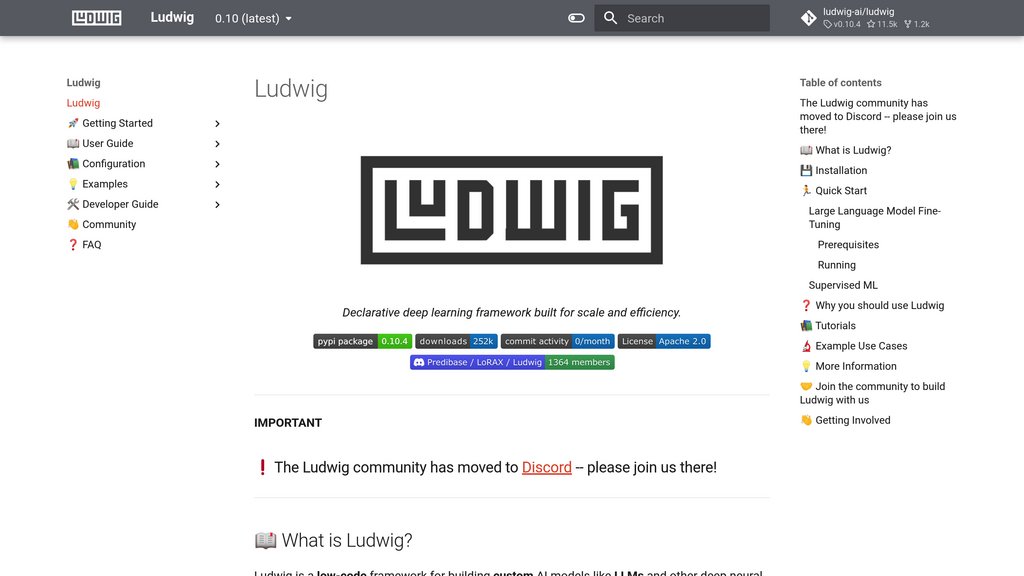
Ludwig is an open-source machine learning framework designed to streamline the creation and training of deep learning models through a declarative, data-driven configuration approach. It enables users to define input and output features, preprocessing, model architecture, and training parameters in a simple configuration file, removing the need for extensive coding. Originally developed by Uber and now hosted by the Linux Foundation AI & Data, Ludwig supports a wide range of tasks including text classification, image captioning, sequence tagging, regression, and more. Its encoder-combiner-decoder architecture flexibly handles diverse data types and integrates advanced features like distributed training, hyperparameter optimization, and easy model deployment.
Key Features
Declarative Configuration
Users define the entire machine learning pipeline-from data preprocessing to model architecture and training-using a simple, flexible configuration file.
Versatile Encoder-Combiner-Decoder Architecture
Supports multiple input and output data types including text, images, categorical data, and time series, enabling diverse machine learning tasks.
Distributed Training and Scalability
Integrates with Ray and Horovod to enable distributed training across multiple GPUs or machines, accelerating model iteration and experimentation.
Hyperparameter Optimization
Built-in support for parallel hyperparameter tuning using Ray Tune, allowing efficient exploration of model configurations.
Low-Code Interface for AutoML
Automates model training by requiring only a dataset, target column, and time budget, making deep learning accessible to non-experts.
Easy Model Serving and Export
Provides command-line tools to serve models via REST API and export models to optimized formats like TorchScript for production use.
Use Cases
- Rapid Prototyping of Deep Learning Models : Researchers and developers can quickly build and iterate on models without extensive programming, focusing on architecture and data.
- Multi-Modal Data Applications : Supports tasks combining text, images, categorical data, and time series, useful in domains like healthcare, finance, and customer service.
- Custom Large Language Model Fine-Tuning : Enables fine-tuning of large language models with private data using efficient techniques like LoRA and quantized training.
- Distributed Training for Large-Scale Projects : Scales training workloads across clusters to reduce time for model development and experimentation.
- Automated Machine Learning for Non-Experts : Allows users without deep ML expertise to train effective models by automating pipeline configuration and training.
FAQs
Ludwig Alternatives

Frigade
A developer-centric platform offering flexible React components and APIs to build high-quality product onboarding and user activation experiences efficiently.

SupaLaunch
A comprehensive SaaS boilerplate combining Next.js and Supabase to accelerate startup development with built-in authentication, payments, AI integration, and UI themes.

Rowy
Open-source low-code backend platform that simplifies managing Firestore databases and building cloud functions with a spreadsheet-like interface on Google Cloud and Firebase.

Permit.io
Comprehensive authorization platform enabling developers to embed fine-grained, real-time access control with no-code and policy-as-code capabilities.

Supabase
Open source Firebase alternative offering a full Postgres backend with integrated authentication, realtime, storage, and edge functions.

Base44
All-in-one AI-powered no-code platform to build fully functional apps instantly with built-in backend services.

Pipedream
A serverless integration platform enabling fast API connections, workflow automation, and custom code execution with extensive API support.

Payload CMS
A next-generation, fully customizable headless CMS and application framework built on Node.js, React, and MongoDB.