
marimo
Ein Open-Source, reaktives Python-Notebook für reproduzierbare, interaktive und teilbare Daten-Workflows – gespeichert als reine Python-Dateien.
Community:
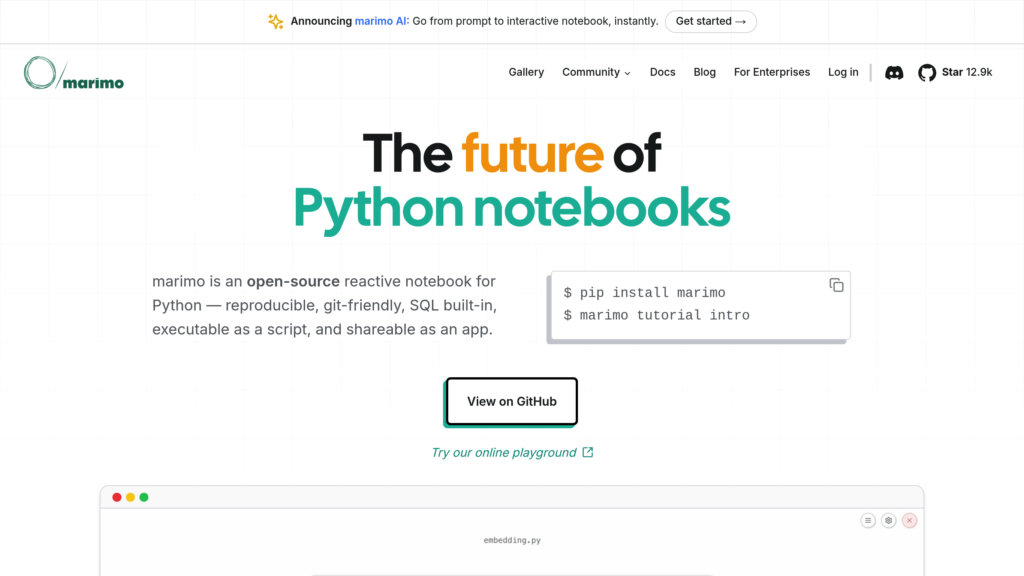


Produktübersicht
Was ist marimo?
marimo ist ein neuartiges Python-Notebook, das interaktives Computing neu definiert – mit Fokus auf Reproduzierbarkeit, Wartbarkeit und nahtlose Interaktivität. Im Gegensatz zu traditionellen Notebooks speichert marimo Notebooks als reine Python-Skripte (.py-Dateien), was Versionskontrolle mit Git, Ausführung als Skript und Deployment als Web-App ermöglicht. Die reaktive Ausführung aktualisiert automatisch abhängige Zellen und verhindert so versteckte Zustände und Synchronisationsfehler. Mit integrierter SQL-Unterstützung, interaktiven UI-Elementen und AI-nativen Editorfunktionen optimiert marimo Datenexploration, Prototyping und Produktions-Workflows für Python-Entwickler.
Hauptfunktionen
Reaktive Ausführung
Abhängige Zellen werden automatisch neu ausgeführt, wenn sich eine Zelle oder ein UI-Element ändert. So bleiben Code, Ausgaben und Programmzustand konsistent – ganz ohne manuelles Eingreifen.
Python-First und Git-freundlich
Notebooks werden als reine Python-Dateien gespeichert, was eine einfache Versionskontrolle, Skriptausführung und den Import von Symbolen zwischen Notebooks oder Python-Dateien ermöglicht.
Integriertes Paketmanagement und Sandbox-Umgebungen
Paketabhängigkeiten werden innerhalb der Notebooks serialisiert und können in isolierten virtuellen Umgebungen ausgeführt werden, um die Reproduzierbarkeit bis hin zu den Paketversionen zu gewährleisten.
Interaktive UI-Elemente
Enthält Schieberegler, Dropdowns, Datenrahmen und Diagramme, die direkt an Python-Werte gebunden sind – für schnelle, codefreie Interaktivität und Datenexploration.
Erstklassige SQL-Unterstützung
Abfragen von DataFrames und Datenbanken direkt im Notebook mit SQL-Zellen, wobei die Ergebnisse als Python-DataFrames für die weitere Verarbeitung zurückgegeben werden.
Teilbar und deploybar
Notebooks können als interaktive Web-Apps (powered by WebAssembly) exportiert oder über die CLI bereitgestellt werden, was das Teilen und Deployen erleichtert.
Anwendungsfälle
- Datenwissenschaft und Analyse : Data Scientists können reproduzierbare, interaktive Notebooks erstellen, die Python und SQL für nahtlose Datenabfragen und Visualisierung integrieren.
- Forschung und Prototyping : Forscher profitieren von deterministischer Ausführung und reaktiver Programmierung, um schnell an Code und Modellen zu iterieren – ganz ohne versteckte Zustandsfehler.
- Kollaborative Entwicklung : Teams können Notebooks als Python-Skripte versionieren, interaktive Apps teilen und Konsistenz zwischen Entwicklung und Produktion sicherstellen.
- Lehr- und Lernwerkzeuge : Lehrende und Lernende können interaktive, reproduzierbare Notebooks erstellen, die Code, Visualisierungen und UI-Elemente für effektives Lehren kombinieren.
- Produktiver Einsatz : Entwickler können vom Prototypen zum Produkt übergehen, indem sie Notebooks als Skripte ausführen oder mit minimalem Aufwand als Web-Apps bereitstellen.
Häufig gestellte Fragen
marimo Alternativen

Drip Capital
Technologiegestützte Handelsfinanzierungsplattform, die auf die Bedürfnisse von KMU im grenzüberschreitenden Handel zugeschnittene Betriebskapitallösungen bietet.

PROVEN Skincare
KI-basierte, personalisierte Hautpflegemarke, die das Skin Genome Project™ nutzt, um individuelle Routinen auf Basis umfangreicher Datenanalysen zu erstellen.

Helsing AI
Fortschrittliche AI-Softwareplattform, die domänenspezifische Verteidigungsfähigkeiten mit Echtzeit-Datenfusion, autonomer Entscheidungsfindung und adaptiver elektronischer Kriegsführung liefert.

Spartan Forge
Fortschrittliche Jagd-App, die hochauflösende Kartierung, LiDAR-Geländedaten und prädiktive Analytik für Rehwildbewegungen kombiniert.

CARCO Group
Führender Anbieter von mobilen Technologielösungen für Fahrzeuginspektionen vor Versicherungsabschluss und Betrugsprävention in der Kraftfahrzeugversicherungsbranche.

Logcomex.ai
Außenhandelsplattform mit spezialisierten AI Agent für Import-/Exportdatenanalyse, Frachtenverfolgung, HS-Code-Klassifizierung und Lieferantenerkennung über natürlichsprachige Befehle.

Carbonfact
Maßgeschneiderte Nachhaltigkeitsmanagement-Plattform für Bekleidungs- und Schuhmarken zur Messung, Berichterstattung und Reduzierung ihres ökologischen Fußabdrucks entlang der Lieferkette.

Cofactr
Eine einheitliche Lieferketten-Ausführungsplattform, die Beschaffung, Bestand und Logistik für Hardware-Hersteller optimiert.