
Layercode
Developer platform for building and deploying low-latency voice AI agents via a managed real-time voice pipeline with full backend control.
Community:

Product Overview
What is Layercode?
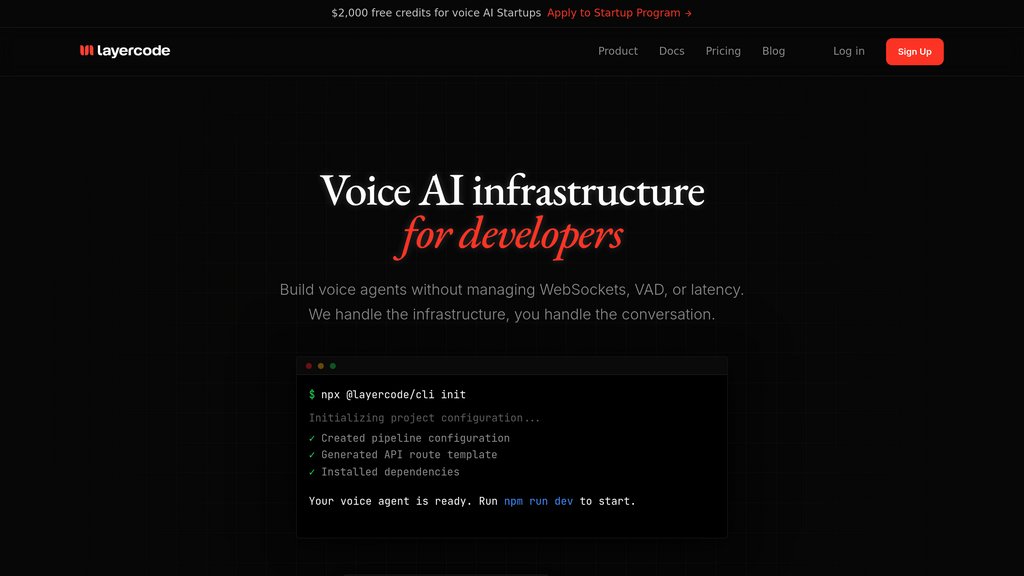
Layercode is a cloud infrastructure platform that enables developers to build production-ready voice AI agents without managing the complexity of real-time audio systems. It handles the full voice pipeline — including speech-to-text, text-to-speech, turn-taking, and audio streaming — and connects to your own backend logic via a simple webhook. Developers retain complete control over their LLM, agent logic, and tool calls, while Layercode delivers the voice layer across a global edge network spanning 330+ locations for sub-50ms audio processing. It supports deployment across web, mobile, and phone channels, with usage-based pricing that only charges for active speaking time.
Key Features
Managed Voice Pipeline
Handles the full real-time audio stack — speech-to-text, text-to-speech, turn-taking, and low-latency audio streaming — so developers only need to focus on agent logic.
Webhook-Based Backend Integration
Connect any LLM, agent framework, or custom backend logic via a single webhook. No lock-in to a specific stack — deploy your backend anywhere.
Global Edge Network
Audio is processed at 330+ edge locations worldwide, delivering sub-50ms latency for voice agents serving users across any region.
Multi-Provider Voice Model Support
Supports leading STT and TTS providers including Deepgram, ElevenLabs, Cartesia, and Rime, with the ability to hot-swap providers without code changes.
CLI & SDK Tooling
A single CLI command scaffolds a full voice agent project with built-in tunneling, sample backends, and dashboard configuration. SDKs available for Node.js, Python, React, and Vanilla JS.
Session Recording & Analytics
Built-in latency analytics, session recording, conversation replay, and transcript export for debugging, QA, and performance monitoring.
Use Cases
- Voice AI Agent Development : Developers can rapidly prototype and ship production-grade voice agents for customer service, virtual assistants, or interactive applications.
- Telephony & Call Automation : Connect voice agents to phone numbers to automate inbound or outbound call workflows without building custom telephony infrastructure.
- Multilingual Voice Applications : Build voice interfaces that support users across languages and regions, leveraging edge deployment for consistent low-latency performance globally.
- LLM-Powered Conversational Products : Product teams can add a voice layer to existing text-based LLM agents or chatbots without rebuilding their core logic.
- Developer Tooling & Coding Assistants : Tools like Layercode's own Sled product demonstrate how voice interfaces can be added to coding agents for hands-free, mobile-accessible workflows.
FAQs
Layercode Alternatives

Speko
Voice AI infrastructure platform for building, routing, and operating speech-based agents across multiple providers.

LiveKit
Open-source framework and cloud platform for building real-time voice, video, and physical AI applications with enterprise-grade infrastructure.

Voiceflow
A collaborative no-code platform to design, build, and deploy AI-powered voice and chat agents with deep customization and multi-platform integration.

Bland AI
Self-hosted AI communication platform enabling ultra-realistic, secure, and scalable phone call automation for various industries.

Synthflow AI
No-code platform for creating customizable AI voice agents that automate outbound and inbound calls with natural, human-like conversations.

Bolna AI
An open-source platform to rapidly build human-like Voice AI front desk agents that automate phone conversations and customer interactions.

Dograh
Open-source voice agent platform for building, deploying, and running customizable phone and real-time voice workflows.

Zoey OS
A voice-first workspace for building a persistent team of specialized companions that can coordinate tasks and act across connected tools.