
Herdr
Terminal-native runtime that keeps coding agent sessions alive in the background and reports which ones need your attention.
Community:


Product Overview
What is Herdr?
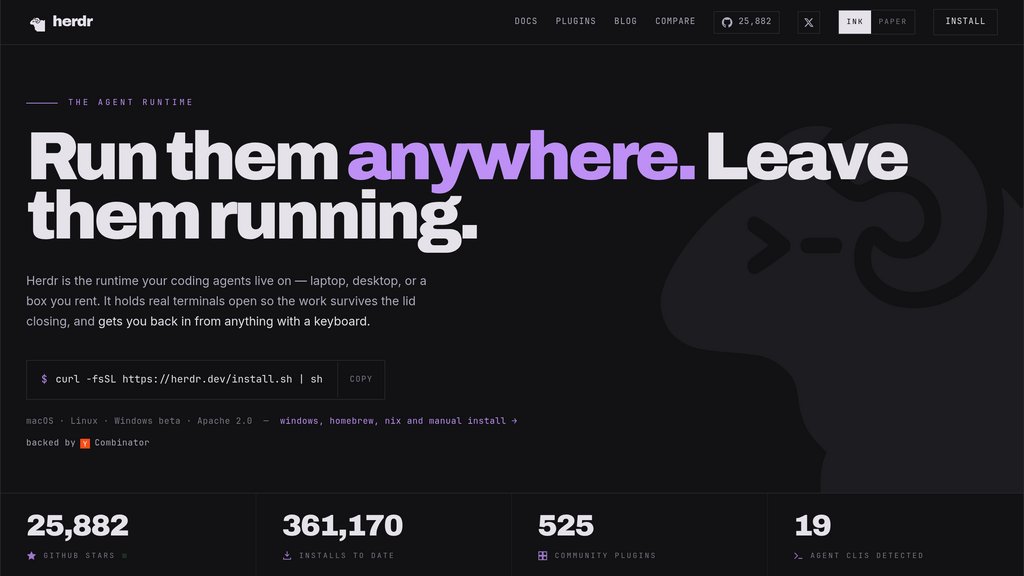
Herdr is a background server, not an app you keep open, that hosts real terminal sessions for coding agents like Claude Code, Codex, Cursor, and opencode so their work survives closed laptops, dropped networks, and machine restarts. It watches every pane and labels each agent working, blocked, or idle, so you never have to scroll through terminals looking for the one waiting on you. Because the CLI and socket API expose the same controls Herdr itself uses, agents can spawn panes, prompt one another, and wait for genuine blocking states instead of guessing. It wraps nothing: agent CLIs run exactly as they always did, just inside terminals that Herdr keeps running and can reattach to from any tty, including over SSH.
Key Features
Persistent Session Runtime
A background server owns the terminals, so sessions survive closed lids, dropped connections, and reboots, restoring layout and state automatically.
Live Agent Status Tracking
Every pane is continuously classified as working, blocked, or idle, so a stuck or waiting agent is surfaced instead of buried.
Agent-Native CLI and Socket API
The same interface used to control Herdr lets agents split panes, launch other agents, and wait on real blocking events rather than polling.
Broad Coding Agent Support
Works out of the box with Claude Code, Codex, Cursor, opencode, Grok, GitHub Copilot CLI, and other popular agent tools without wrapping or modifying them.
Keyboard- and Mouse-Driven Interface
Supports tmux-style prefix key navigation alongside clicking, dragging, and splitting panes, all in one lightweight Rust binary with no Electron overhead.
Cross-Platform Remote Access
Runs on macOS and Linux (Windows in beta) and can be reattached from any terminal or SSH session, making it usable on local machines or rented servers.
Use Cases
- Parallel Multi-Agent Development : Run several coding agents across different projects at once and quickly identify which one needs a decision versus which is still working.
- Unattended Long Coding Sessions : Start an agent task, close the laptop or walk away, and resume exactly where things left off without losing progress or output.
- Remote and Cloud Development : Run and monitor agents on a rented server or VM, attaching over SSH from any device when needed.
- Agent-to-Agent Orchestration : Script coordination where one agent spawns, prompts, or waits on another using Herdr's socket API instead of manual switching.
- Replacing Ad Hoc tmux Setups : Give developers already using tmux-style workflows a purpose-built alternative that understands agent state, not just raw panes.
FAQs
Herdr Alternatives

Prime Intellect
Full-stack platform for training, evaluating, and deploying custom AI models through integrated compute, RL environments, and inference.

cmux
A native macOS terminal built for multitasking with coding agents, featuring vertical tabs, split panes, an embedded browser, and a socket API.

exe.dev
Developer infrastructure platform providing persistent Linux VMs, disposable sandboxes, and a built-in web coding agent.

Lakera AI
Advanced AI security platform providing real-time threat detection, prompt injection defense, and compliance controls for generative AI applications.

Turnkey
Turnkey offers secure, scalable, and flexible wallet infrastructure with seamless private key management and onchain automation through a unified API.

Tessl
A package manager for agent skills and context, enabling teams to build, evaluate, version, and distribute context for agentic software development.

One
Agent infrastructure platform providing 84,000+ open source tools across 500+ apps with managed auth and context optimization.

Infinity by ProjectX
Cloud-native operating system that runs heavy applications like Blender, VS Code, and Isaac Sim directly in any browser with dedicated GPU per app.