Dagger
Open-source runtime for composable, containerized workflows with strong modularity, repeatability, and cross-platform support.
Community:

Product Overview
What is Dagger?
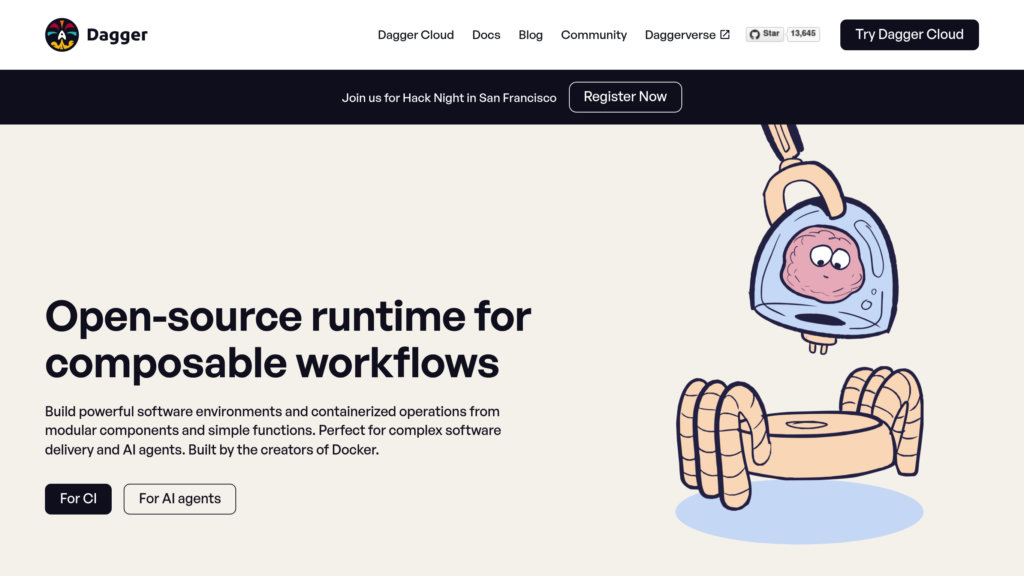
Dagger is an open-source platform designed to build and run composable workflows by transforming code into containerized operations. It excels in environments requiring high repeatability, modularity, and observability, making it ideal for complex systems such as AI agents and CI/CD pipelines. Dagger supports multiple programming languages and integrates seamlessly with any compute platform, enabling developers to create reproducible, scalable workflows with built-in caching, tracing, and real-time debugging.
Key Features
Containerized Workflow Execution
Transforms code into containerized, composable operations that can run in any language and environment, supporting parallelism and chaining for reproducible workflows.
Universal Type System
Enables type-safe composition and interoperability across multiple programming languages and platforms without translation overhead.
Automatic Artifact Caching
Caches immutable artifacts produced by operations, including those involving LLMs and API calls, to speed up execution and reduce costs.
Built-in Observability
Provides comprehensive tracing, logging, and metrics for full visibility into workflow execution, facilitating debugging and performance monitoring.
LLM Augmentation
Natively integrates any large language model, automatically discovering and using available functions to build intelligent agents with minimal code.
Interactive Terminal
Offers an interactive shell for real-time prototyping, testing, and debugging of workflows directly from the terminal.
Use Cases
- CI/CD Pipeline Automation : Build portable, reproducible continuous integration and deployment pipelines that run consistently across different environments and CI engines.
- AI Agent Development : Create modular AI agents by composing LLMs and other components into workflows that are easy to extend and debug.
- Complex Workflow Orchestration : Manage workflows with many moving parts requiring repeatability and observability, such as integration testing and data processing pipelines.
- GPU-Accelerated Tasks in Pipelines : Offload GPU-specific tasks to remote runners on demand, optimizing costs and resource usage within containerized workflows.
- Cross-Language Development : Leverage the universal type system to mix and match components written in different programming languages seamlessly.
FAQs
Dagger Alternatives

Composio
Developer-focused integration platform streamlining AI agents' connection with external applications and services.

PagerDuty
A real-time incident response platform that automates alerting, escalations, and collaboration to improve operational reliability and customer experience.

MyClaw
Managed cloud hosting platform for deploying and running always-on AI agents like OpenClaw and Hermes with zero DevOps.

Ansible
Open-source, agentless automation platform for IT configuration, deployment, and orchestration using simple YAML playbooks.

Workato
Enterprise integration and automation platform connecting applications, data, and workflows with AI-powered capabilities.

Moxo
Business operations platform that orchestrates workflows across teams, external participants, AI agents, and systems.

Moveworks
An AI-powered enterprise platform that automates employee support by resolving IT, HR, and facilities requests through conversational AI integrated with business systems.

Invisible Technologies
Enterprise platform that structures data, automates workflows, deploys agents, and evaluates AI performance — built for organizations that need AI to actually work at scale.