
Browser Use
Open-source AI-driven browser automation tool enabling AI agents to interact with websites like humans for seamless web tasks.
Community:


Product Overview
What is Browser Use?
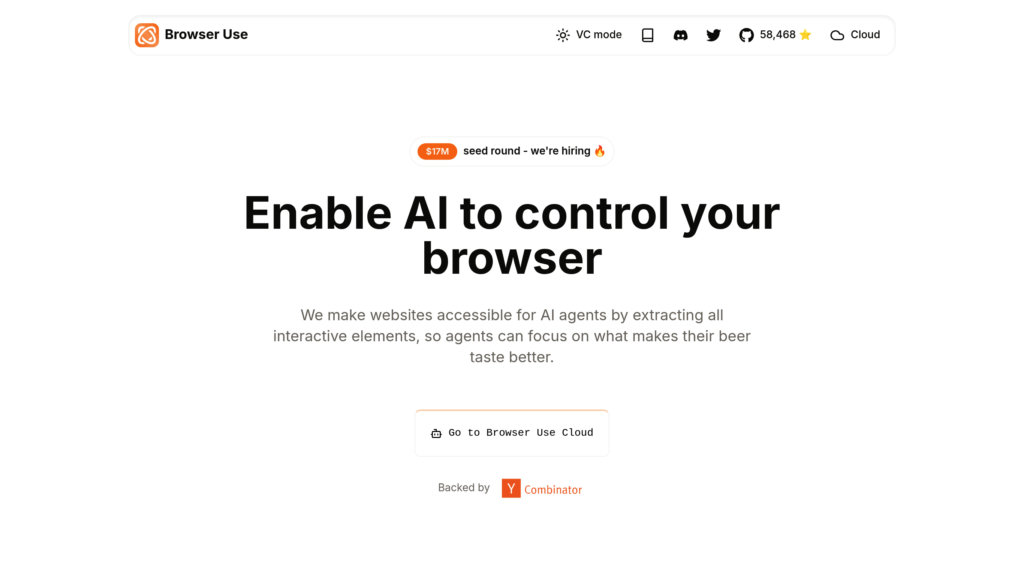
Browser Use is a Python-based open-source library designed to empower AI agents with direct control over real web browsers. It bridges AI language models with browser automation, allowing agents to autonomously navigate websites, interact with page elements, extract data, and perform complex multi-step workflows. Built on Playwright and integrated with LangChain, it supports multiple advanced language models such as GPT-4o, Claude, and Gemini. Browser Use offers both local and cloud-hosted versions, enabling flexible deployment for developers and businesses seeking to automate web tasks efficiently.
Key Features
AI-Powered Browser Automation
Enables AI agents to navigate websites, click buttons, fill forms, scroll, and handle dynamic content just like a human user.
Multi-Model Integration
Supports various large language models including OpenAI GPT-4o, Anthropic Claude, Google Gemini, and local models for versatile AI workflows.
Robust Web Interaction
Leverages Playwright for reliable browser control including multi-tab management, error recovery, and interaction with JavaScript-heavy pages.
Flexible Deployment
Offers both a Python library for local use and a cloud-hosted API with real-time task monitoring and scalable automation.
Customizable Agent Interface
Simple Agent class with configurable parameters for task definition, visual input, step limits, and custom function integration.
Visual and Data Extraction Capabilities
Supports screenshots, element tracking, and extraction of structured data for advanced web scraping and research applications.
Use Cases
- Automated Web Research : AI agents autonomously gather and analyze data from complex websites, accelerating research and information collection.
- Workflow Automation : Automates multi-step online processes such as job applications, flight bookings, and form submissions without manual intervention.
- E-commerce Monitoring : Enables price comparison, stock checking, and shopping cart management through AI-driven browser interactions.
- Educational Assistance : Automates academic resource searches, online course enrollments, and web-based research tasks for students and educators.
- Data Extraction and Scraping : Facilitates structured data collection from web pages for market analysis, competitive intelligence, and reporting.
FAQs
Browser Use Alternatives

TinyFish
Enterprise infrastructure for web data operations — enabling agents to navigate, authenticate, extract, and transact across hundreds of live sites simultaneously via a single API.

BrowserAct
Agent-native browser infrastructure for web automation, structured data extraction, and authenticated browsing.

Airtop
AI-powered cloud browser automation platform enabling natural language control of web interactions, including complex authentication and scalable session management.

Scrapybara
API-driven virtual desktop infrastructure enabling AI agents to perform scalable, secure, and automated computing tasks with browser and OS-level control.

Agentbase
Serverless agent platform that enables developers to build and deploy production-grade autonomous agents with built-in browser automation, tools, and persistent environments through a single API.

Quaso
Turns plain English instructions into web automations, letting anyone browse live, run scheduled Functions, and connect apps without code.

Rindler
Turns any website, even ones without an API, into a structured interface AI agents can reliably call to read data and complete tasks.

OpenClaw
Open-source personal AI assistant that runs on your machine with persistent memory, multi-platform messaging, and full system automation capabilities.