

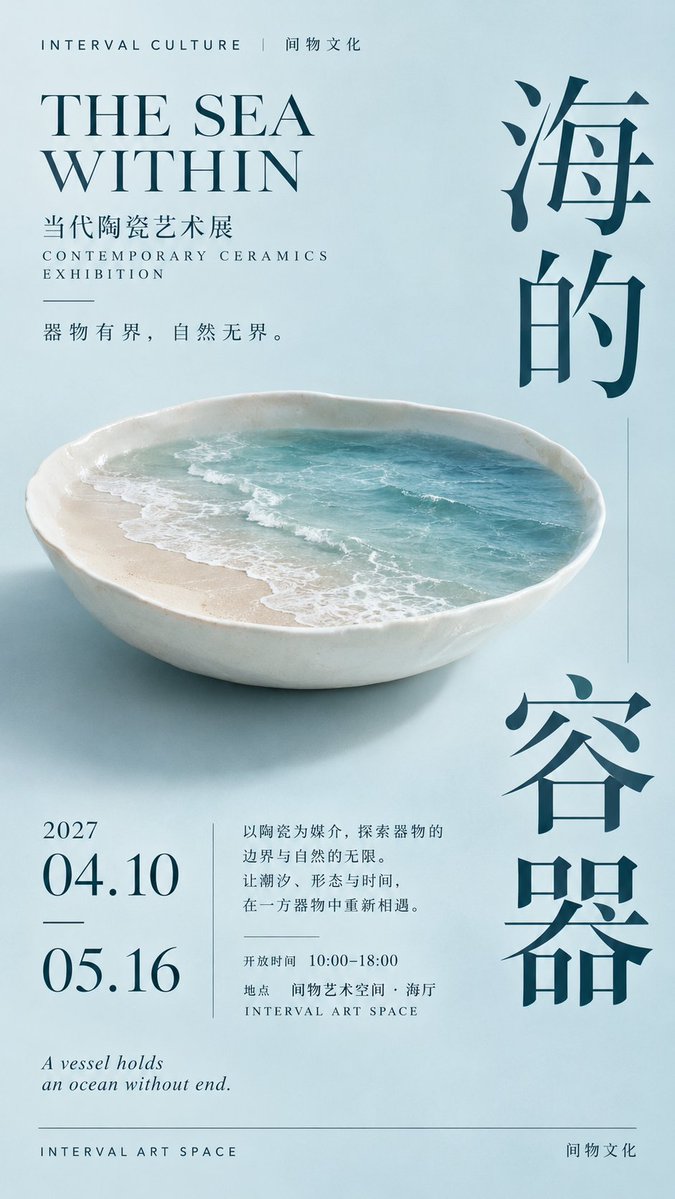
【Poster theme】: 【Core visual subject】: 【Main title and English title】: 【Brand / exhibition / event information】: 【Primary color palette】: low-saturation gray-blue, mist white, and deep ink teal 【Text language】: Chinese / Japanese / English / bilingual 【Aspect ratio】: 9:16 Design an art poster with a mature Japanese graphic design language and Eastern poetic aesthetics, combining low-saturation cool colors, Eastern negative space, visual metaphors, asymmetric composition, and refined editorial typography. Visual Expression Build a central visual with its own symbolic meaning around the theme. It may use objects combined with miniature nature, architectural geometry and light and shadow, detailed line drawings of natural specimens, poetic landscape photography, or artistic text-and-image collage. Express the theme through contrasts of scale, relationships between reality and illusion, spatial layering, and visual metaphors, allowing the image itself to possess narrative depth and artistic value. Color and Texture Use mist blue, grayish teal-blue, sea-salt blue, warm paper white, and deep ink teal, with a small amount of dry vermilion permitted as an accent. The overall image should be high in brightness, low in saturation, calm, and translucent, with delicate natural light and shadow, realistic materials, and the premium printed texture of matte art paper. Desaturated but not faded, soft but not blurry, warm but not aged. Composition and Typography Use an asymmetric editorial composition and an implicit grid system, flexibly combining expansive negative space, displaced oversized characters, vertical sidebars, overlapping text and imagery, partial cropping, and contrasts between large and small scales. Use refined Song typefaces, Japanese Mincho typefaces, English serif typefaces, slender sans-serif typefaces, and a small amount of natural handwriting. Create rich typographic hierarchy and visual rhythm through mixed horizontal and vertical typesetting, giant titles, large date numerals, narrow explanatory columns, fine divider lines, and tiny institutional information. Let both text and imagery participate in the composition, allowing expansive blank space to coexist with localized areas of dense editorial information. According to the theme, thoughtfully plan meaningful textual content such as the title, subtitle, thematic phrase, event introduction, date, and location. Overall Requirements Present a design standard associated with a professional Japanese graphic design studio, a contemporary art exhibition, and an independent publication. Different themes may change the subject, medium, and layout, but should maintain a unified color palette, typography, print texture, and design language. From a distance, the poster should appear minimal yet visually impactful; up close, it should reveal rich artistic details and typographic beauty. Avoid template-like compositions, excessive simplification, cheap effects, meaningless text, random numbering, four-point starburst symbols, and watermarks. Directly output a high-definition art poster with accurate text, a complete composition, and professional print-grade visual quality.