

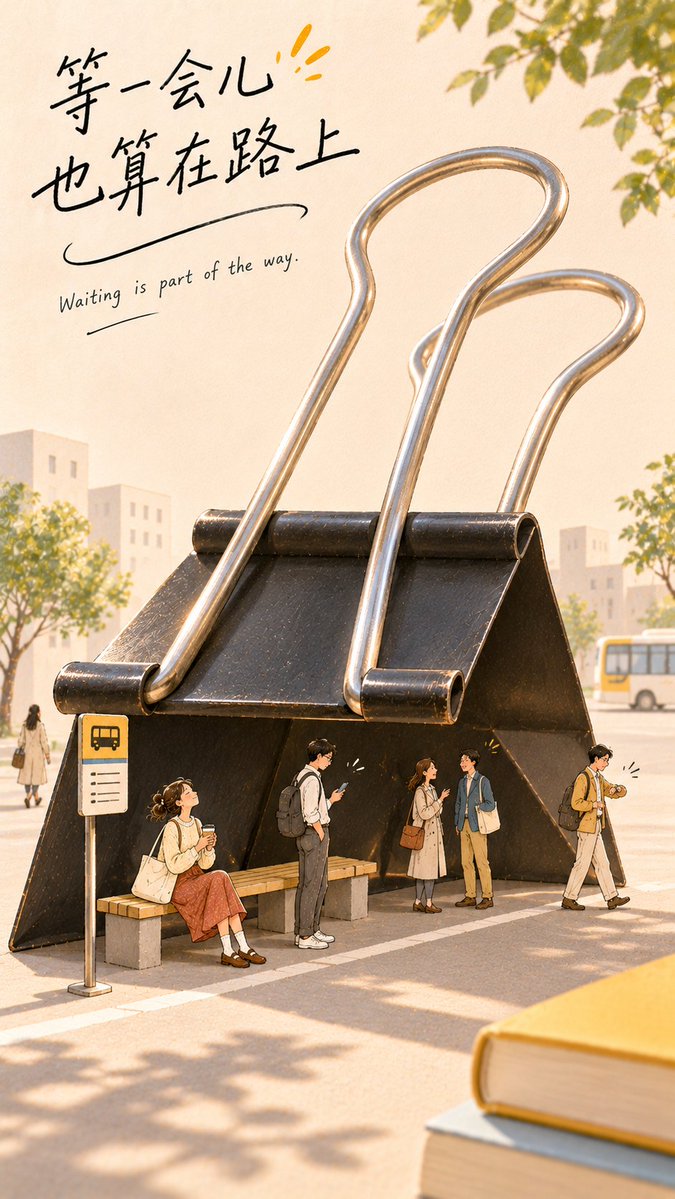
【Core real object】: {paper clip / pencil / adhesive tape / binder clip / another everyday object} 【Urban function】: {pedestrian bridge / tunnel / station / walkway / park / building, etc.} 【Character actions】: {commuting / waiting for transportation / cycling / drinking coffee / checking a phone / talking, etc.} 【Main copy】: {a short, visually evocative Chinese sentence} 【Accent color】: {yellow / brick red / navy blue / other} 【Aspect ratio】: {9:16 by default} Create a creative mixed-reality poster titled “Desk City | Desktop City.” Enlarge the 【Core real object】 dozens of times while fully preserving its familiar original structure, realistic proportions, and photographic-quality materials. Do not redesign it as an ordinary building. Use its inherent form so that it naturally performs the 【Urban function】: the object must remain instantly recognizable, while the miniature characters already use it normally as part of the city’s infrastructure. Render the core object with the look of highly realistic product photography, showing authentic material, texture, weight, edges, subtle signs of use, natural highlights, and cast shadows. Avoid plastic-looking CGI, excessively mirrored surfaces, glass, transparent refraction, and science-fiction aesthetics. Add 4–7 tiny, hand-drawn adult urban characters that create an obvious scale contrast with the enormous real object. Draw the characters with black and gray pencil linework, small amounts of colored pencil and crayon fill, simple facial features, and natural proportions. Dress them in low-saturation commuter clothing in cream white, navy blue, brick red, caramel brown, and similar colors. The characters must genuinely use the giant object: walking on it, passing through it, waiting, cycling, resting, or talking, rather than merely standing beside it. They should not look at the camera. Their actions should feel natural and rooted in everyday life, making the absurd giant-object premise look like an entirely ordinary day in the city. Use a minimalist “desktop city / architectural model” visual language for the environment, retaining only a few cream-white geometric buildings, small trees, road markings, and essential facilities. Use large areas of warm cream white, light beige gray, and paper texture in the background. Deliberately reduce information density so the giant real object becomes the absolute visual anchor. Emphasize the composition formula “one powerful shape + miniature characters + generous negative space.” The core object must be large enough to be recognized immediately, even at thumbnail size. Use perspective, circular negative space, long axes, curves, or geometric volumes to create a clear stop-scroll visual relationship. Place the 【Main copy】 in the open area using natural, slightly irregular handwritten Chinese lettering, resembling an everyday journal, architectural sketch, or picture-book narration. A very small English side note may be added, but do not pile up large amounts of decorative text. Use soft natural daylight or warm afternoon light throughout. Make the real object, hand-drawn characters, and environment share the same shadows and spatial relationships so the photographic materials and hand-drawn linework genuinely merge within one world. The final result should simultaneously possess the photographic quality of a real object, the everyday warmth of hand-drawn characters, the reality displacement created by gigantic scale, the playfulness of a miniature desktop city, and the complete design quality of an editorial poster. At first glance, the viewer should recognize a familiar real-world object; at second glance, they should discover that the tiny hand-drawn people have already transformed it into an entire city. Avoid: glass, transparent materials, refraction, fully photographic characters, a fully hand-drawn core object, completely transforming the original object into an ordinary building, complex cities, futuristic science fiction, neon lights, excessive numbers of characters, meaningless English, and information overload.