

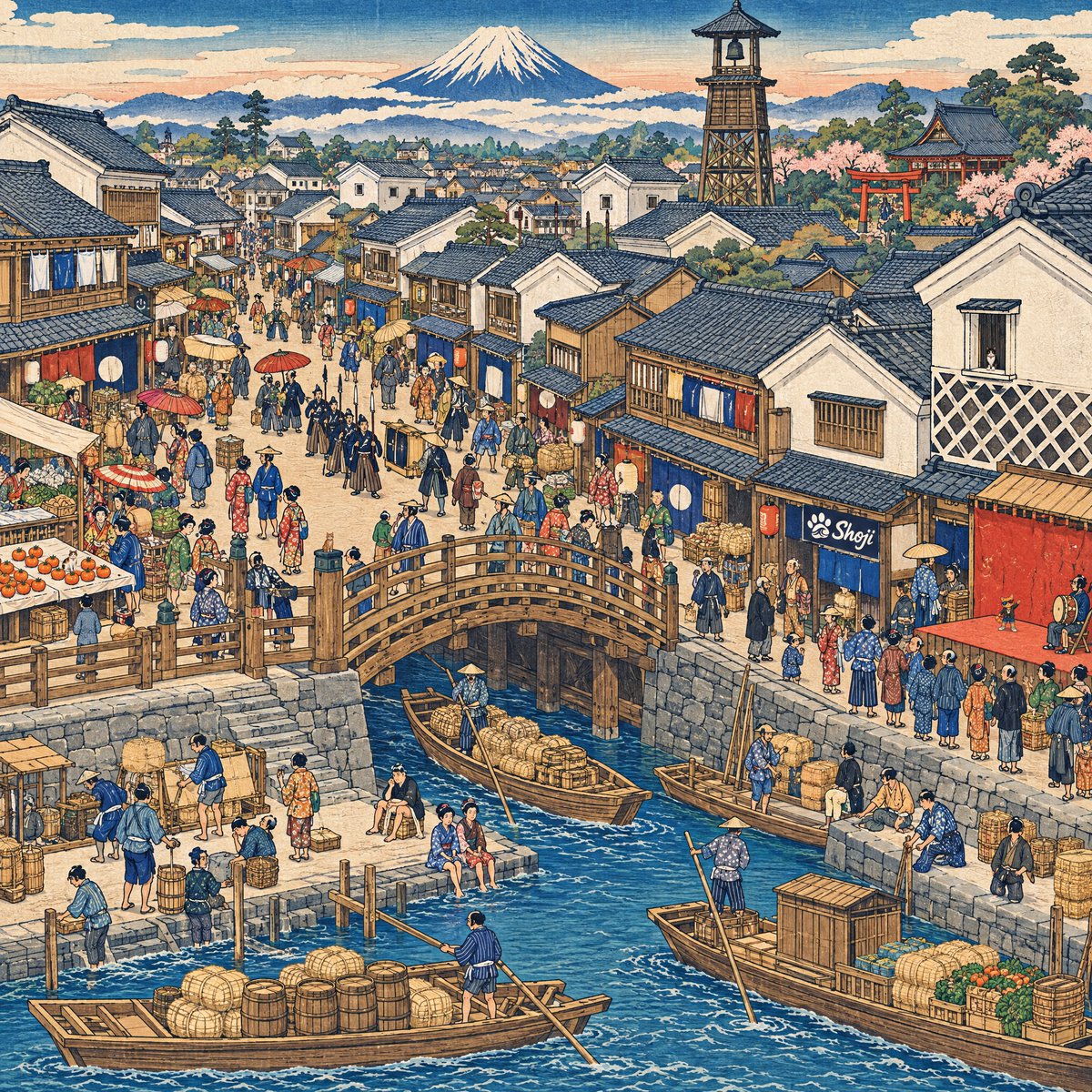
A busy main street of Edo, Japan, around 1830, square 1:1, in the spirit of a classic seek-and-find book, seen from a high, extremely wide view so that the whole merchant district fits in one picture, everything is tiny and there is an enormous amount to look at. A broad avenue crosses a steep arched wooden bridge over a canal in the middle of the picture; both banks are lined with tightly packed two-storey merchant shops with tiled roofs, plain noren curtains, lattice windows and balconies; between them rise fireproof white-walled storehouses, a tall wooden fire-watch tower with a small bell roof, tea houses, tiny alleys and a small shrine gate. Far away at the top, a snow-capped Mount Fuji over soft bands of mist and layered clouds. Left: a market street with stalls selling vegetables, rice crackers, sweets, pottery and umbrellas, and a fruit stall with persimmons laid out on a white cloth. Centre: the arched bridge crowded with people, boats passing under it. Right: a row of grand merchant houses, a big white-walled storehouse with a black-and-white diamond-lattice tile pattern on its lower walls and a small window under its roof, and a small open-air stage with a red backdrop where street performers entertain a crowd. Full of tiny details: laundry on balconies, plain hanging lanterns, stacked rice bales, water buckets, children playing, a palanquin, a procession of a feudal lord's retinue with spears and umbrellas. The lower third of the picture is only the canal and the wharf: many cargo boats loaded with barrels and rice bales, boatmen with poles, stone steps down to the water, porters, and people sitting at the water's edge. About 180 minuscule people in Edo-period clothing, each doing something. A standing person is only about 3% of the picture height. The look is the point: an Edo-period multi-colour Japanese woodblock print (nishiki-e style): flat areas of colour with no shading, bold even dark-indigo key lines, soft hand-printed colour gradation bands in the sky and mist, visible wood-grain texture and cream washi paper grain, slightly imperfect colour registration, a limited palette of indigo blue, vermilion red, ochre yellow, moss green, pale pink and cream. Sharp and crisp everywhere (no blur). Not a photograph, not a 3D render, not a smooth digital vector. The picture fills the whole frame to all four edges: no border, no frame, no title cartouche, no artist signature, no seal stamps, no caption. Exactly one small logo: a small flat dark navy signboard hanging above the door of a merchant shop in the right half of the picture, about 4% of the picture width, with a cream-coloured cat paw print whose big pad holds a swirling ocean wave, and the word "Shoji" in cream cursive brush lettering to its right. Apart from that signboard there are no letters, words, numbers, digits, kanji or kana anywhere: no shop signs with writing, no writing on noren curtains, lanterns or banners, no posters. THE ONLY ANIMALS IN THE WHOLE PICTURE ARE FOUR CATS, and there are NEVER MORE THAN FOUR: not five, not a spare one, no look-alike twin of any cat. No other animal at all: no horses, oxen, dogs, birds, fish, carp streamers, dragons, foxes, raccoon-dog statues, lucky-cat figurines or insects, and no animal-shaped signs, lanterns, kites, statues or patterns; nobody wears an animal mask, animal ears, a tail or cat ears. The four cats are tiny, all at the same distance from the viewer, each in a DIFFERENT kind of place at a DIFFERENT height: their feet are between about 30% and 60% of the picture height measured from the top, and NONE is in the lower third. Each cat is in the open, never hidden behind anything, and each appears only ONCE. The three real cats are each SMALL: only about 2% of the picture height (about 40 pixels in a 2048-pixel-high picture), about two thirds of the height of a standing person, clearly smaller than the people but readable as cats, a bare cat with only a thin red collar with a tiny gold bell. From left to right: 1. ONE calico cat (white with orange and black patches) sitting upright on the white cloth of the persimmon stall at the far left, among the orange persimmons, feet at about 52% of the height, its white and orange fur close to the colours of the cloth and fruit. This is the only calico; 2. ONE orange tabby cat (orange fur with darker stripes, white muzzle and chest) sitting upright on top of the wooden corner post of the bridge railing at the foot of the arched bridge, left of the centre, feet at about 50% of the height. This is the only tabby; 3. ONE black-and-white "hachiware" cat (black head and back, a white blaze splitting the face, white chest and paws) sitting upright on the sill of the small window under the roof of the big white-walled storehouse in the upper right, right above the black-and-white diamond-lattice tiles, feet at about 34% of the height. This is the only hachiware cat; 4. Shoji Cat, an upright standing orange tabby cat about three heads tall in a black leather jacket, denim shorts, cream sneakers and black wayfarer sunglasses with blue and red lenses, dancing with one arm raised on the small red open-air stage at the far right, among a few people, feet at about 57% of the height, about 1.3 times as tall as the seated cats (about 52 pixels), still shorter than the people. Besides the cats, a few small things to discover, none more eye-catching than anything else: Mount Fuji, the fire-watch tower and the arched bridge. No black or dark round objects and no dark animal-like shapes that could be mistaken for a cat. No watermark.