

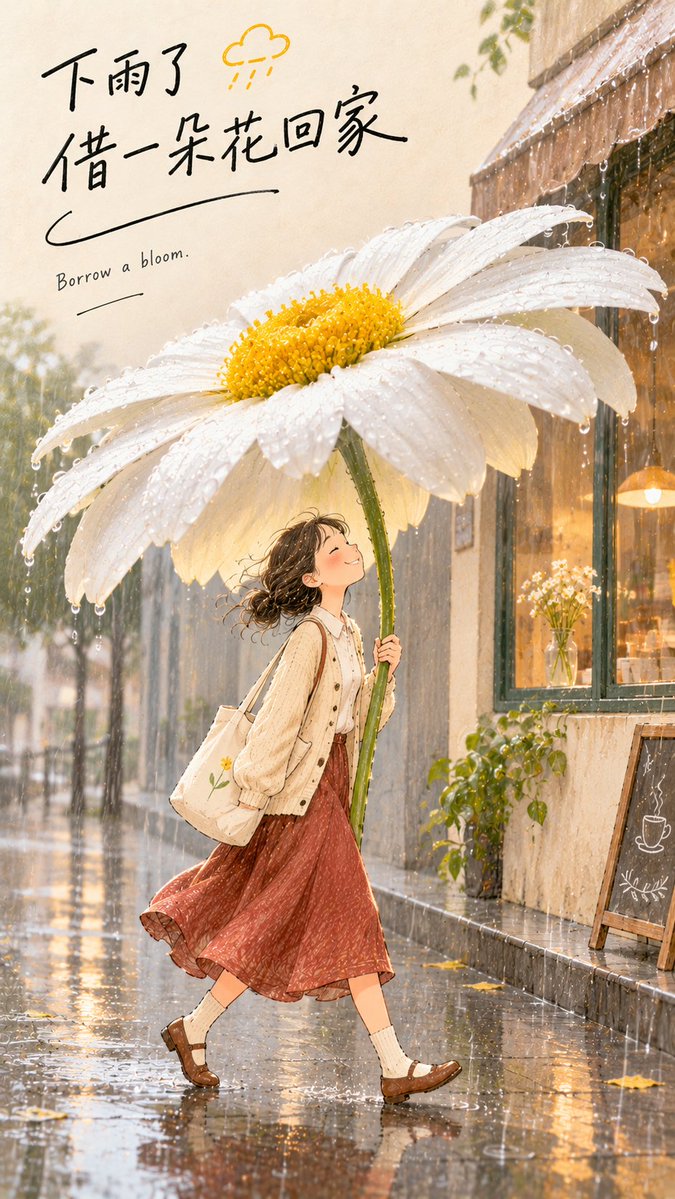
【Core photorealistic object】: {flower / food / product / everyday object} 【Hand-drawn character】: {character identity, outfit, and action} 【Functional displacement】: {the object becomes a sofa / lamp / umbrella / bed / another functional item} 【Everyday setting】: {interior / street / café / room, etc.} 【Main copy】: {a short, visually evocative Chinese phrase} 【Primary color】: {enter the main color} 【Aspect ratio】: {9:16 by default} Create a creative poster combining “photographic texture × hand-drawn line art,” blending real and illustrated elements. The image should center on a highly realistic 【Core photorealistic object】 that retains photographic-quality materials, textures, lighting, volume, and fine details. At the same time, include a clearly 【Hand-drawn character】 rendered with pencil lines, colored pencils, crayons, or light watercolor, creating a clear yet natural contrast between reality and illustration. Do not simply place an illustrated person next to a real object. Make the 【Core photorealistic object】 genuinely perform the use specified under 【Functional displacement】 and establish explicit physical interaction with the character. For example, the character should actually sit inside it, hold it, use it, lean against it, or lie within it, allowing viewers to understand this slightly surreal but logically convincing visual relationship at first glance. Keep the environment restrained and semi-realistic, retaining only a small number of elements needed to communicate the 【Everyday setting】. Use warm creamy white, pale beige paper, or a soft living space as the base. Leave generous negative space and avoid excessive furniture, decoration, or irrelevant details. The character should retain an obvious handmade texture: natural pencil contours, slightly irregular lines, simple facial features, and low-saturation colored-pencil blocks. The pose should feel relaxed and natural, without looking at the camera or adopting a commercial model pose. The realistic object should preserve authentic photographic materials so that the “half photograph, half picture book” layering is immediately apparent. Use realistic, soft lighting. Let the photorealistic object naturally affect the character and surrounding environment by producing reflections, cast shadows, transmitted light, or localized warm illumination. The realistic and illustrated elements should genuinely appear to exist within the same space rather than looking like two pasted layers. Use the composition “large main subject + small character + generous negative space + a few everyday details.” The core photorealistic object should be large enough to remain immediately recognizable even as a thumbnail. Keep the character relatively small and use the scale contrast to strengthen the visual surprise. Add the 【Main copy】 within the negative space using natural, slightly irregular handwritten Chinese lettering, similar to a picture-book title, diary entry, or journal handwriting. A very small English side note may be included, but do not add large amounts of decorative text. Use the 【Primary color】 as the central color anchor, complemented by low-saturation supporting colors such as creamy white, natural wood, gray-green, and caramel brown. The final result should simultaneously feature the material quality of realistic photography, the warmth of hand-drawn line art, the design sensibility of an editorial poster, and an immediately understandable “functional displacement” concept. Avoid: pure photography, pure illustration, 3D CGI, a lack of interaction between the character and the real object, ordinary group-photo composition, complex commercial settings, excessive decoration, meaningless English text, and information overload.