

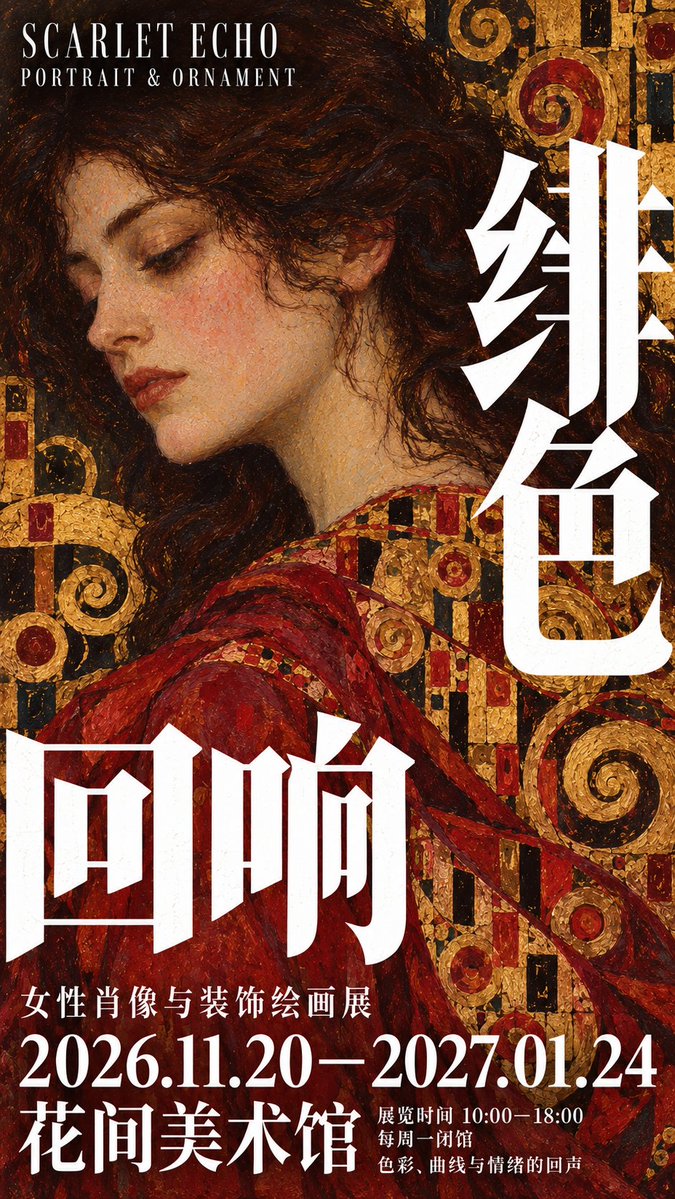
Exhibition name: 【enter the exhibition title】 Character and pose: 【appearance, hairstyle, clothing, and pose of an adult person】 Primary color palette: 【main color + supporting color】 Decorative patterns: 【botanical, geometric, spiral, or other thematic patterns】 English exhibition name: 【enter the English title】 Subtitle: 【enter the exhibition theme】 Exhibition date: 【enter the date】 Exhibition venue: 【enter the venue】 Design a 9:16 vertical art exhibition poster that combines Klimt-style ornamental oil painting with Japanese museum editorial layout. Output only one full-bleed flat poster. Use an original half-length portrait of an adult person as the main subject. Enlarge it significantly and crop parts of the hair, shoulders, and clothing so the face forms a clear focal point in the upper half. Depending on the pose, use a left- or right-weighted composition and reserve space for a monumental title. Keep the facial features and the structure of the neck and shoulders natural, with a distinctive, characterful expression. Build the face with small oil-painted strokes in ochre, dusty pink, dark red, and cool gray. Preserve the interplay of warm and cool tones, exposed underpainting, and a mixture of sharp and soft edges. Use finer brushwork on the face and freer strokes in the hair, fabric, and background to evoke the texture of a printed art reproduction. Avoid photographic skin smoothing, seamless digital gradients, and a uniformly thick impasto texture across the entire image. Use the specified main color to create broad, clearly defined color fields in the clothing. Indicate volume with only a few folds, gradually transforming the remaining areas into flat decoration. Extend the specified patterns along the shoulders, back, sleeves, or fabric folds, allowing them to cross parts of the figure’s outline and merge with the background. Vary the size, density, and spacing of the patterns; keep the area around the face quiet while making the clothing and edge areas visually rich. Paint the matte-gold ornamentation with yellow ochre, beige, dark copper, and black-brown, preserving layered color and subtle grain. Adjust the amount of gold according to the main palette: warm-gold themes may cover the entire composition, while dark blue, green, or scarlet themes should retain concentrated blocks of color. Avoid mirror-like metal, jewelry, and three-dimensional embossed effects. Design the Chinese exhibition title as monumental typography that actively contributes to the composition. Use a tall, slender Ming or Song typeface with pronounced contrast between thick and thin strokes. Depending on the figure’s position, choose either a vertical arrangement along an edge or a staggered combination of horizontal and vertical text, overprinting it directly across the hair, clothing, and background. A small number of nonessential strokes may be cropped at the edge, but the main characters must remain complete, accurate, and legible, without covering the eyes, nose, or mouth. Use mainly creamy white or deep black lettering to create strong tonal contrast with the background. Arrange the English exhibition name in thin, elongated type at the top. Directly overlay the subtitle, date, and venue at the bottom. Establish three typographic scales: monumental Chinese text, a medium-sized date, and compact small exhibition information. The text groups should share clear alignment lines without a separate bottom bar. Maintain a rich density of exhibition information while ensuring that all text remains clear and that the date and venue are fully contained within the frame. Make the volume of the face, the flat patterns of the clothing and background, and the monumental typography work together. Even when viewed at a reduced size, the face, primary color block, and exhibition title should remain immediately recognizable. Use only the entered text. Do not add random foreign words, fictional sponsors, numbers, four-pointed starbursts, watermarks, frames, or presentation mockups. If a reference image is provided, absorb its brushwork, typographic proportions, and information density while recreating the person and patterns as original designs.