

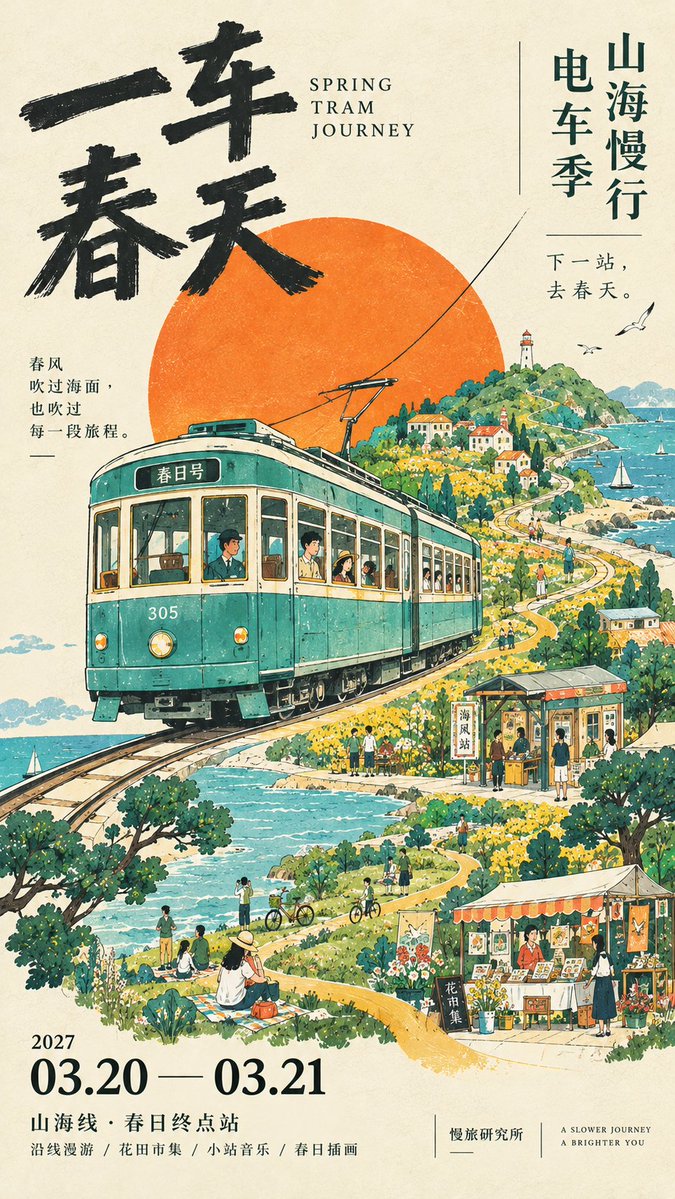
【Poster theme】: {enter the theme} 【Main Chinese title】: {enter the title} 【English title】: {enter the English name} 【Core visual concept】: {one strong central subject + one clear visual relationship, for example: a tram traveling through mountains and the sea, a kite drawing out an entire coastal route, a strip of film connecting different scenes, or a printing roller revealing a city} 【Main visual elements】: {people, architecture, nature, objects, etc.} 【Primary color palette】: {2–3 main colors + 1 accent color} 【Event date】: {enter the date} 【Event location】: {enter the location} 【Event content】: {enter the event activities} 【Aspect ratio】: 9:16 Create an artistic cultural event poster with an East Asian retro hand-drawn aesthetic, combining the visual language of independent cultural exhibition posters from Japan and Taiwan, vintage picture-book illustration, traditional graphic printing, and experimental editorial design. Build a clear, complete, large-scale visual framework around the 【Core visual concept】. Do not merely stack several beautiful elements together. Make the main subject actively participate in the composition: objects may transform into roads, cities, or natural landscapes, while continuous curves, changes in scale, overlaps, interweaving, and enclosing forms may be used to connect the entire image. From a distance, the viewer should first notice a striking large form and a clear visual concept. At closer range, people, buildings, and details of everyday life should gradually reveal themselves. Use free, slightly irregular hand-drawn ink lines combined with two-dimensional flat color fields and localized detailed linework. Buildings, trees, people, and objects may feature slight exaggeration, asymmetry, and a naturally naive hand-drawn quality, while avoiding an overly mechanical or standardized appearance. Use warm ivory off-white paper as the base, paired with natural retro colors such as botanical green, lake blue-green, cinnabar red, terracotta orange, mustard yellow, deep indigo, and charcoal black. Limit the number of colors in each poster and establish the visual focal point with one highly recognizable accent color. Keep the colors complete, saturated, and flat, retaining only a subtle paper texture and traditional print quality. Avoid heavy aging effects and random grain. The central area may contain many small stories, but every detail must develop around the theme. Character movements should feel natural, and the scenes should convey a sense of everyday life. Intentionally preserve negative space around the outer areas to maintain the principle of “locally rich, globally clear.” Use bold typography with visible hand-drawn brushwork for the main Chinese title. It may be arranged in staggered positions, pressed into corners, wrapped around elements, or partially interwoven with the main subject. Use more restrained editorial typography for the English title, date, location, and event information. Establish a clear hierarchy through different font sizes, horizontal and vertical arrangements, fine rules, and whitespace. The text must participate in the composition rather than simply being placed over the illustration. All content must have genuine meaning; avoid random Japanese text, garbled characters, fake English, and meaningless decoration. The overall result should convey the quality of a cultural event poster created by a mature independent illustrator: establish the large form first, then enrich the details; keep the visual relationships clear and the storytelling restrained; make the hand-drawn work feel natural but not rough; use retro colors without making them dull; and create a rich layout while preserving room to breathe. Works within the same series should maintain consistent paper, linework, color quality, and editorial aesthetics. However, each theme should introduce a newly designed main subject, spatial relationship, and compositional structure. Do not mechanically copy the structure of the previous poster. Avoid generic children’s cartoons, 3D miniature models, CG rendering, photographic realism, complex gradients, excessive aging, heavy grain, meaningless piles of elements, four-point starbursts, and template-based layouts. The final output should be a complete, refined, collectible, high-definition 9:16 cultural art poster.