

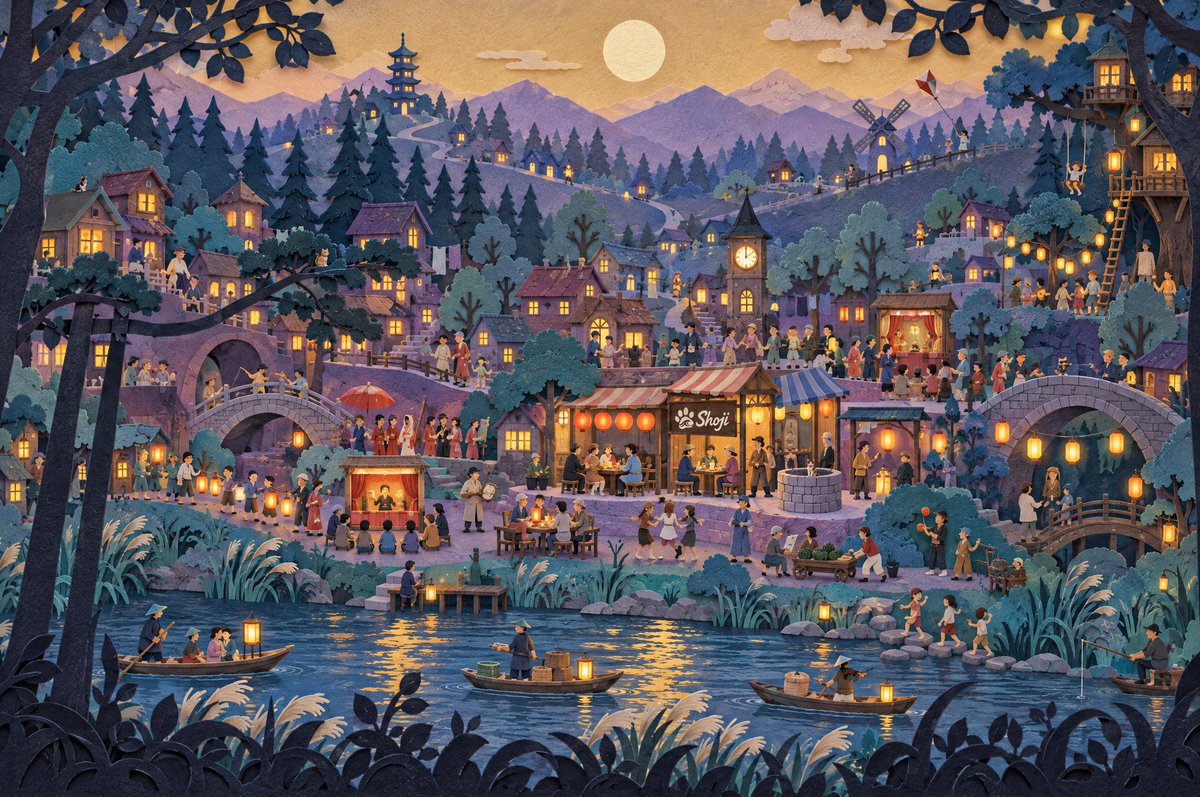
A handmade layered paper-cut diorama (a "shadow box" of cut paper), horizontal 3:2, a "find the hidden cats" picture in the spirit of a classic seek-and-find book: a moonlit forest village by a river seen from far away in a pulled-back wide view, so that the picture holds a huge amount of tiny detail. It is built from EIGHT clearly separate sheets of paper stacked one behind the other, each a different flat color of real paper with visible fibre, crisp hand-cut edges and a soft cast shadow on the sheet behind it. From the front to the back: a thin dark indigo foreground sheet of curling branches along the top corners and bottom edge, a deep navy sheet of slender pine trunks, a teal sheet of the near forest, reeds and the riverbank, a plum-purple sheet with the village (many houses climbing terraced slopes, small arched stone bridges, a tea stall and a market square), a dusty-blue sheet of more houses and trees, a lavender sheet of rolling hills with a winding road, a pale peach sheet of distant mountains, and the back sheet: a small full cream moon in a pale gold sky. Warm amber and honey-yellow light leaks through the gaps and cut-out holes between the sheets, as if a lamp were hidden behind the diorama: windows, lanterns and the moon are cut-outs backed with glowing yellow tissue paper. A limited palette of indigo, navy, teal, plum, dusty blue, lavender, peach and cream, with the warm amber glow as the only bright accent. It must read as cut paper. The paper fills the whole picture to all four edges: no frame, no border. About 200 tiny paper villagers in plain everyday clothes, each with a small story (an adult is only about 45 pixels tall in a 1360-pixel-high picture): a lantern parade of children, ferrymen poling small flat boats, a night market with plain striped awnings, a puppet show, a storyteller with listeners, women hanging lanterns on ladders, a boy on a swing, friends crossing arched bridges, a clock tower, a kite flyer, a juggler. Dozens of small cottages, a treehouse with lit windows, a windmill, a pagoda-like tower, stepping stones and reeds. A logo appears exactly ONCE, small: a modest dark wooden signboard hanging at the front of the tea stall in the middle of the picture (about 4% of the picture width), showing a cream-colored cat paw print whose big pad contains a swirling ocean-wave shape, with the word "Shoji" in cream cursive brush lettering to its right. Apart from that logo there are NO letters, NO words, NO numbers anywhere. Exactly FOUR cats are hidden in the scene and NO other animal: no birds, no insects, no fish, no dogs, no cat ears or masks on anybody, no cat painted on any sign. All four are on the same plum village sheet, in the open, easy to overlook, and ALL FOUR ARE THE SAME TINY SIZE: each about 1.4% of the picture height (roughly 20 to 25 pixels tall), about two fifths of an adult villager's height, no cat bigger than another: (1) a black-and-white "hachiware" cat (black head and back, a white blaze splitting the face, white chest and paws) sitting upright on the ridge of a small cottage roof at the far left; (2) a brown mackerel tabby (warm brown fur with dark stripes, white muzzle) sitting upright on a pine branch, center-left; (3) a calico cat (mostly white with distinct orange and black patches) sitting upright on the stone rim of the village well beside the tea stall, center-right; (4) an upright standing orange tabby cat about three heads tall, exactly as tall as the other three cats and as small as they are, far smaller than the villagers around him, wearing black wayfarer sunglasses whose lenses are blue on one side and red on the other, an open black leather biker jacket, rolled-up denim shorts and cream sneakers, pointing with one hand, standing on the top of an arched stone bridge at the right. The tabby, hachiware and calico are real four-legged cats with a thin red collar and a tiny gold bell, no clothes. No cat appears in the lower third of the picture. No black or dark round object that could be mistaken for a cat. No watermark.