

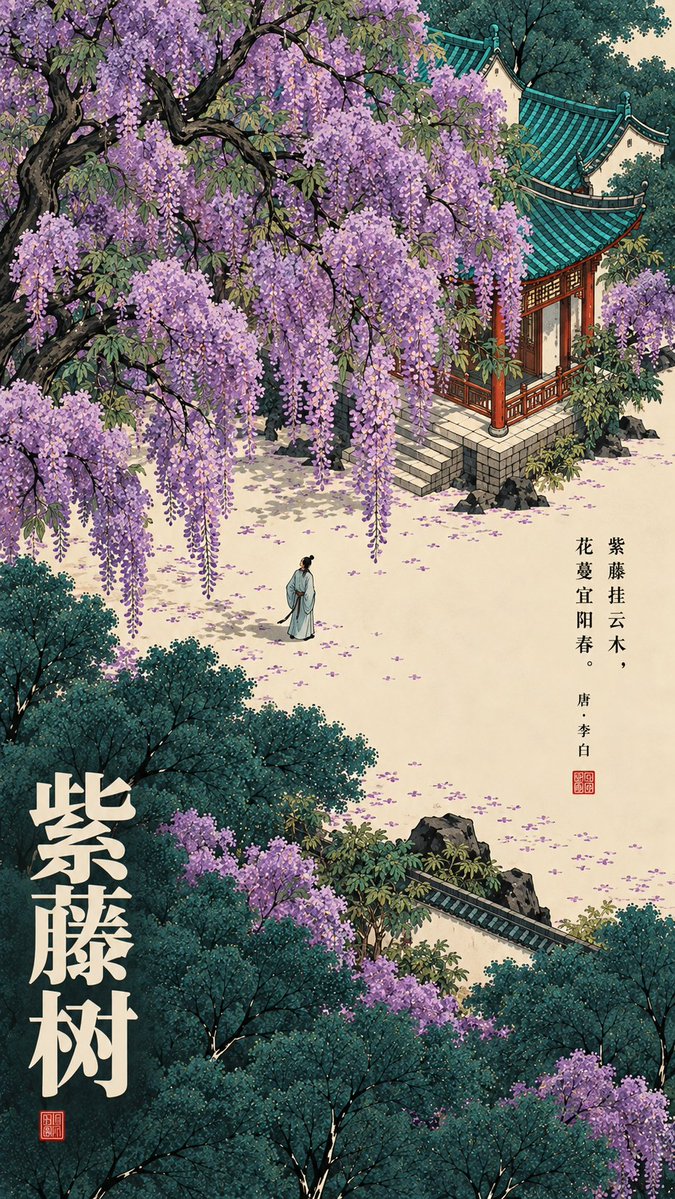
【Classical Chinese Poem】{Enter the poem title, author, and original text} 【Main Poster Title】{Extract 2–4 representative Chinese characters} 【Core Imagery】{For example: cascading wisteria blossoms, blue-green upturned eaves, begonias after rain, a silk fan and fireflies} 【Scene】{For example: a Jiangnan courtyard, a waterside village, a classical garden} 【Visual Relationships】{For example: trailing flower vines, red and green complementing one another, plants surrounding the architecture} 【Primary Color Palette】{Choose 2–3 harmonious traditional Eastern colors} 【Aspect Ratio】9:16 Based on the classical Chinese poem, create a New Chinese-style fine-line color art poster with textbook-quality illustration. Transform the poem’s plants, architecture, figures, and emotions into a complete, refined, and poetic Eastern scene. 【Visual Style and Texture】 Use a visual language that combines contemporary Eastern decorative illustration with traditional gongbi fine-line drawing. Render the tree canopies as complete masses of soft, fluffy, cloud-like color, with a delicate powder-speckled texture around their edges. Weave slender, continuous, naturally branching ink-black limbs through their interiors. Artistically simplify the flowers and trees according to their natural growth patterns. Preserve the natural hanging form of wisteria, arrange begonia clusters with an orderly balance of dense and sparse areas, and keep the lines of the branches and leaves elegant and flowing. Express the overall form of each plant through complete color planes rather than drawing dense petals and leaves individually. For the traditional architecture, use finely ordered blue-green roof tiles, elegant upturned eaves, warm-white walls, and a small amount of vermilion wooden structure. Keep the overall treatment flat, with rich, even color and a clean, matte, delicate decorative paper texture. 【Composition and Space】 Use a high-angle bird’s-eye view, Eastern scattered-point perspective, and modern flat composition. Organize the image through enveloping flowers and trees, interwoven branches, partially obscured architecture, natural curves, and large areas of warm beige-white negative space, creating a clear visual focus and distinct spatial layers. Adjust the composition flexibly according to the poem, emphasizing its most representative scenery and relationships between actions. Render the architecture precisely, simplify the plants, keep the figures concise, and preserve negative space in the background. Avoid repeatedly using a fixed courtyard layout, and do not force unrelated pavilions, figures, or decorations into the scene. Keep the ground and water surfaces simple, using only a few fine lines and irregular ink-colored shadows to suggest space. 【Eastern Color Palette】 Use traditional Eastern colors such as mineral blue, mineral green, deep blue-black, vermilion red, wisteria violet, pink ochre, and warm ivory white. Use one dominant color to establish visual weight, then use a contrasting color to highlight the plants, architecture, or human subject. Pair these colors with fine ink lines and warm-white negative space. Emphasize complete large color planes, harmonious warm-cool relationships, and clearly separated value levels. The colors should be rich yet restrained, even, matte, and unfaded. Avoid chaotic colors, complex gradients, heavy textures, and excessive artificial aging. 【Chinese Art Poster Typography】 In the lower portion of the image or within a dark canopy area along one side, integrate a large Chinese title in warm ivory white. Use a bold, upright, elegant Eastern artistic typeface that naturally overlaps with the colored masses of the plants. In suitable areas of negative space, add refined, small-scale vertical lines from the original poem, an accurate author credit, and one or two vermilion seals. Keep the text clear and distinctly hierarchical, allowing it to merge naturally with the landscape. Do not add fictional exhibition information, numbering, or meaningless ornamentation. 【Final Quality】 Maintain the composition of complete large color masses, soft cloud-like tree canopies, slender continuous ink lines, refined blue-green architecture, and elegant negative space. The main subject and supporting scenery should have clearly differentiated levels of detail, and the poetic imagery should follow the laws of nature. Avoid photorealistic photography, 3D, anime, thick oil-paint impasto, heavy ink-wash painting, dense individually rendered flowers and leaves, overly elaborate architecture, complex ground surfaces, excessive grain, and artificial aging. The final result should be a New Chinese-style classical poetry art poster with a unified visual style, sophisticated color palette, distinct poetic atmosphere, and mature Eastern decorative aesthetics.