

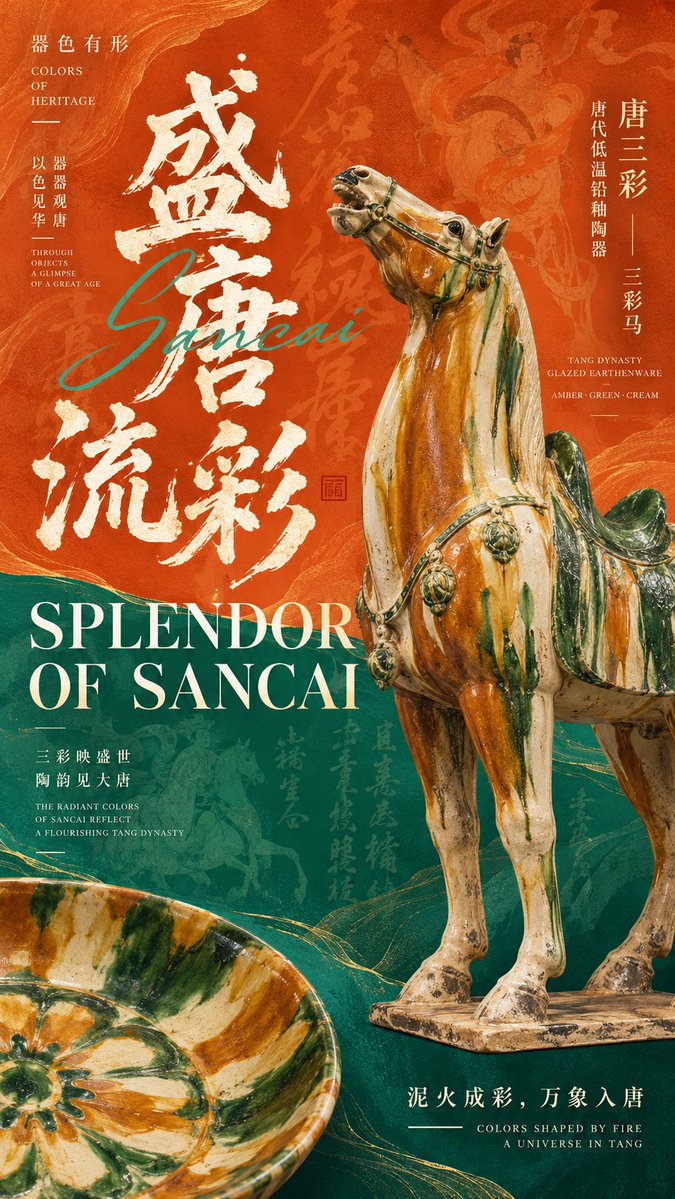
【Cultural theme】: Enter a theme, such as Tang sancai pottery, blue-and-white porcelain, Jun ware, or Jian ware 【Core artifact】: Enter its name, vessel form, and material characteristics 【Chinese main title】: Enter text 【English main title】: Enter text 【Cultural tagline】: Enter text 【Series name】: 器色有形 / COLORS OF HERITAGE 【Primary and supporting colors】: Enter colors 【Visual mode】: Dark mineral / high-saturation color contrast / gradient optical raster 【Aspect ratio】: 9:16 Create a highly polished experimental typography art poster about Eastern cultural heritage, combining traditional Chinese aesthetics, museum exhibition visuals, retro editorial design, and contemporary experimental typography. I. Artifact and composition Use an artifact with authentic cultural characteristics as the central visual. Display it at a large scale with an accurate form, refined material textures, a natural glaze or convincing surface quality, and museum-collection photography-style layers of light and shadow. Parts of the artifact may be enlarged and extend beyond the frame, creating foreground and background occlusion with the text. Add one partially cropped or semitransparent supporting artifact, using differences in size, sharpness, direction, and form to establish spatial depth. II. Typography and layout Use enormous, powerful brush calligraphy for the Chinese main title. Give it natural brush tips, dry-brush gaps, and variations in stroke thickness so that it becomes a major visual graphic within the composition. Set the English main title in a high-quality uppercase retro serif typeface. Enlarge, break into multiple lines, offset, and overlap the letters so they interact with the Chinese calligraphy and artifact. A small amount of elegant English cursive lettering may be added as a supporting element. The image must have a complete editorial information hierarchy, including the series name, artifact name, cultural classification, craft description, short Chinese and English phrases, and a few refined annotation lines. Keep the information density medium to high while maintaining a clear hierarchy between primary and secondary elements. III. Color and background Design the image according to the selected visual mode: - Dark mineral: Use ink black, deep blue, copper gold, and similar colors, combining mineral textures, localized metallic details, and semitransparent calligraphic background patterns to convey a deep and weighty cultural atmosphere. - High-saturation color contrast: Divide large areas using two vivid primary colors, paired with organic curves, offset artifacts extending beyond the frame, enormous typography, and low-contrast cultural patterns to create a retro editorial design aesthetic. - Gradient optical raster: Use cyan-blue, indigo-violet, and similar gradient color fields with spatial depth, overlaid with continuous, fine, densely spaced vertical raster lines. Make the lines bend slightly around the artifact's edges, vary in density, and pass in front of and behind it, creating a contemporary optical-art effect in which the artifact partially appears and disappears. Integrate theme-related traditional calligraphy, decorative patterns, flowing glaze colors, or historical and cultural textures into the background at low opacity, enriching the image without interfering with the main information. IV. Visual hierarchy and finish Build three primary visual anchors using the enormous Chinese calligraphy, the core artifact, and the large English title. Create rich spatial depth and reading rhythm through artifact sections extending beyond the frame, overlapping text, color contrast, ghosted background imagery, and delicate lines. From a distance, the composition should have a strong visual impact and clear large-scale forms. Viewed up close, it should reveal refined materials, calligraphic textures, cultural information, and graphic details. The entire poster should achieve the finish of a professional cultural heritage exhibition, art publication, and cultural brand design. It should be a complete work with its own thematic expression rather than an ordinary artifact-display template. Ensure that the artifact's form is accurate, the text is clear, the layout is precise, and the colors are sophisticated. Avoid garbled characters, fabricated exhibition information, meaningless English, cheap-looking 3D, excessive technological effects, random numbering, four-point starbursts, and watermarks. Produce a high-definition vertical art poster in a 9:16 aspect ratio.