

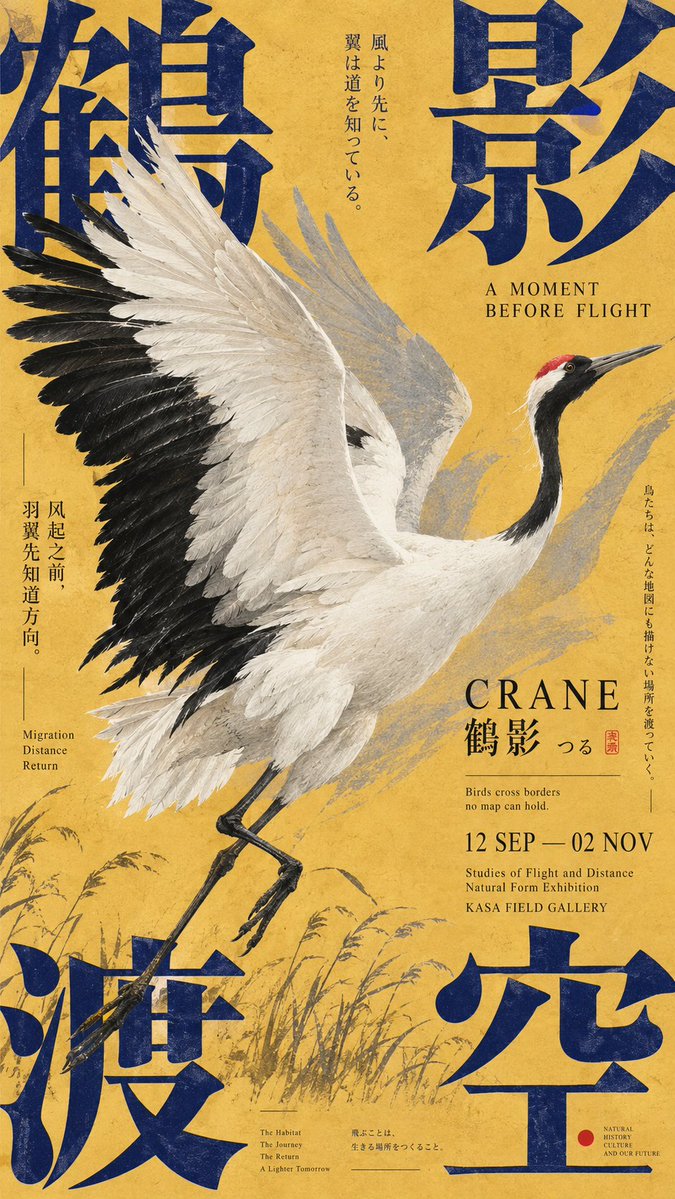
Create a premium 9:16 Japanese-inspired editorial poster using the following creative direction. Theme: [Your exhibition, cultural event, or artistic concept] Main Typography: [Large English, Chinese, or Japanese headline] Visual Subject: [Wildlife, natural elements, printed materials, objects, or abstract forms] Color Palette: [Choose 2–4 harmonious or contrasting colors] Supporting Text: [Subtitle, dates, venue, and meaningful multilingual details] Visual Style & Typography Draw inspiration from Japanese cultural exhibition posters, experimental typography, independent publishing, and contemporary editorial graphic design. Make typography the main visual structure, using oversized letterforms, expressive Kanji, bold cropping, unconventional spacing, and a sophisticated mix of Chinese, Japanese, and English. Explore dynamic relationships between text and imagery through overlapping, masking, fragmented layouts, negative space, and layered compositions. Depending on the theme, use calligraphic collage, large characters framing illustrations, typography interacting with natural objects, or dense editorial arrangements. Composition & Information Hierarchy Build a visually striking yet carefully organized composition. Combine dominant headlines with smaller vertical text columns, exhibition details, dates, poetic phrases, fine rules, and compact information blocks. Maintain the rich visual density of authentic Japanese art posters. Every element should contribute to the concept, with clear hierarchy, intentional asymmetry, balanced negative space, and strong readability even at thumbnail size. Imagery & Print Texture Integrate illustrations, photography, archival fragments, or physical materials naturally into the typography. Objects should interact with letters through meaningful overlap and spatial relationships rather than appearing as separate decorations. Use subtle paper fibers, offset printing textures, ink grain, restrained registration imperfections, and tactile printed surfaces. Keep colors rich and controlled, with authentic material details and refined editorial craftsmanship. Final Art Direction The result should feel like an original poster commissioned by a Japanese art museum, independent publisher, cultural gallery, or design exhibition. Each composition should have its own distinctive visual concept while maintaining a cohesive Japanese editorial aesthetic. Avoid generic AI poster templates, excessive minimalism, meaningless filler text, random decorations, glossy 3D effects, artificial gradients, numbering, sparkles, and watermarks.