

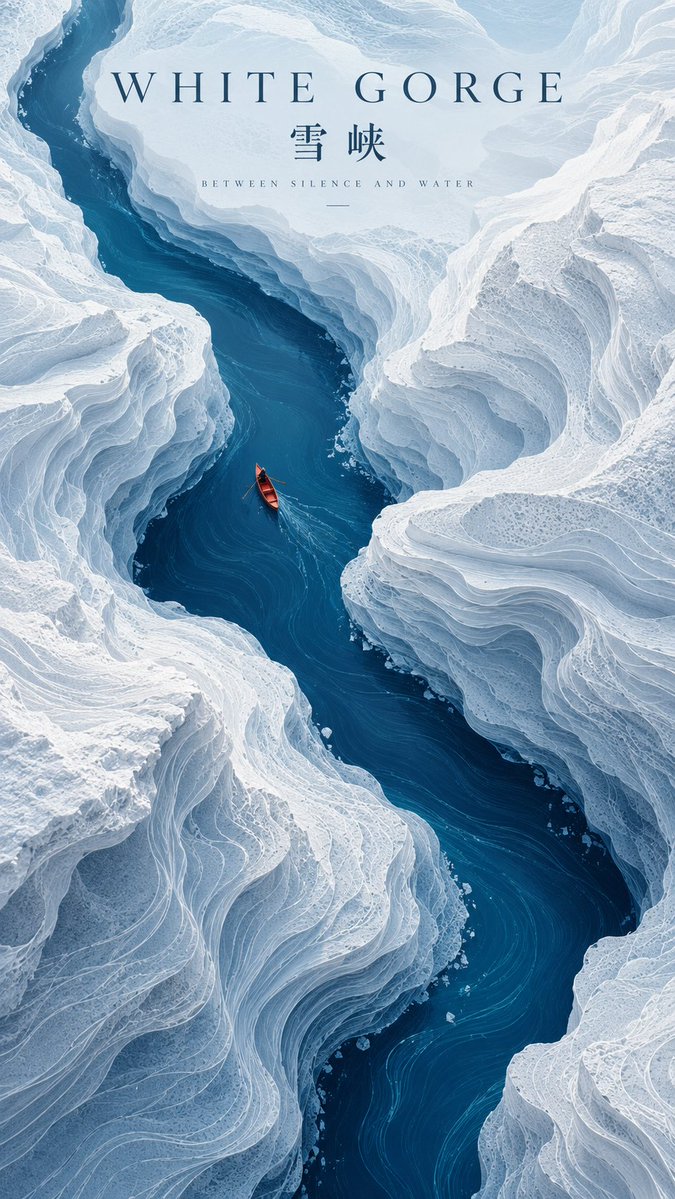
【Title】[TITLE] 【Subtitle】[SUBTITLE] 【Landscape】[canyon / river / cloud mountains / glacier / desert / coast] 【Main Palette】[PRIMARY COLORS] 【Scale Anchor】[tiny traveler / canoe / boat / small building] 【Visual Destination】[moon / distant light / horizon / mountain pass] 【Aspect Ratio】9:16 Create a refined vertical art poster that transforms a natural landscape into a flowing topographic world. Build the terrain from hundreds of long, smooth, continuous contour lines that follow the shape, depth, and movement of the land. The lines should feel like a fusion of topographic maps, silk threads, and abstract Chinese landscape painting — directional, elegant, and highly organized rather than random decorative waves. Use one strong visual path, such as a river, valley, ridge, cloud road, or negative-space corridor, to guide the eye from foreground to distance. Keep the natural environment monumental and place only one or two extremely small human figures, boats, or architectural elements as scale anchors. Use clear spatial hierarchy: dense flowing lines in the main terrain, calmer negative space around the visual path, simpler and softer details in the distance. Control the palette with 2–4 dominant colors rather than evenly distributed rainbow tones. Use large, clean color fields and let color changes reinforce depth and movement. Add minimal editorial typography: [TITLE] [SUBTITLE] [SHORT POETIC LINE] Typography should feel like a contemporary exhibition poster or art-book cover — elegant, widely spaced, restrained, and secondary to the landscape. The final image should feel poetic, monumental, calm, and highly designed, combining Eastern landscape aesthetics, contour-line abstraction, negative space, and modern editorial composition. Avoid realistic landscape photography, random waves, chaotic line patterns, excessive texture, generic fantasy CGI, plastic 3D surfaces, watermarks, logos, copyright text, or copied reference typography.