

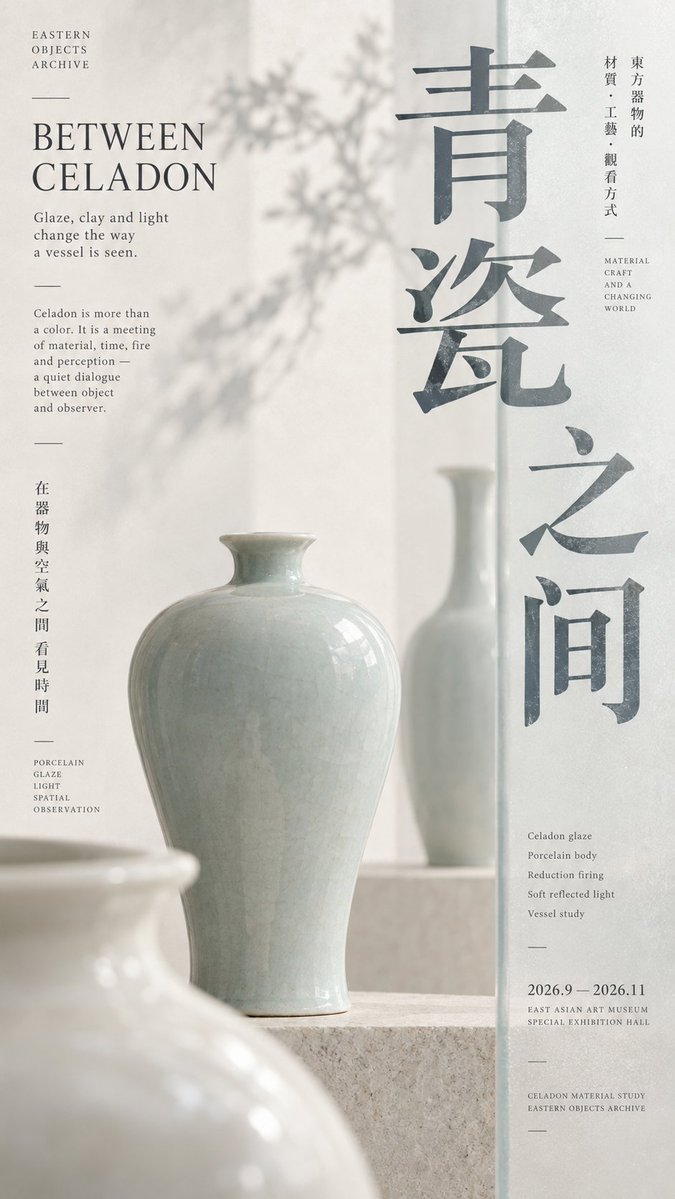
[Theme]: {celadon / traditional clothing / xuan paper / inkstone / another Eastern cultural material} [Chinese Title]: {a 4–6-character thematic name} [English Title]: {the corresponding English exhibition title} [Primary Subject]: {artifact / textile / paper / material object} [Supporting Archive]: {line drawing / ancient painting / landscape / structural diagram / material study / documents, etc.} [Primary Palette]: {moon white and blue-gray / pale jade / warm beige-gray / ink black, etc.} [Core Composition]: {depth with negative space / diagonal suspension / layered paper collage / large material crop, etc.} [Aspect Ratio]: 9:16 Design a refined Eastern cultural heritage editorial poster that reorganizes traditional Eastern artifacts, textiles, paper, or natural materials within the visual system of a contemporary museum exhibition, art publication, or cultural research project. The overall visual language should emphasize restraint, negative space, materiality, and information hierarchy. It should not resemble a traditional decorative Chinese-style poster or an ordinary product presentation. Use a clean, warm ivory, moon-white, or extremely pale gray-white art-paper or exhibition-space background. Retain only extremely subtle, realistic textures of paper, fabric, or natural materials. Do not make it aged, dirty, or yellowed. Use a mature asymmetrical editorial grid. Integrate the [Primary Subject] into the composition through enlargement, cropping, suspension, transmitted light, defocus, layering, diagonal entry, or partial extension beyond the frame. Do not present the complete subject neatly in the center; make the subject itself part of the layout structure. Build clear spatial relationships according to the [Core Composition]. Use a blurred foreground, a midground subject, and a distant silhouette to create depth. Use translucent paper, textiles, glass, or natural cast shadows to form layers. Use large material sections, negative space, and shadows to create abstract geometric relationships. Allow the subject’s contours, folds, edges, openings, textures, or structural lines to participate naturally in the typography. For typography, combine modern Chinese Song or Ming typefaces with high-contrast English serif typefaces. Use the Chinese title as a primary or secondary visual anchor, arranging it horizontally, vertically, in an offset position, or as a large-scale partial element according to the image. Let the English title occupy another editorial level. Do not make every piece of text the same size; establish a clear scale difference between a large headline, medium-sized explanation, and extremely small archival information. Add a limited amount of genuinely meaningful exhibition information, material research, production methods, cultural context, and institutional information within the negative space. Make the image resemble a real museum catalog, art publication, or research-oriented exhibition rather than using random English or Lorem Ipsum. Add theme-related [Supporting Archive] material, such as artifact contour drawings, landscape archives, structural diagrams of traditional clothing, material cross-sections, paper textures, rubbings, manuscripts, artifact-form classifications, and craft research diagrams. All supporting content must have reduced contrast, partial cropping, and partial transparency. It should function only as second- or third-level information and must not compete with the primary subject. Use low-saturation colors associated with Eastern materials, limited to 3–5 principal tonal levels according to the theme. Examples include warm ivory + moon white + blue-gray; warm off-white + pale jade + ink gray; warm white + pale tea brown + stone gray; warm white + ink black + pale stone. Do not pile up large amounts of red, gold, blue-green, or other traditional colors merely to create an “Eastern” feeling. The image must establish three clear viewing levels. From a distance: the subject’s large shape, the title, and the negative space should work first, retaining a clear visual center even at thumbnail size. At a medium distance: the viewer should discover the materials, light and shadow, depth, projections, cropping, and spatial relationship between the subject and the typography. At close range: the archival information, research labels, line drawings, material descriptions, and small text should become readable. Maintain approximately 45%–60% effective negative space. However, that space must be controlled by the subject’s direction, lighting, material boundaries, and typographic grid; it must not simply be left empty. The final result should resemble the principal visual identity for an Eastern heritage exhibition created by a top Asian art museum, design museum, traditional craft research institute, or sophisticated independent art publication. Traditional objects should be reorganized through contemporary editorial design to produce a quiet, restrained, authentic, airy, and knowledgeable image with the completeness of a finished artwork and a mature information hierarchy. Avoid: traditional Chinese-style templates, a complete centered subject, commercial product advertising, e-commerce displays, excessive red-and-gold palettes, auspicious-cloud borders, calligraphy covering the entire image, excessive aging, dirty paper, plastic-looking CGI materials, intense luxury highlights, random English, insufficient information, template-like minimalism, numbering, “No.”, “Vol.”, and four-pointed starbursts.