

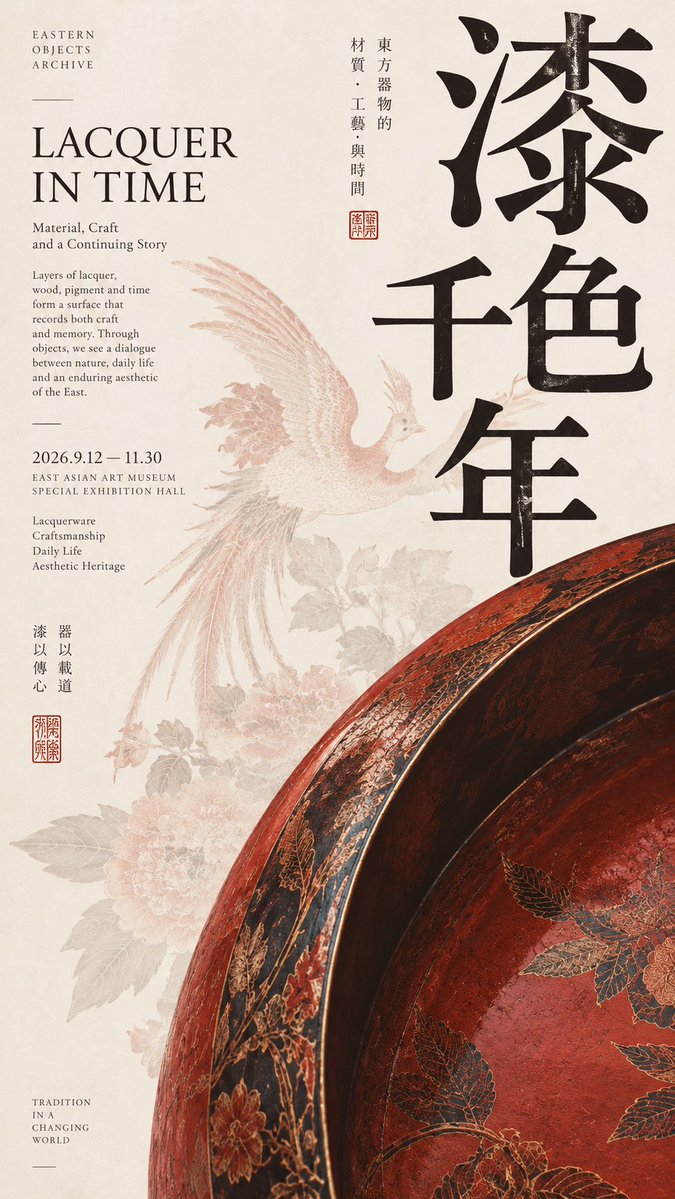
【Theme】: {for example: lacquerware / bronze / inkstone / guqin / jade / ceramics} 【Chinese Title】: {a 4–6-character thematic name} 【English Title】: {the corresponding English exhibition title} 【Core Artifact】: {a specific artifact} 【Supporting Archival Elements】: {ancient painting / rubbing / qin notation / line drawing / inscription / material study, etc.} 【Primary Color Palette】: {for example: cinnabar red + ink black / bronze gray-green / black and gray / dark wood brown} 【Composition Mechanism】: {interweaving with giant characters / enormous circular arc / black-and-white planes / long diagonal axis, etc.} 【Aspect Ratio】: 9:16 Design a sophisticated editorial poster about Eastern cultural heritage, reorganizing traditional Eastern artifacts within the visual system of a contemporary museum exhibition and art publication. Use a warm, clean ivory-white art-paper background with extremely subtle, realistic paper fibers. Do not make it look aged, dirty, or yellowed. Employ a low-saturation palette inspired by Eastern materials, generous negative space, an asymmetrical editorial grid, and a mixture of modern Chinese Song/Ming typefaces with high-contrast Latin Serif fonts. Present the core artifact through realistic, museum-quality photography with a tangible sense of material weight, rather than as an ordinary product display. Following the 【Composition Mechanism】, boldly crop and enlarge the artifact, weave it diagonally through the layout, or let parts extend beyond the frame so that the artifact itself becomes part of the graphic structure. Use large-scale Chinese typography as a powerful visual anchor, with the English title forming the second level of hierarchy. Add extremely small exhibition notes, material research, dates, craftsmanship details, and archival information along the edges and within areas of negative space, creating a striking scale contrast of “giant title × microscopic information.” Include 【Supporting Archival Elements】 that are authentically related to the 【Core Artifact】, such as fragments of ancient paintings, rubbings of inscriptions, line drawings of the artifact, qin notation, or material-research diagrams. All archival elements should be low-contrast, semi-transparent, and partially cropped, serving only as a secondary information layer without competing with the main subject. The image must have three clearly defined levels of reading: From a distance: the large silhouette of the artifact and the large title should register first; From a medium distance: the interplay among the artifact, typography, and archival layers should become visible; Up close: the miniature captions, material information, and research details should become readable. All text should have the authentic tone of a cultural exhibition and museum publication. Do not use Lorem Ipsum or random, meaningless English. The composition should be information-rich without appearing crowded, with high density around the main subject, low density in the background, and approximately 40%–55% effective negative space. The final result should resemble the key visual for an Eastern cultural heritage exhibition produced by a leading Asian art museum, cultural research institution, or independent design studio: traditional subject matter, contemporary typography, a quiet, restrained, and refined atmosphere, together with clear visual impact and the sense of a fully resolved artwork. Avoid: generic Chinese-style posters, centered product photography, e-commerce advertising, traditional borders, excessive auspicious-cloud motifs, gold effects, calligraphy covering the entire image, excessive aging, dirty textures, highly saturated colors, random decoration, insufficient information, template-like minimalism, numbering, “No.,” “Vol.,” and four-point starbursts.