

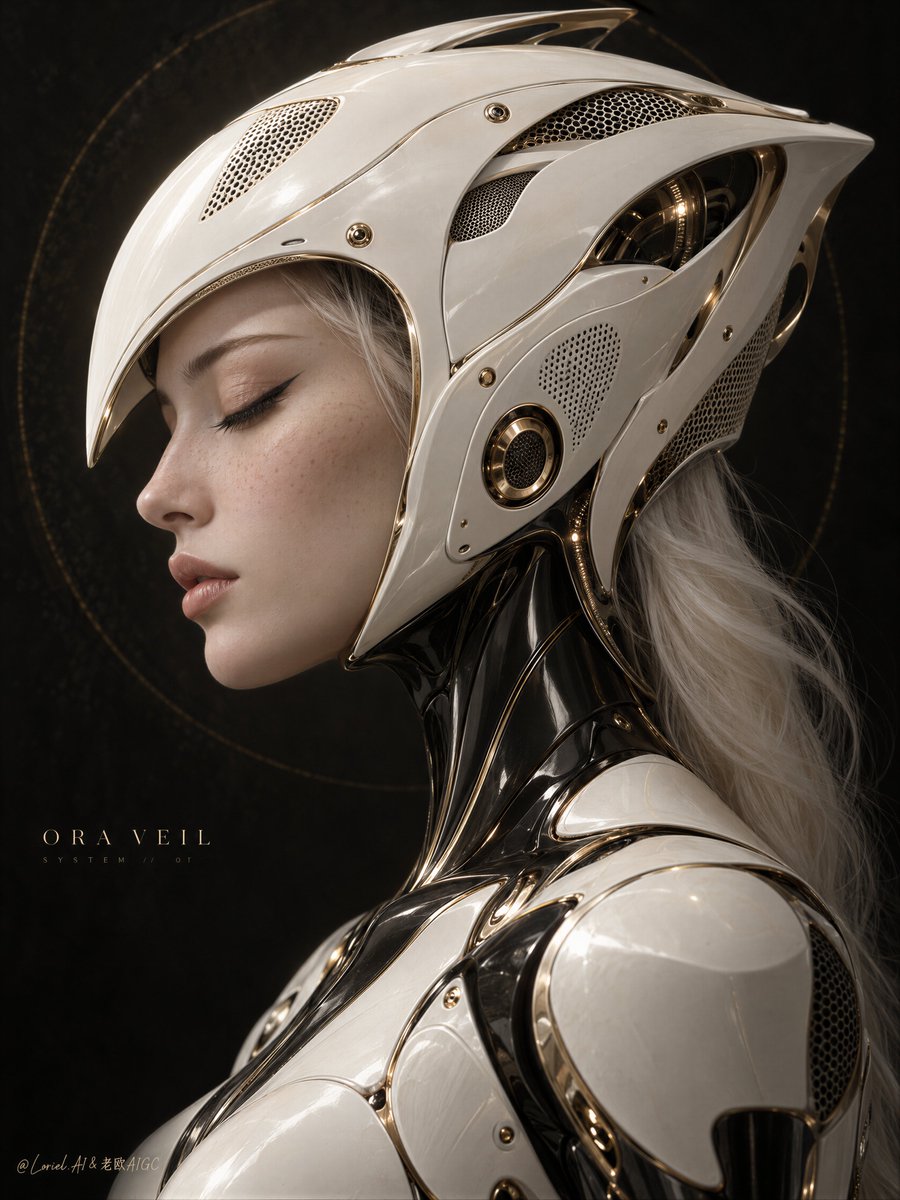
Create a flagship future-luxury portrait poster for a fictional international design house named ORA VEIL SYSTEM, designed as a single vertically composed master image that fully merges Orbit, Transit, and Port into one best solution: emotionally hypnotic, materially exacting, and curatorially distilled. The image must feel like a Cannes-level luxury-tech campaign, a collectible gallery print, and a couture cybernetic portrait at once. The absolute hero is one female-coded android bust shown in a tight left-facing side-profile composition, filling most of the frame from the helmet crown to the upper torso. The pose is perfectly still and ceremonial: chin slightly lowered, eyelids closed, lips soft, neck elongated, presence serene and untouchable. The final read must be immediate and iconic: one sacred profile, one sculptural helmet, one porcelain face, one black-white-gold body system. The helmet is the primary design event. Build a highly refined biomorphic helmet shell in glossy ivory-white ceramic composite with aerodynamic couture curvature, asymmetric cutouts, precision perforation fields, delicate mesh insets, and restrained warm-gold trim lines. The silhouette should feel avian, elegant, and future-ritualistic rather than industrial or militarized. Use polished gold details sparingly but precisely: tiny mechanical fasteners, mesh glints, rim accents, and thin structural seams. Through selected vent openings, reveal subtle internal engineering in warm metallic tones, never cluttered, never bulky. The entire helmet must feel museum-grade, collectible, and flawlessly engineered. The face must remain human, luminous, and emotionally magnetic. She has pale porcelain skin with believable softness, faint freckles or subtle skin speckling across the cheek, precise dark eyeliner on closed lids, soft peach-nude lips, and a refined nose and jawline. The skin must feel alive rather than doll-like: natural pores, subtle tonal variation, realistic skin elasticity, and no plastic smoothing. A small veil of white-blonde hair should fall behind the helmet near the neck, adding softness and quiet contrast against the machine shell. The neck and upper torso form a secondary luxury-material system. Construct an elegant biomechanical chassis in lacquered obsidian-black and ivory-white surfaces with smooth contour transitions, sculpted shoulder armor forms, and fine gold tracery threading through selected seams and articulation points. The black neck structure should feel long, graceful, and liquid-polished, while the shoulder and chest planes remain controlled, minimal, and couture-like. Avoid bulky robotics, exposed cables, or mechanical chaos. This is not hard sci-fi armor; it is luxury machine anatomy. The background must be a near-black premium void with subtle tonal depth and barely perceptible ornamental texture or atmospheric bloom, just enough to lift the silhouette from darkness. Keep the environment empty, reverent, and rare. No scenery, no extra props, no visual noise, no narrative clutter. The entire frame should feel like a sacred object portrait staged in darkness. Typography must be almost absent and entirely newly invented in English only. Do not copy any text from the source image. Optionally place one tiny brand mark such as "ORA VEIL" or "ORA VEIL // 01" near a lower corner or edge in a refined serif-sans combination in warm ivory or muted gold. If any secondary text appears, keep it museum-like, microscopic, and fully subordinate to the portrait silhouette. Orbit: the image must strike instantly through the serenity of the closed-eye profile, the sculptural purity of the helmet, and the emotional tension between tenderness and machine precision. Transit: the visual system must feel expandable into a luxury portrait series where future variations explore different helmet silhouettes, shell finishes, metallic accents, and emotional states while preserving the same sacred profile grammar. Port: every nonessential detail must be removed so the image remains cold, rare, exact, and collectible, with no decorative excess and no wasted information. Lighting must be soft, directional, and luxurious. Use a controlled upper-front key with a slight side bias to sculpt the helmet volume, skim the cheekbone and lips, and reveal gloss transitions along the black neck structure. Gold accents should catch restrained warm highlights. Shadows must remain deep, velvety, and dimensional without collapsing into dead black. The effect should feel intimate, reverent, and premium. Use a disciplined 60/30/10 palette hierarchy: 60% ivory-white shell and pale skin luminosity, 30% obsidian-black body structure and dark background depth, 10% warm metallic gold detailing and tiny amber highlights. The image must feel restrained, precious, and globally premium. Material semantics are critical. The white shell must feel like polished ceramic composite with flawless finish and subtle micro-curvature. The black structural sections must feel lacquered, dense, and luxurious. Gold elements must feel finely machined and precious. Skin must feel alive and soft. Hair must feel real and slightly silky. The entire portrait must hold refined micro-detail without becoming noisy. The final image should read as a future-luxury icon where porcelain humanity, sacred stillness, and couture machine design are fused into one exact commercial object. It must be photoreal, elegant, globally premium, and unforgettable at first glance. Quality target and structured exclusions: photoreal only, correct feminine facial anatomy, no warped helmet geometry, no broken mesh logic, no bulky mech parts, no toy-like surfaces, no plastic skin, no unreadable text, no random letters, no cluttered background, no muddy blacks, no dead black blocks, no style drift, no AI artifacts, no watermark, no real person names, no real brand names.