

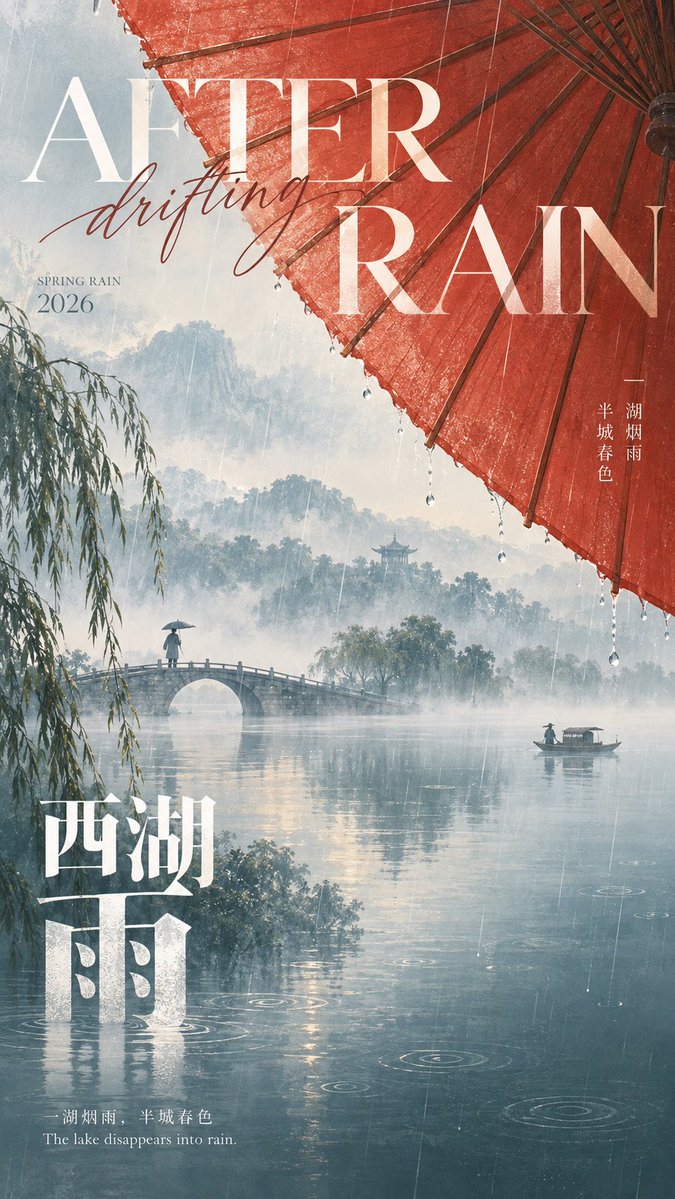
Prompt: 【Theme】: {fill in, e.g.: West Lake Rain / White Dew / Spring Tea / Lantern Festival} 【English main title】: {fill in} 【Chinese main title】: {fill in} 【Subtitle】: {fill in} 【Oversized hero visual】: {fill in, e.g.: giant oil-paper umbrella / dewdrop / tea bowl / lantern} 【Oriental landscape】: {fill in, e.g.: lake surface / valley / tea mountain / Jiangnan waterside} 【Tiny figures and their action】: {fill in} 【Dominant color】: {fill in} 【Accent color】: {fill in} 【Small season / year text】: {optional} 【Aspect ratio】: {default 9:16} Generate a refined, modern, Oriental-poetic editorial poster that fuses the mood of an Oriental landscape, an oversized hero visual, tiny-figure narrative, and modern Chinese-English typography into a complete visual work. Do not make it an ordinary Chinese-style promo image, a tourism poster, or a festival template; instead reach the design completeness of a cultural brand campaign, an art-festival visual, or a magazine editorial poster. Build the space with large soft color fields, using the 【dominant color】 as the main environmental color and the 【accent color】 only to concentrate and strengthen the 【oversized hero visual】, so the subject is recognizable at a glance even as a thumbnail. Render the background landscape with ink washes, pastel diffusion, thin mist, and soft-edged color blocks, reducing realistic detail; don't let buildings, trees, and mountains stand out too much. Enlarge the 【oversized hero visual】 far beyond real proportion and let it truly enter the picture space through cropping, occlusion, interpenetration, or perspective, rather than simply floating. Keep only one strongest visual anchor, avoiding multiple large objects competing for the eye. Add 【tiny figures and their action】 at a very small scale, using the scale contrast between the giant environment/object and the tiny figures to strengthen the sense of space, poetry, and story. The figures should not be the protagonist and should not pose; they only serve as a scale reference and narrative point. At the top or upper half, use a huge 【English main title】 in a thin, high-contrast, modern editorial serif, allowing the text to cross the frame, offset, and be cropped, forming real front-back occlusion relationships with the giant object, mist, plants, rain lines, water drops, or steam. You may add one thin, natural English handwritten stroke as a soft visual line, but don't stack too many fonts. Place the 【Chinese main title】 in the lower-center or lower-left area, clearly enlarged, creating partial occlusion, edge bleed, reflection, or interpenetration with the landscape, so the text becomes part of the composition rather than simply overlaid on the surface. Use 【subtitle】 as the caption, keeping it concise and real. According to the theme, add one "physical relationship" to strengthen the sense of visual method, such as: refraction, reflection, steam becoming cloud, rain ripples, front-back occlusion, transparent medium, huge scale difference, an object passing through the text. The visual relationship should be understandable at first glance and reveal a surprise on the second. Control information density: the three zones — top typography, central hero visual, and bottom Chinese title — can be denser, while the rest is actively left as white space. Avoid tiny text and ornaments all over the screen. All text must be real, meaningful, and legible, with no gibberish, meaningless English, fake logos, fake brands, numbering, or template placeholder info. Keep the texture refined, soft, restrained, and modern-Oriental. Avoid overly strong CGI light effects, cheap glow, plastic materials, over-sharpening, piled-up traditional patterns, tourism-promo feel, e-commerce-sale feel, complex ancient architectural clusters, festival elements all over the screen, and four-point star ornaments. The final work must simultaneously have: large color fields, a strong visual anchor, a giant object with tiny figures, Oriental poetic mood, modern editorial typography, real spatial interpenetration, an evident design method, and the completeness of a finished poster.