

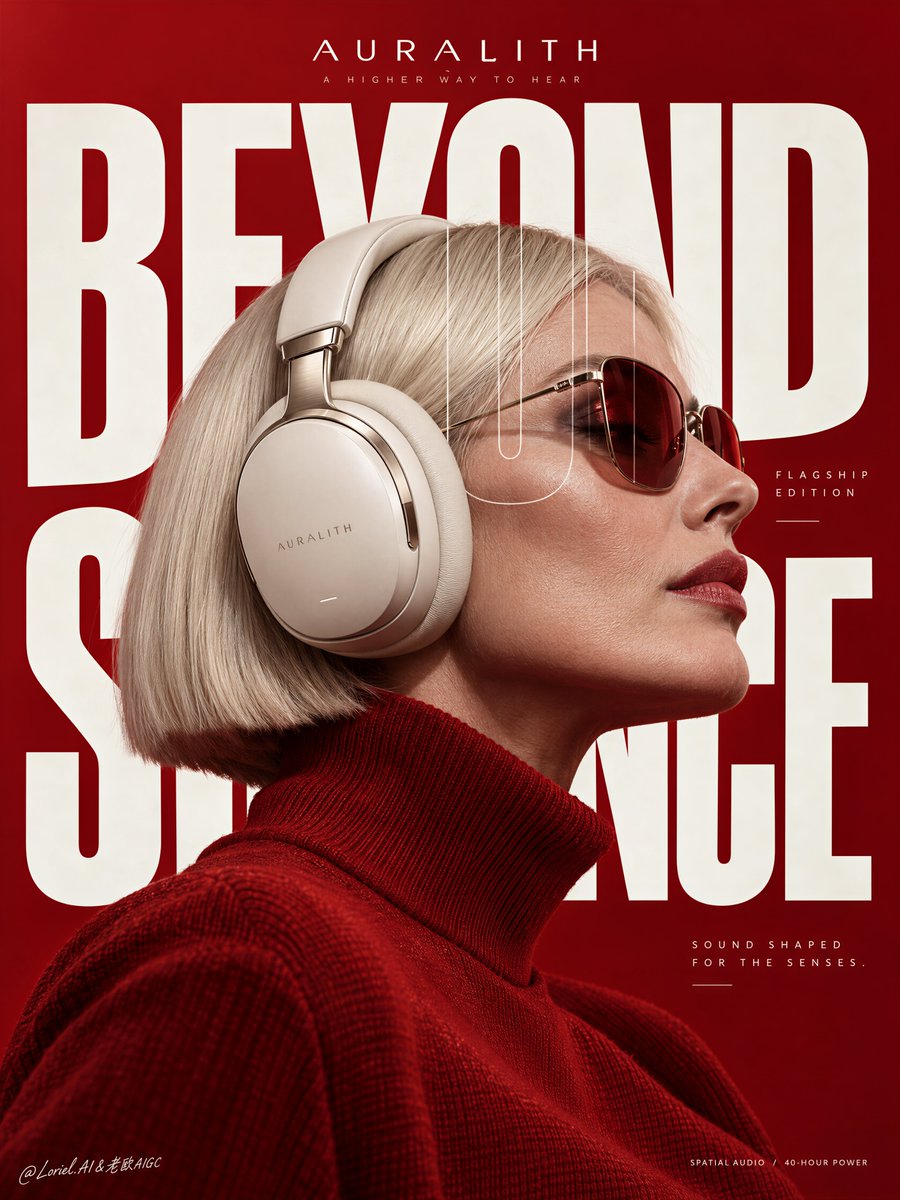
Create a premium fashion-tech advertising poster for a fictional international audio brand named AURALITH, designed as a single vertically composed main visual where product design, editorial portraiture, and monumental typography fuse into one iconic campaign image. Preserve the structural force of the reference as pure visual grammar only: a saturated monochrome red field, one dominant mature female side-profile portrait, oversized white typographic architecture behind and partially across the portrait, and a pair of luxury over-ear headphones worn as the central commercial product. The final image must integrate Orbit, Transit, and Port at once: immediately striking, materially refined, and curatorially reduced. The true hero is the headphone product. Render it as a flagship premium wireless over-ear design with pearl-ivory or soft matte ceramic finish, precise elliptical earcups, subtle brushed-metal hinges, smooth memory-foam cushions, elegant headband curvature, refined seam logic, and believable contact pressure against the head. The headphones must feel expensive, tactile, and technologically advanced without looking generic or overdesigned. Keep the product large, clean, and unmistakably legible, with enough lighting contrast to reveal its industrial design language. The woman is a real mature fashion subject, seen in close side profile or near-profile, occupying the center-right of the composition. She has a blunt platinum-blonde bob cut with exact geometry, cool reflective shine, sculptural jawline, elegant neck, refined lips, and calm, self-contained attitude. Her expression is poised, severe, and contemporary, as if she is listening to something beyond the visible world. She wears a high-neck knit or sculptural red textile garment that merges tonally with the environment while still revealing premium weave texture and volume. If sunglasses remain, they should be sleek, fashion-forward, and lightly tinted, reinforcing the luxury-tech mood. Skin must be realistic and sophisticated: visible pores, subtle tonal shifts, soft natural sheen, no plastic smoothing, no waxy beauty-retouch finish. The composition must feel more international, more reduced, and more art-directed than a standard electronics advertisement. Push the figure slightly off-center so the typography and negative space can breathe. Let the portrait intersect with the giant letterforms as if the body and the brand statement are cut from the same visual architecture. Avoid unnecessary prop elements, interface clutter, feature icons, or retail-style comparison language. The image should function like a main gallery poster for a luxury sound object. Color and lighting system: 70% lacquer red, crimson, and deep tonal scarlet across the full environment and garment; 15% pearl ivory, soft cream, and pale ceramic product tones; 10% skin, blonde highlights, and soft neutral warmth; 5% crisp white typography and subtle shadow anchors. Use one soft directional studio key from upper-front-left, a delicate fill to preserve facial structure, and subtle specular highlights on the headphone shell, eyewear, lips, and knit texture. Build tonal separation inside the red field through velvet-like gradients and soft shadow falloff, not through black voids. The red must feel luxurious, saturated, and cinematic, never cheap or flat. Typography is the second major hero after the product. Create one giant stacked uppercase statement in bold refined condensed lettering, such as "BEYOND SILENCE" or "LISTEN FURTHER", arranged behind and through the portrait in a monumental white typographic block. Some letters should sit behind the head and headphones, while one thin-outline layer or partial stroke may pass lightly across the face or garment with exact graphic control. Add only two minimal supporting text cues: one short product-tier line such as "Flagship Edition" and one short emotional line such as "Sound shaped for the senses." If needed, add one tiny bottom technical anchor like "Spatial audio / 40-hour power", but keep it extremely restrained. Typography must behave as architectural composition, not sales copy. Material semantics must be explicit and elevated: matte knit structure, subtle ceramic shell sheen, brushed-metal hinge reflection, foam cushion softness, glossy lens tint, platinum hair precision, soft lip texture, and premium print-poster contrast. The final image should read as both a high-end consumer-tech campaign and a collectible fashion-art poster. Rendering target: photoreal luxury audio campaign, editorial fashion realism, reduced but powerful poster architecture, product-dominant hierarchy, bold monochrome branding, and world-class print-finish sophistication. Quality control and structured exclusions: photoreal only, correct facial anatomy, realistic neck-shoulder proportion, believable ear and jaw structure, no warped headphones, no floating earcups, no broken headband geometry, no plastic skin, no waxy hair, no unreadable text, no garbled letters, no cluttered background, no cheap tech-ad styling, no random logos, no style drift, no AI slop, no real person names.