

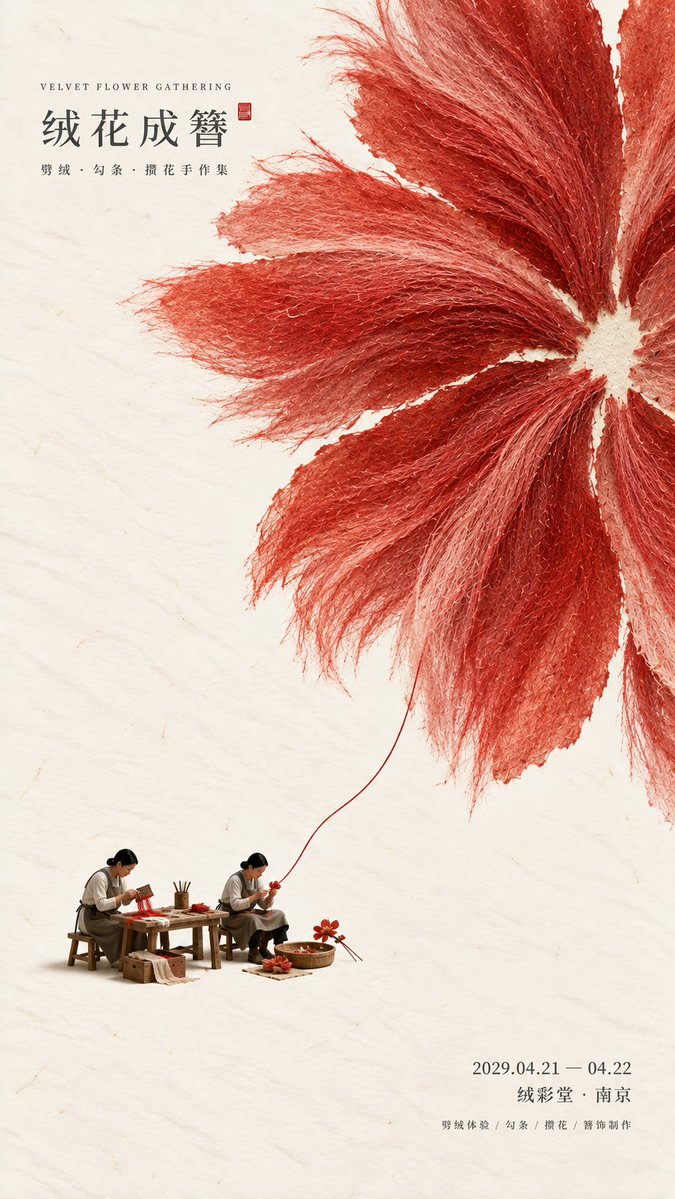
【Poster theme】 【Main title】 【Core large color field】 【Structural method】 【Dominant palette】 【Miniature cultural scene】 【Figure's action】 【Cultural artifact】 【Event information】 【Aspect ratio】 Design a modern Oriental cultural event poster centered on "paper fiber + large color field + intentional negative space + miniature cultural scene." Use a warm, soft ivory-white handmade paper as the background, preserving about 45%–60% of large-area negative space. Use the【core large color field】to establish the first focal point, and per the【structural method】form clear, methodical large-shape relationships; the theme can be expressed through radiating fibers, paper cutouts, connected cracks, positive-negative transformation, or rubbing marks, but do not turn it into an ordinary realistic object. The color field should have obvious natural paper fibers, pulp particles, watercolor or mineral-pigment sedimentation, natural feathered edges, and a matte texture. Use the【dominant palette】overall, with low-saturation yet full, dense colors; from a distance one first sees the large shape and color relationship, and only up close does one notice the material details. Near the color field, add a very small-scale【miniature cultural scene】in which figures are genuinely performing the【figure's action】; figures, tools, and the【cultural artifact】together occupy only about 3%–5%, with no staged posing or product display. The figures uniformly use a two-dimensional light-watercolor-on-paper illustration technique: simple features, light volume, complete flat color blocks, and a few continuous drapery lines, belonging to the same visual world as the paper and color field. Avoid photographic realism, 3D miniature models, CGI lighting, strong shadows, and real depth of field. Establish one real scale connection between the miniature scene and the huge main visual—such as fibers, paper scraps, cracks, repair staples, ink marks, tool trails, or the material itself—so that the "small handcraft action" naturally extends into the "large color-field structure." The main title【main title】uses a small-scale modern Song or Ming serif, placed in the negative-space area; date, location, and【event information】use an even smaller type size with restrained typesetting. The text does not compete with the main visual and includes no meaningless placeholder words. The overall reading order is: negative space and color field → structural relationship → paper-fiber texture → miniature cultural scene → craft action → title and event information. The final result is an Oriental editorial poster that catches the eye from afar and, up close, reveals paper texture, detail, and a cultural story. Avoid giant titles, ordinary Chinese-style illustration, realistic figures, 3D miniature models, photographic backgrounds, PPT grids, a commercial-ad feel, dirty old paper, random noise, CGI, glass or mirror materials, logos, watermarks, numbering, and starburst decorations.