

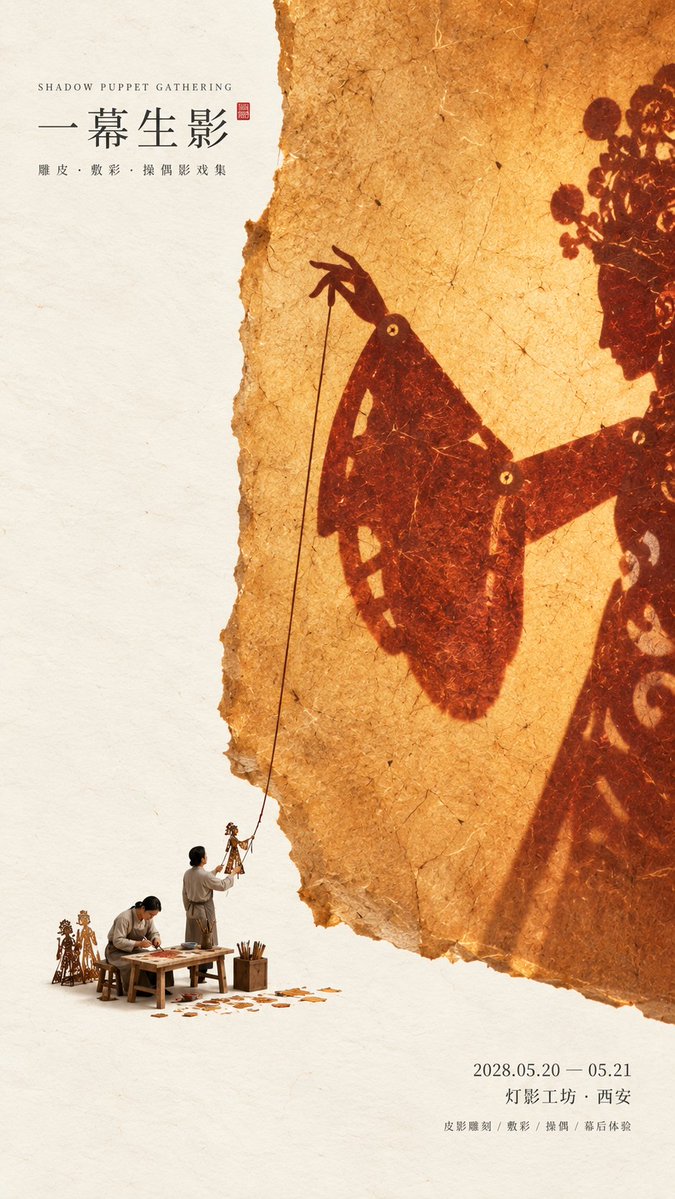
【Poster theme】 【Main title】 【Core large color field】 【Main palette】 【Miniature cultural scene】 【Core action】 【Cultural objects】 【Event info】 【Aspect ratio】9:16 vertical Design a cultural event poster with modern Oriental editorial aesthetics, using "paper fiber + large color field + deliberate negative space + miniature cultural scene" as the core visual method. The background uses soft, clean, warm ivory-white handmade paper, keeping very light natural fibers and delicate pulp texture. The composition deliberately preserves about 45%–60% large negative space, making the emptiness part of the layout; do not fill the background with lots of landscapes, plants, architecture, or decorative elements. Use the 【Core large color field】 as the primary visual subject, occupying about 25%–40% of the frame; depending on the 【Poster theme】 it can appear as a curtain, nested layers, a long scroll, thin paper, pulp, an object structure, or another large abstract form, but not as an ordinary realistic object. The color field must have a real, refined handmade-paper material feel: natural long and short fibers, pulp grains, watercolor or mineral-pigment deposits, large-scale natural color variation, faint press marks, natural deckle edges, and a matte surface. Rich in texture yet clean and intact; no grime, yellow stains, severe damage, random mottling, strong noise, or cheap vintage effects. The overall main color uses the 【Main palette】, with a restrained number of colors. Low saturation, but color fields must be complete and dense; do not interpret "Oriental feel" as faded, grayed, or aged. A tiny vermilion-red seal or a small warm-color node may serve as an accent, total area kept to 1%–2% of the frame. Near the color field, add a 【Miniature cultural scene】 of very small scale but complete narrative. Figures, table, tools, and objects together take up only about 3%–5% of the frame, so that from afar one first sees the big form and negative space, and only up close discovers the figures completing the 【Core action】. All figures must use a 2D paper-based light-color illustration language, sharing the same paper, the same pigments, and the same painterly visual language as the whole poster. Faces use only a few restrained lines and dots to summarize features; no real skin texture, pores, eye highlights, or photographic facial shadows. Bodies use only slight 2D light-and-shade for basic volume; clothing mainly uses complete, low-saturation, matte flat color blocks, with only a few continuous natural linear folds. Beneath the feet, keep only a very faint contact shadow. Forbidden: photographic realism, 3D miniature-model look, CGI volume, plastic skin, cinematic lighting, strong rim light, photographic depth of field, and strong cast shadows. Figures must look like Oriental editorial illustration painted directly on paper. Depending on the theme, add a few 【Cultural objects】 that genuinely take part in the figures' action; no tidy product display, no cluttered workbench. Objects, figures, and scene all keep the paper-based light-color and delicate fine-brush quality. Establish a clear but restrained "scale connection" between the miniature scene and the huge main visual. Depending on the theme, use a zither string, a puppet rod, a fiber, a lacquer line, a paper edge, a tool trail, or another thin line of real origin, visually linking the miniature handwork to the huge color field. The connecting element must have a real start, a complete path, and a definite end; it must not float, break, or serve as meaningless decoration. The main title 【Main title】 sits in the large negative-space area, in a slender, upright Chinese Song or Ming typeface with the air of a modern Oriental cultural institution. The title stays medium-small in scale, avoiding giant typography, making the text the second visual layer. Above the title, a tiny English event category may be added; below it, a short line of Chinese subtitle. Date, location, and event info use a smaller font, grouped in the marginal negative space, forming the information hierarchy of a real cultural poster. The overall style fuses handmade-paper collage, watercolor or mineral-pigment texture, 2D paper-based light-color illustration, miniature cultural narrative, and modern Oriental editorial design.