

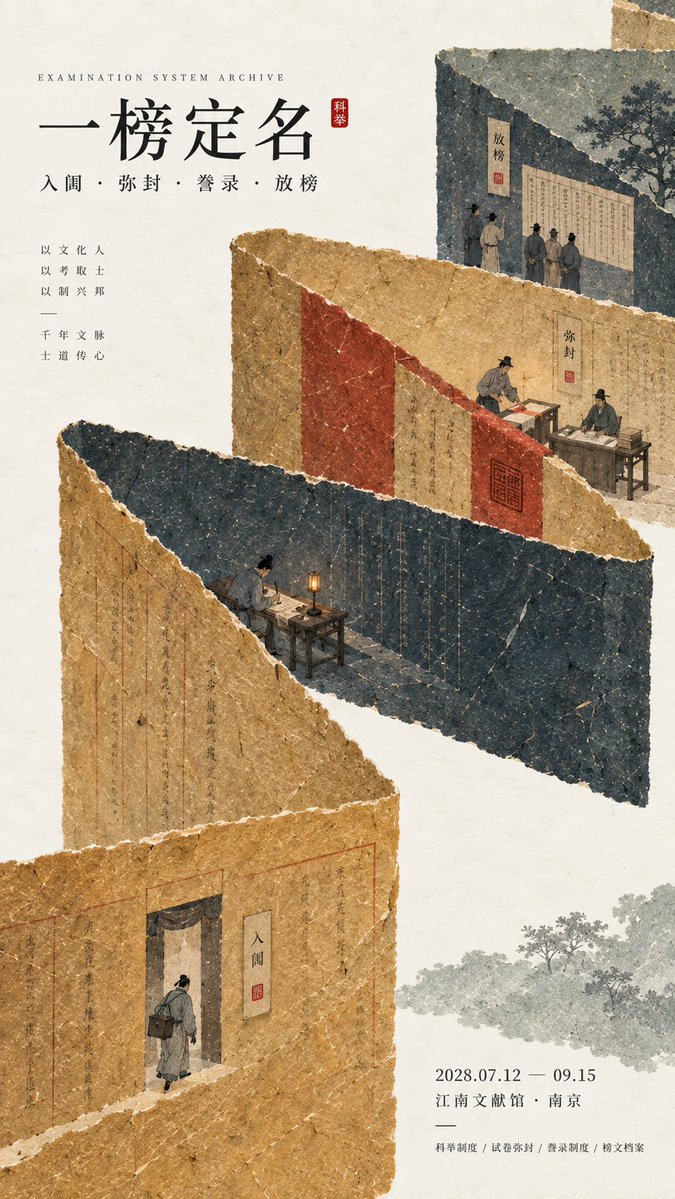
【Theme / Exhibition name】{fill in, e.g.: imperial examination system / urban night patrol / ancient water conservancy / mortise-and-tenon structure} 【Main title】{fill in} 【Core system / cultural logic】{fill in, e.g.: enter→seal→announce / evening drum→night patrol→dawn / diversion→measuring→irrigation} 【Main color field】{fill in 3–5 colors, e.g.: old wheat gold + ink cyan + cinnabar / deep indigo + gray blue + warm ochre} 【Micro-scene nodes】{fill in 2–4 continuous scenes} 【Exhibition info】{date / place / type, optional} 【Aspect ratio】9:16 vertical Design a historical-culture poster with modern Eastern editorial aesthetics, using "paper fiber + large color fields + micro-scenes" as the core visual language. Do not understand traditional culture as a pile of ancient architecture, calligraphy, auspicious clouds or artifacts; first distill the 【core system / cultural logic】, then let large handmade-paper color fields directly carry structure, space, time, flow, order or process, so that from afar one first sees a strong, clear large form, and only up close gradually discovers the hidden cultural narrative. Use the 【main color field】 to build 2–5 primary paper color blocks of distinctly different areas, keeping low saturation but full color density. All blocks have rich, real texture of handmade paper, pulp, watercolor or mineral pigment, with visible natural long and short fibers, pigment sediment, slight press marks, large-scale natural color variation and irregular torn edges; overall matte, clean and complete, with no dirtiness, yellow stains, random mottling, cheap retro or digital gradients. According to the theme, let the color fields express the system's operating logic through folding, branching, interweaving, interlocking, layer offset, supporting, segmenting, enclosing or negative-space relations, rather than as mere decorative background. Embed the 【micro-scene nodes】 in the large color-field structure, keeping figures and props at a very small scale, about 3%–6% of the frame overall. Each scene must show a clear action and have causal or temporal relations with one another, e.g. "enter→execute→record→complete", so the tiny figures truly carry the narrative rather than posing statically. Costumes and objects match the theme's era and status but stay restrained, not a cinematic period blockbuster; the scene keeps only the key props that explain the system relation, without piling on decoration or irrelevant cultural symbols. The layout uses the editorial language of modern Eastern cultural institutions, museums or archive exhibitions. The main title 【Main title】 uses a refined Song/Mincho or publishing-feel Chinese typeface, kept at small-medium size, not overpowering the large color fields; auxiliary English, dates, places and captions use smaller size, forming a clear hierarchy. You may add very few cinnabar seals, paper tags, archive labels or node text, but they must have a real relation to the theme's logic, never random decoration just for "national style". The reading order should be: large color-field structure and color relations → system or spatial logic → continuous narrative of tiny figures → main title and exhibition info. The final image should have a strong large form and visual impact from afar, and paper fiber, figure action and historical detail up close, combining design sense, narrative sense and cultural completeness. Avoid book-cover feel, traditional old-style illustration, screen-filling ancient architecture, huge titles, regular PPT-style layout, modern infographic arrows, meaningless placeholder English, element pile-up, commercial ad feel, 3D CGI, glass material, neon colors, logo, watermark, numbering and starburst decorations.