

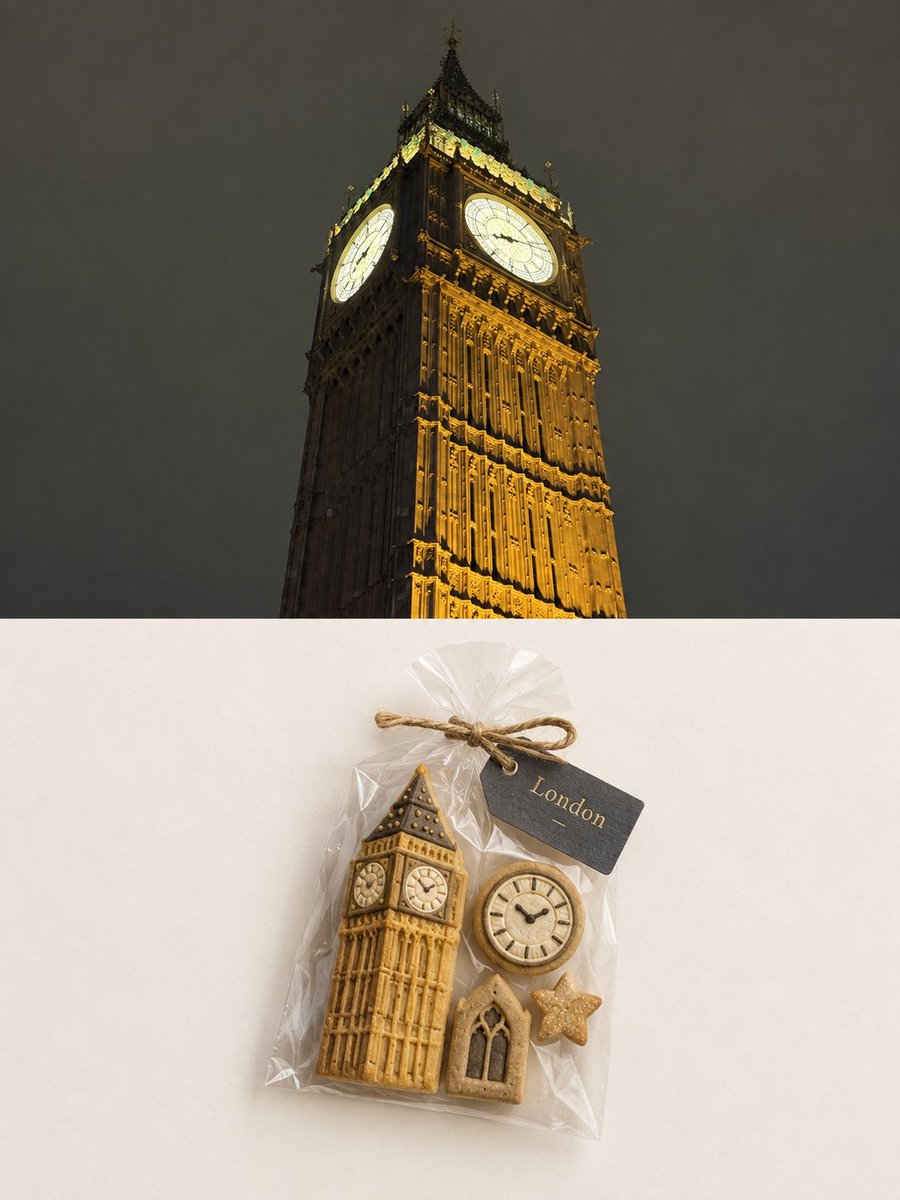
Carefully observe each uploaded photo one by one and turn each one into an independent design poster. Do not combine multiple photos into a collage. Always output one artwork per photo. The overall format should be a 3:4 vertical composition. Divide the canvas exactly in half horizontally, 50% top and 50% bottom. Top 50% = Original photo Bottom 50% = A small handmade cookie set inspired by the photo 【Top Half | Original Photo | Most Important】 Use the original photo as-is. Do not replace the person, cat, dog, animal, building, flower, food, object, landscape, or any other subject with something different. Accurately preserve the face, expression, eyes, ears, hairstyle, fur color, patterns, body shape, posture, pose, clothing, belongings, orientation, colors, lighting, and overall atmosphere. Only extend the background naturally if necessary. Do not distort or alter the main subject itself. 【Bottom Half | Small Handmade Cookie Set】 Carefully observe the original photo and choose one main subject that best represents the image. Create one “main subject cookie” that recreates that subject, plus 2–4 “related mini cookies” naturally inspired by the subject, location, season, event, or atmosphere of the photo, for a total set of approximately 3–5 small cookies. For example, if the main subject is a cat, create the cat itself plus items such as a fish, treat, ball of yarn, paw print, or toy, selecting whatever best suits that specific cat and photo. Do not use the same combination every time. Design the contents individually for each photo. 【Most Important | Do Not Generalize the Main Subject】 Do not replace the main subject cookie with a “generic cat,” “generic dog,” “generic person,” or other generalized version. The cookie must represent the exact individual, animal, or object shown in the original photo. Pay especially close attention to: * Face shape * Expression * Eye shape * Ear shape and angle * Hairstyle * Fur color and patterns * Body shape * Orientation * Posture and pose * Distinctive belongings or accessories Match these details to the original photo as closely as possible. For a cat, it should not merely be recognizable as “a cat.” When compared with the photo above, the highest priority is that it feels like: “This is exactly this cat!” If the subject is shown in profile, keep it in profile. If it looks sleepy, preserve the sleepy expression. If it is sitting, recreate the same sitting pose. Do not arbitrarily turn it to face forward or change it into a different pose. 【How to Make the Cookies】 Do not print the photograph onto a cookie. Instead, cut the cookies into the actual shapes of the main subject and each motif. Do not simply draw brown line art onto ordinary round cookies. Recreate the defining characteristics using methods that would realistically work for handmade cookies, such as the outer silhouette, shallow embossed details, and natural variations in dough color. 【Rustic Handmade Feel】 All cookies should be quite small, miniature-sized cookies. Do not make them perfectly polished like mass-produced products. Preserve details such as: * Slightly uneven outlines * Subtle distortions * Asymmetrical shapes * Uneven thickness * Tiny cracks or air bubbles * Rounded edges * Natural variations in browning They should not look like failed cookies, but rather have the charming irregularity of cookies individually cut and baked by hand. However, the handmade quality must not distort the main subject’s face or distinctive characteristics to the point that it looks like a different subject. 【Packaging | Change It for Every Photo】 Arrange the 3–5 mini cookies together in one small package. Do not use a fixed color, pattern, material, string, or small tag for the packaging. Design these automatically based on the original photo. Extract 2–3 colors from elements such as the subject’s fur, clothing, flowers, scenery, season, sky, lighting, or accent colors, and turn them into a soft, slightly desaturated palette. If a pattern is used, make it a subtle hand-drawn pattern based on small motifs inspired by the photo. Do not print the photograph itself. Choose a packaging material that suits the photo, such as: * A transparent bag * Semi-transparent glassine paper * Wax paper * Natural off-white tissue paper * A small paper bag Preserve the warmth of hand-wrapped packaging with natural wrinkles, slightly uneven folds, and minor misalignment. 【Most Important | Do Not Decorate the Background】 The background of the bottom half must consist only of very pale, plain paper that harmonizes with the photo, such as: * Cream white * Ivory * Natural off-white * Light beige * Pale gray-white Do not add any flowers, plants, dishes, props, ribbons, paper scraps, patterns, illustrations, or other decorations to the background. Nothing should be placed there except the packaged cookie set. Leave a generous amount of empty space. 【Most Important | Keep the Entire Set Small and Compact】 Not only the cookies, but the entire set including the packaging should appear quite small. As a guideline, the full package should occupy only about 25–30% of the width of the bottom half. Do not enlarge it so that it fills the bottom section. The composition should feel like one small bundle placed casually near the center of a wide field of plain empty space. The little package should feel compact, soft, and slightly plump, almost as if it has simply been set down there. It may sit at a slight angle, and the mini cookies inside may overlap naturally. However, the face, shape, and distinctive features of the main subject cookie should still be clearly recognizable. Use soft natural light and only a very faint contact shadow. Do not make the package float in midair. It should feel naturally placed on real paper. 【Final Image】 Top 50% = Original photo exactly as-is Bottom 50% = Main subject cookie closely resembling the photo + related mini cookies inspired by the photo + custom packaging designed specifically for that photo The main subject should have the same face, expression, orientation, posture, and defining characteristics as in the original photo. The cookies should be small, slightly uneven, rustic, and handmade. The packaging should change in color, pattern, and material depending on each photo. The background must remain completely simple and plain. The entire set should be quite small, sitting compactly within a large amount of empty space. When comparing the photo above with the cookies below, the finished artwork should make the viewer feel: “This photo has been transformed directly into a tiny handmade cookie set!”