

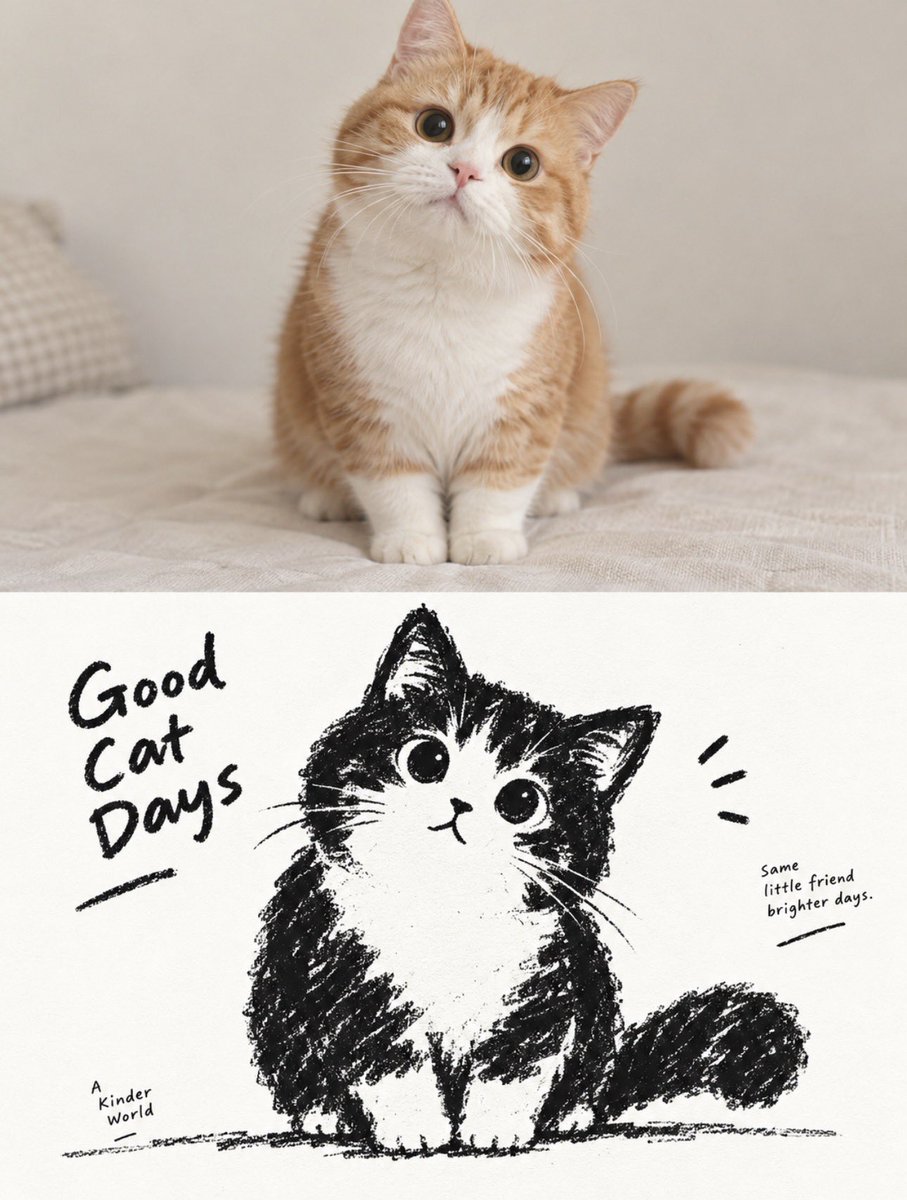
Create a vertical "top-bottom dual-panel" style poster, with the canvas strictly divided into two areas, keeping ample white space overall, a quiet mood, and a refined children's-book editorial feel. Top half: Show the original photo uploaded by the user. The subject is limited to people, pets, animals, or the interaction between people and pets, preserving the subject's real photographic state, including shape, fur or skin color, hairstyle, clothing, posture, action, expression, and overall temperament. The top half should not be repainted in an illustration style; it should look like a clean, real, clear reference photo. The background may be moderately simplified and cropped, but do not let buildings and environment become the protagonist; the focus is always the human or animal subject. Bottom half: Extract the same subject from the top photo and reconstruct it as a minimalist thick-black dry-media silhouette illustration. Do not mechanically trace the photo's details; instead compress the subject into rounded, sturdy, slightly naive summarized forms, moderately enlarging the head, face, ears, hand gestures, tail, body contour, or the most memorable part, so it remains recognizable at a glance with minimal information. If the photo contains multiple subjects, preserve the most important interaction, treating them as one whole visual unit rather than distributing focus evenly. Use only a near-pure-white paper ground + dense black crayon, charcoal, or dry-scrub marks; no color, no grayscale gradients. The black forms are not smooth solid vector blocks, but formed by short, forceful, repeated crayon strokes, preserving paper grain, broken strokes, pressure marks, rough edges, uneven density, and partially exposed white. The contours wobble slightly, are incomplete and imprecise, keeping a genuine handmade feel. The subject's most crucial recognition features can be reinforced through "white feature areas suddenly cut out of the black silhouette," such as a person's facial contour, the area around the eyes, hairline, mouth shape, a pet's face, muzzle area, chest pattern, an object's core structure, or the most recognizable part; then complete the expression and details with very few black dots, short lines, or symbols. Do not pursue realistic features and precise structures, but let black and white form a direct, fun, and strong recognition relationship. Keep the composition with large areas of pure white + one main visual relationship. The subject can float centered, or be slightly offset, partially cropped, or placed near the bottom of the frame, using only a rough ground-friction line, a few short lines, or very few environmental symbols to hint at space. Grass blades, wind, tabletop, ground, smoke, road, shadow, or other environmental information should all be compressed into very few crayon marks, keeping the background quiet and empty. Overall, do not pursue complex scenes, but let one posture, action, distance, or relationship carry the main narrative. Keep a small text system that combines refined editorial feel with children's-book feel. Do not just write the location or object name, but extract a short English title from the emotion, action, relationship, time, or tiny story in the photo, paired with numbering, a fitting aphorism, chapter number, or one very short, understated caption. The text can be restrained typographic small print, or include a very small amount of clumsy handwriting, crayon lettering, or not-quite-regular letterforms, so it seems to originally belong to this illustration. The text needs to form a clever relationship with the shapes: it can align along the ground line, extend in the direction of the subject's motion, hide in large white spaces, slightly overlap the contour, wedge into the negative space between two subjects, or connect the numbering to the subject with a thin line. Keep "one short title + 1–2 groups of tiny auxiliary text," making the text part of the composition's rhythm rather than an ordinary poster title. Overall present the visual features of "real original photo on the top + thick black, clean white, simple forms, rough texture on the bottom," maintaining a subtle balance among the childlike, soft, quiet, humorous, and lonely, like an old black-and-white children's book re-edited by a refined design studio. Avoid smooth digital outlines, precise line art, realistic light and shadow, thick paint, three-dimensional effects, color, large-area gray rendering, cartoon-sticker feel, and templated commercial illustration.