
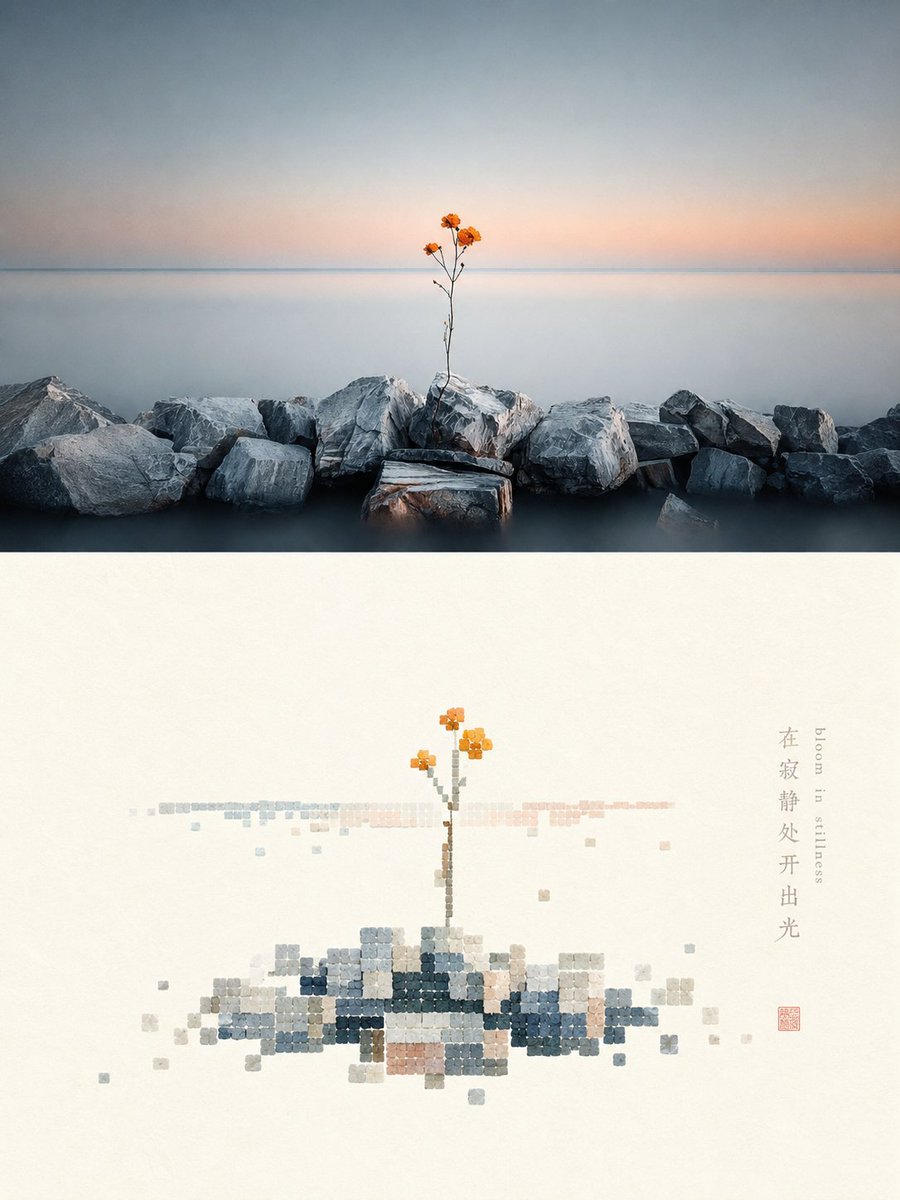
Turn each photo I upload into a separate high-end design poster, without multi-image collage; each photo is output individually. Use an overall 3:4 vertical composition, with the top and bottom areas strictly 1:1 in height, each taking up 50% of the frame. In the top half, keep the original photo, preserving the subject's identity, structure, pose, real texture, natural light and shadow, and original color atmosphere; apply only slight high-end color grading so it has the texture of an art magazine, independent publication, and exhibition image. To fit the format, you may naturally extend the environmental background, but must not stretch, distort, or alter the subject. In the bottom half, first understand the most memorable **subject, basic composition, perspective relationships, structural flow, visual memory points, and overall mood** of the original photo, then reconstruct them into a minimalist pixel landscape with a material-collage feel. Do not fully copy the photo; remove irrelevant details and keep only the most representative structure, flow, and visual memory points, re-summarizing them through the order of regular blocks and the texture of natural material, so the correspondence with the photo above is recognizable at a glance. The pixel modules are not standard digital color blocks, but resemble **small square and near-square fragments cut from rough shells, thin shell flakes, or natural mineral shell layers**. Keep a clear geometric grid order, but edges may be slightly chipped and not fully regular; the surface carries natural layering, powdery grain, slight bumps, wear, and uneven color, dominated by a matte, natural, gentle material feel. The subject's core area is formed by relatively dense modules, while toward the edges they gradually decrease, go missing, break off, and float, letting the form dissipate naturally from clarity into blank space. Strictly control the total number of modules, no more than 200 overall, each module uniform or nearly uniform in size, avoiding fine noise, standard mosaic, and game-pixel feel. The composition maintains the relationship between a **small-scale seal and large areas of blank space**, arranging the position freely according to the subject's own direction, proportion, and visual center of gravity, which may be off-center, edge-aligned, suspended, or partially cropped. The subject takes up about 30%–45% of the bottom half, and the rest of the space is actively left empty. Blank space is not an empty background, but a compositional element as important as the subject, module density, and dissipating edges; through positive and negative shapes, density, clustering, and asymmetrical balance, it establishes breathing, spatial feel, and pause. Prefer to cut information rather than fill the frame, making the subject look like a material seal carefully placed on a large sheet of paper. The colors are re-mixed by extracting the **brightest, most vivid, most vital colors** from the photo above, rather than averaging color or faithfully copying the original values. Moderately raise brightness, purity, and transparency overall, naturally deriving from the original bright integrated colors such as clear sky blue, lake teal, tender green, warm yellow, coral orange, and peach pink, forming a warm and healing color rhythm through fresh warm-cool relationships. Use plenty of pure warm white or very light near-white tones harmonized with the original's integrated color temperature as breathing space; the main colors are bright and spirited but not glaring, and local warm orange, gold, coral red, or soft pink can serve as sunlit accent colors. Preserve the shell material's own slight natural color variation and layering, but avoid letting it turn gray, aged, or dirty because of this. Avoid dirty gray, aged look, dull Morandi tones, dark brown filters, gloomy earth colors, fluorescent colors, and cheap candy feel. Text intervenes only as a minimal editorial touch, with no language restriction and no preset fixed title or numbering. You may freely extract a few words or short phrases from the subject, location, action, emotion, or metaphor of the photo, placed quietly in the blank space or at the subject's edge, forming a refined image-text relationship with the material modules without stealing the spotlight. Overall, present a high-end visual effect composed of **natural material collage, shell-textured pixels, regular geometric order, gradual dissipation, small-scale seal, large areas of artistic blank space, and modern editorial layout**, more like a reconstruction poster from contemporary material art and a design studio than ordinary digital pixel art. Avoid fully copying the photo, complex backgrounds, real details, standard solid color blocks, smooth vectors, plastic mosaic, strong pearlescence, game-UI feel, filled frame, excessive text, and templated effects.