
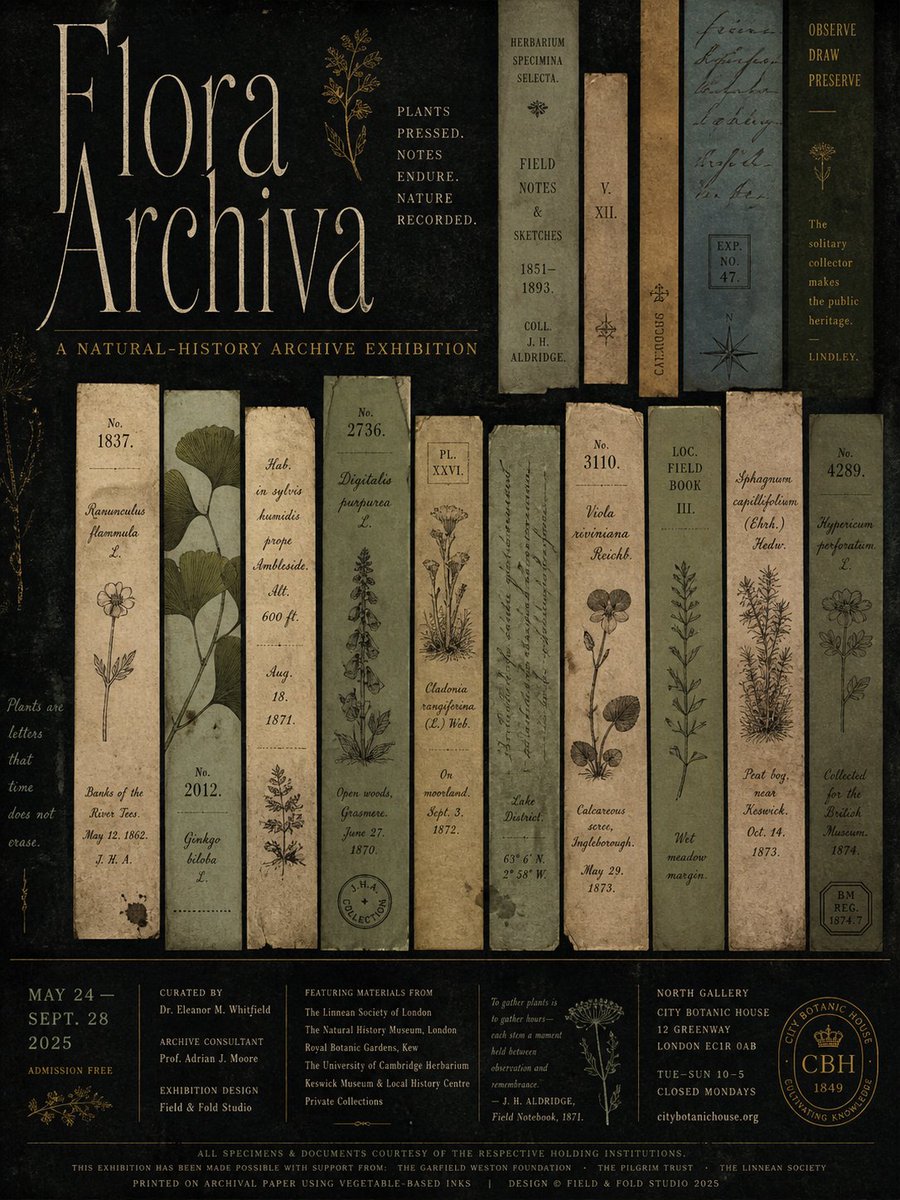
Build a book-slip exhibition-poster composition around any chosen subject: a deep, low-brightness patterned ground occupies the whole scene, with texture like darkened fabric, old-paper rubbings, or dark printing texture that only reveals its patterning and friction marks at close range. Break the subject information into multiple narrow, tall vertical color strips that fall from the upper edge of the frame, sitting tightly against one another or leaving hairline gaps, forming a reading rhythm of juxtaposed antique book fragments, scroll labels, and museum-catalog slips. Place the largest title slightly right of center, set in thin, bony calligraphic structures with elongated strokes and open whitespace; ink-black or pale lettering strongly contrasts with the dark ground, and some strokes may press close to the edges of the color strips, making the text look cut out of the black field. The vertical strips on both sides and above carry subject-derived short phrases, symbols, handwritten marks, or dense annotations, with tight letter-spacing and long columns, markedly varied sizes, forming a multi-level read from the large title to fragmentary information to bottom notes. Colors are derived from the subject content but keep role relationships: large areas are a low-value near-black background; the main paper slips use oxidized-paper tones, mineral blue, pale cyan, or subject-matched low-saturation mid-value colors, with a little gold or warm color as narrow-strip accents and to light up fine text; the overall mood should be restrained, antique, and quiet, the bright parts like old paper and mineral pigments lit in the dark rather than clean new printing. Paper surfaces retain fibers, specks, fading, local staining, ink bleed, and slight edge wear, concentrated on the paper, lettering, and column boundaries, while the dark ground stays heavy and intact. Text and texture must interlock: handwritten lines may float, break, and press over the paper grain; tiny museum-catalog-style information gathers at the bottom forming a dense footnote zone but must not overpower the central title; keep the unevenness within a strict array, the clear order within the traces of old objects.