
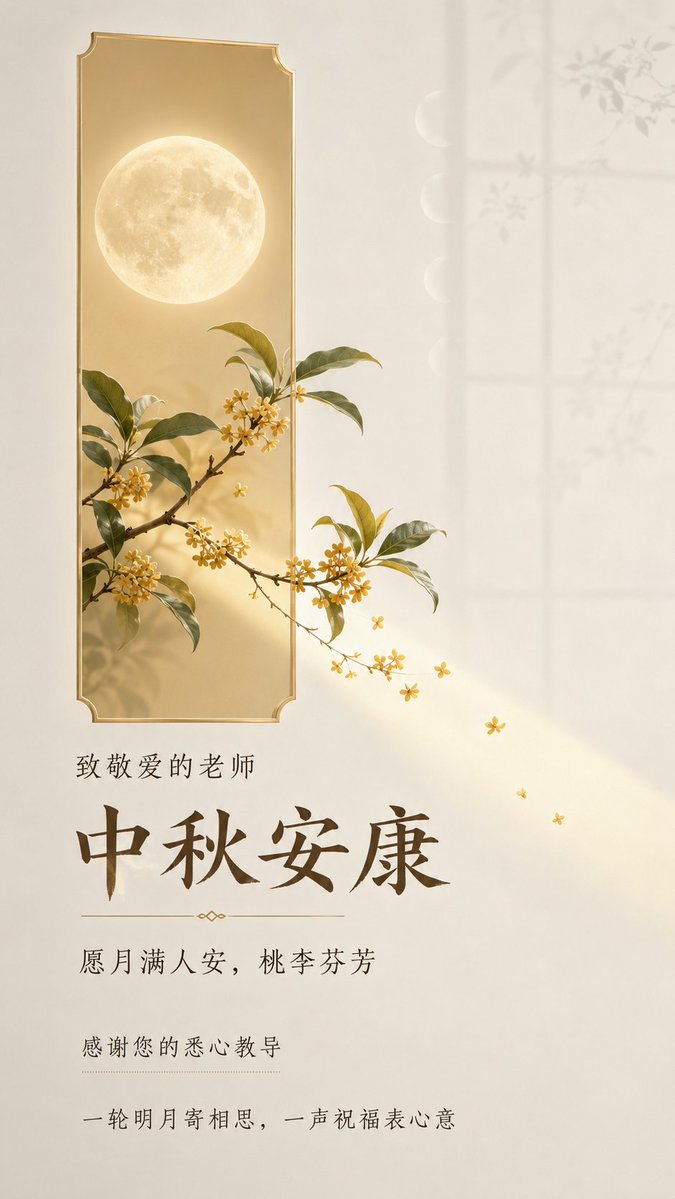
@CreateImage Design a vertical Mid-Autumn teacher-greeting poster for the WeChat chat window and mobile forwarding, aimed at a respected teacher, with short viewing time but full readability, information density between text-light and standard. The core visual language is "real objects passing through a geometric emotional window": a realistic full moon, an osmanthus branch and a few osmanthus blossoms as the subject, expressing the single visual event of "moonlight and blessings passing through the window to reach the teacher." Place a narrow, elongated, low-saturation light champagne-gold geometric block as the visual anchor and spatial container, like a quiet emotional window lit by moonlight, keeping clear, controlled edges and slight translucency. The full moon sits inside the window; the osmanthus branch naturally emerges from one end, and leaves, blossoms and a sliver of moonlight cross the boundary and extend into the large outer whitespace, creating real spatial penetration; the subject must not be fully trapped by the block, nor become a decorative icon. The background is a topic-related "moonlit classroom air field": whitespace from warm ivory to very light misty gray, like moonlit air by a classroom window at night, keeping in the distance only very faint, nearly transparent window-lattice outlines and a soft moon-phase arc, letting the subject emerge from a quiet distance and reserving a truly clean breathing zone for text. Add only a few fine-line moon phases and osmanthus-branch shadows causally linked to the theme, with a complete, clean, matte surface and only subtle controlled luminance variation; no irrelevant scenery, crowded decoration or dramatic dark fields. The text must accurately render the following Chinese, with no pseudo-text, garbled characters, extra English or unapproved content, keeping natural, clear Simplified Chinese glyphs: 1. "中秋安康"—main title, the first reading entry, a gentle yet solemn high-recognition title lock. 2. "致敬爱的老师"—the addressee, a short kicker, forming a warm identity confirmation with the main title. 3. "愿月满人安,桃李芬芳"—festival wish, an authored expression, the emotional promise after the main title. 4. "感谢您的悉心教导"—teacher-student sentiment note, an authored expression, appearing as a short line or light callout, carrying the thank-you function. 5. "一轮明月寄相思,一声祝福表心意"—closing copy, an authored expression, as a quiet bottom/edge caption line, completing the reading loop from festival to gratitude for the teacher. Reading order: addressee → main title → festival wish → thank-you note → closing copy. The text forms 4 readable blocks: kicker and main title adjacent but hierarchically distinct; the wish as an independent soft short line; the thank-you note and closing copy forming a light coda. Most of the whitespace stays text-free, giving the moonlight window and boundary-crossing subject ample room. No dates, school, names, institution, contacts, event location or signature, since none were provided and should not be fabricated. The composition adopts a complete editorial greeting poster: the geometric window and realistic moon-osmanthus subject form the sole visual focus; text is organized naturally along the relationship of moonlight overflowing from the window, forming a gentle reading path from the addressee above to the title near the subject and the blessing coda below; the text does not float over an irrelevant image but echoes the window edge, moonlight and whitespace. Preserve Eastern whitespace, modern order, natural vitality, light-luxury quality and restrained editorial temperament, avoiding template-like stacking. Colors use a warm, low-saturation moonlight scheme: ivory and very light misty gray as large-area space; the light champagne-gold window and soft moonlight carry the festive warmth; the moon face is natural warm white; osmanthus and foliage use real but restrained pale gold, olive green and a little dark grayish brown as visual anchors; text uses soft dark grayish brown rather than pure black. Keep high luminance, low to mid-low saturation and soft contrast, so the viewer feels peace, warmth, respect and being tenderly remembered; clear separation between subject and whitespace, but the whole is not heavy, not noisy, without highly saturated festive red-gold. Typography adopts a modern humanist editorial temperament suited to Chinese mobile reading: the main title is a clear, slightly bookish, steady Chinese display glyph, strokes with a warm handwritten touch but precise, complete edges; auxiliary text in light, regular, spacious Chinese layout creates rhythm, distinguishing addressee, wish, thank-you and closing by weight, density, whitespace and line length, not turning everything into same-size centered stacking. Text enters the scene like moonlight, gaining emphasis near the window edge and receding moderately into the whitespace; keep natural Simplified Chinese legibility, all glyphs complete and clear. The subject adopts fine realistic photographic quality: the moon face has restrained real ring-shaped shading and a soft halo; the osmanthus branch has slender twigs, clustered small flowers and leaves with recognizable natural form and delicate layering; finished with soft diffuse moonlight, a clean matte surface, precisely controlled edges and natural spatial depth; no heavy shadows, no cartoonization, no 3D icons, no watermark, no UI elements, no pseudo-text, no causeless symbols, no cheap template feel. THEORY_LOGIC = SET[whitespace composition::visual metaphor::editorial hierarchy] || SYNTHESIS[use the window as a relationship boundary, letting moon and osmanthus cross into the quiet whitespace; use main title, wish, thanks and closing to form a progressive rhythm from recognition to emotional resonance, keeping the teacher-gratitude theme clear, gentle and respectful in fast mobile reading] METAPHOR_LOGIC = moonlight passes through the emotional window, carrying the Mid-Autumn reunion and osmanthus fragrance across the boundary to the teacher, and the whitespace becomes the quiet space where gratitude is heard.