
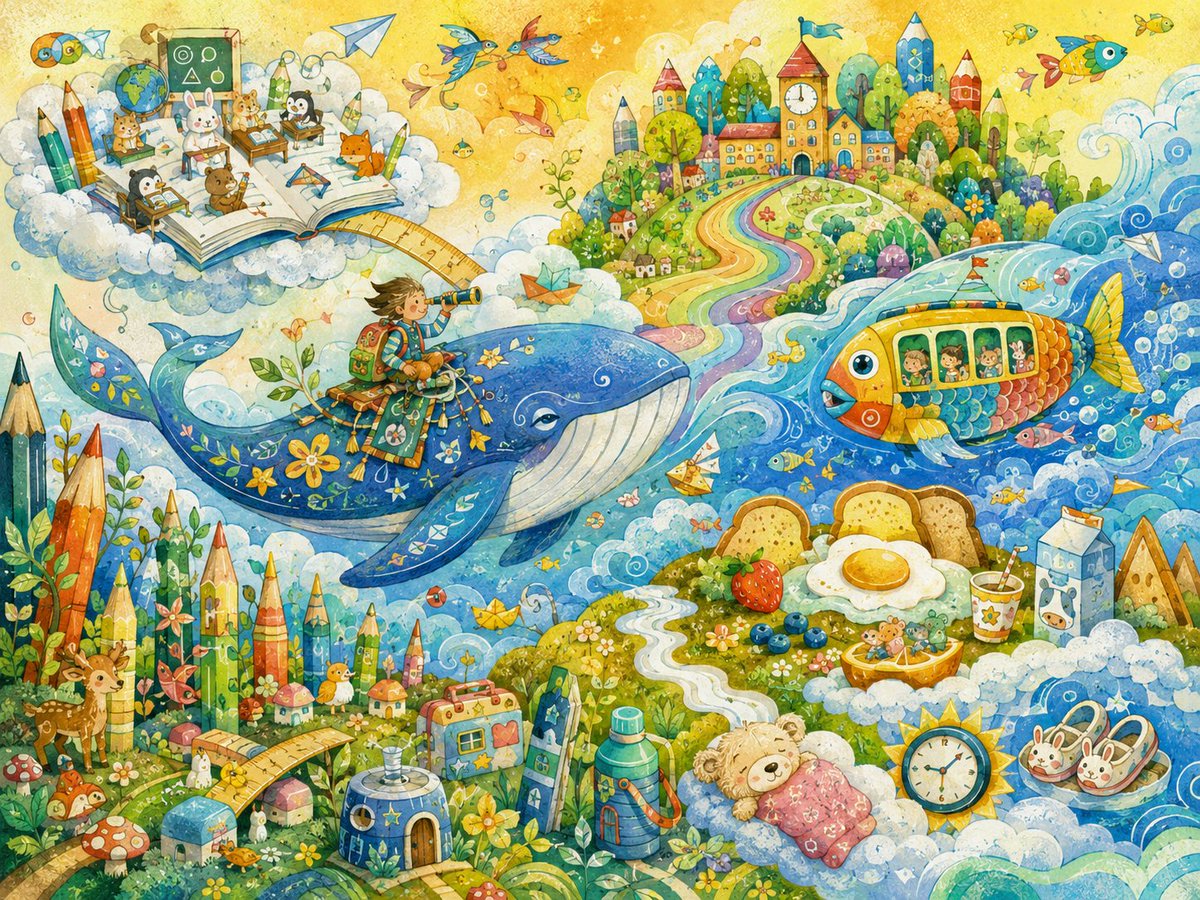
Child’s dream: [Describe what the child remembers from the dream in their own words] Main character: [child / pet / family member / toy / other] Important details: [people, animals, places, objects, colors, feelings, strange moments] Dream mood: [happy / magical / funny / adventurous / strange / slightly scary / peaceful] Aspect ratio: [wide landscape, around 1.41:1] Turn the child’s dream into a richly illustrated dream world. Use the dream description as the story foundation, but don’t simply depict one literal scene. Expand it into one main event plus several interconnected mini-stories, as if different fragments of the same dream were unfolding together on one page. Transform familiar memories and everyday objects into imaginative dream elements: bedrooms can become landscapes, blankets can turn into rivers, books can become mountains, toys can come alive, houses can fly, animals can travel through the sky, and ordinary objects can quietly change into something magical. If the dream is happy or beautiful, preserve its warmth and sense of wonder so it feels like a memory worth keeping. If the dream is strange or slightly scary, keep the important story elements but reinterpret them through a gentle, colorful, child-friendly visual language — mysterious rather than frightening, imaginative rather than dark. Create a layered composition with several large flowing shapes, medium-sized story scenes, and many small discoveries hidden throughout the image. Every area should contain a little story, while the whole image still feels like one continuous dream. Visual style: colorful hand-painted watercolor storybook illustration × contemporary folk art × naïve art. Use clean, bright and cheerful colors: golden yellow, turquoise, sky blue, mint green and jade green, with accents of coral orange, soft pink and cream white. Keep all colors fresh and clear with smooth, natural transitions. Use only subtle watercolor texture. Avoid muddy colors, black speckles, dirty stains, rough pigment granulation, distressed textures, heavy paper aging or dark gray-brown shadows. Use fine, smooth, continuous colored outlines instead of heavy black outlines. Keep curves, clouds, plants, water, characters and decorative shapes clean and flowing. Keep the image mostly flat and decorative rather than realistic 3D. Avoid miniature-model aesthetics, photorealism and dramatic cinematic lighting. The final image should feel like a child’s dream has been turned into a colorful watercolor painting they can actually see, talk about, and keep as a memory. No readable text, logos, borders or watermarks.