
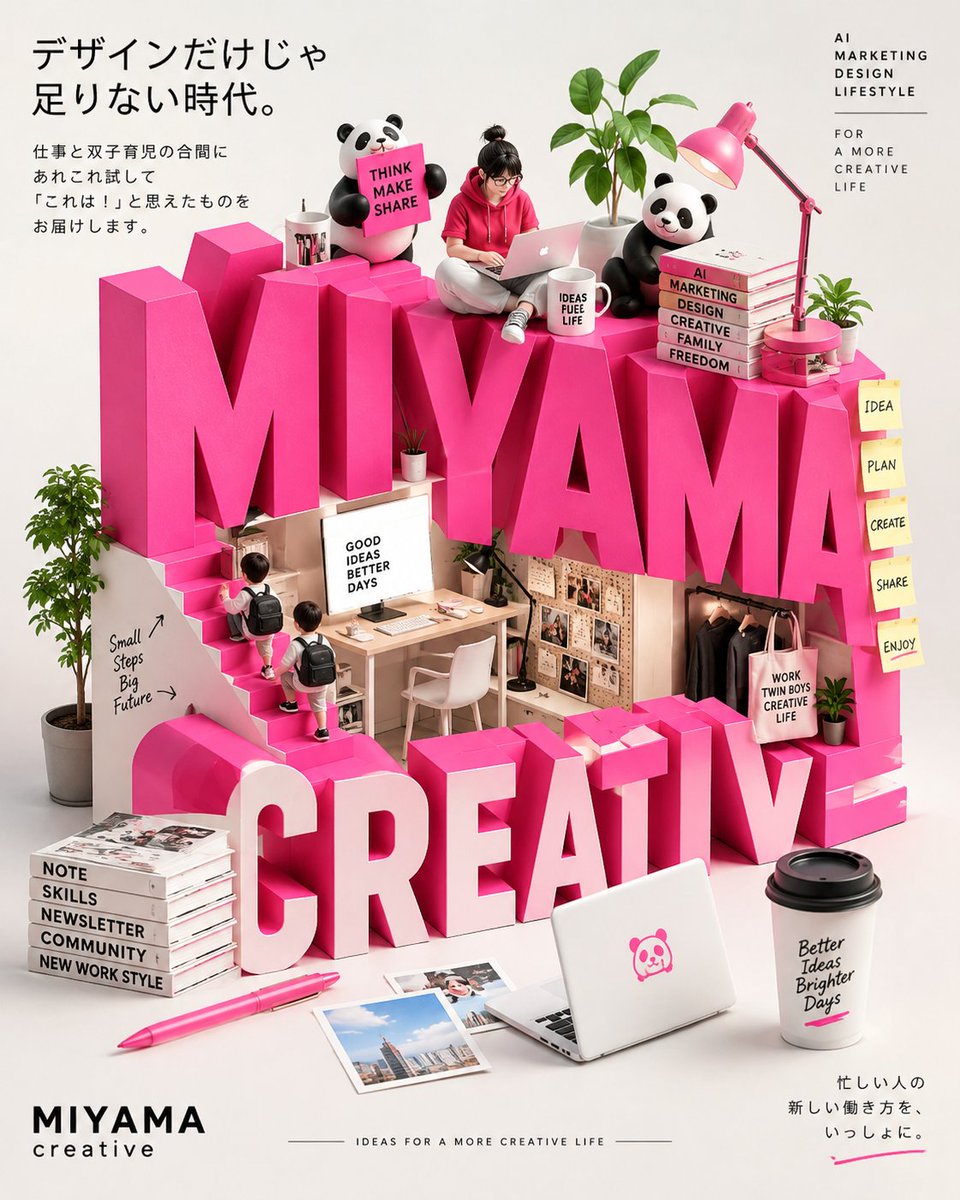
You are a top-tier advertising creative director, art director, 3D artist, brand designer, typographer, UX designer, and marketer. Read the attached social media profile, X, Instagram, note, landing page, or post screenshot, and translate the essence of that person, brand, or service into a **3D miniature editorial diorama with high-budget advertising quality**. Do not show explanations or analysis; generate only 1 finished image. ## Input Brand name / person name {{If blank, read from the attached image}} Product / service / activity {{If blank, read from the attached image}} Japanese copy {{One short phrase. If blank, the AI completes it}} English copy {{If blank, reconstruct into 1–3 words from the brand's philosophy}} Supplementary information {{Maximum 3 items}} Size / ratio {{Vertical 4:5}} Use {{Social media post / brand announcement / note announcement / course ad / service introduction}} ## Concept Do not reproduce the social media screen. From the attached image, extract the brand's philosophy, target audience, emotional temperature, colors, and value provided, and convert them into **a single symbolic three-dimensional world**. The goal is: **Giant dimensional typography × a small theater of figures × a precise advertising model** Design it so that the brand's philosophy itself becomes architecture or a stage, with figures acting within it. Symbol, not explanation. Impression, not information. Worldview, not self-introduction. ## 3D space At the center, place a **giant Latin-letter typography of 1–3 words** symbolizing the brand as a three-dimensional structure. Use a bold, strong sans-serif or a condensed sans-serif, and make the letters function as: - architecture - walls - stairs - pedestals - floors - bridges - workspaces Embed figures, furniture, and small objects inside, in the gaps, and on top of the letters, creating a composition where **the typography itself becomes the world**. ## Figures and motifs 1 to 3 figures. Place them small and symbolic, drawing appeal from pose and action rather than the face. According to the brand content, choose **one action symbolizing experiential value**: writing, thinking, arranging, carrying, assembling, climbing stairs, etc. Up to 3–5 motifs. Examples: pen, notebook, smartphone, color chips, paper scraps, card, light, ruler, an abstracted digital window. Do not literally describe the work; visualize the transformation: **thoughts get organized** **vague sensations take shape** **taste is cultivated** **ideas get assembled** ## Art direction Give it the texture of an advertising model actually built and photographed. Use matte paint, cardboard, printed paper, wood, foam board, resin, acrylic, etc., naturally expressing material thickness and contact shadows. Not a toy, but a **high-end visual of an art set built and photographed by an advertising agency**. Extract the color palette from the attached image and organize it into 4 colors at most: - base color - giant typography color - complementary or structural color - small accent color Limit the accent to only a few spots; do not spread the colors evenly. ## Composition and shooting Vertical 4:5. Use a slight overhead view at about 30–45 degrees as the base, with a composition that makes the entire diorama understandable at a glance. Keep the leading three-dimensional world at about 60–75% of the frame, leaving sufficient white space. Guide the gaze in the order: **giant typography → figure theater → information device → supplementary information** Use soft directional light, natural contact shadows, and moderate depth of field for a bright, clean, high-end advertising shoot. ## Typography English dominant, information minimal. 1. Giant dimensional Latin letters, 1–3 words 2. Brand name or English title 3. Japanese copy, one phrase 4. Supplementary information, maximum 3 items Place Japanese small and neat; long text or white-band copy is forbidden. Within the diorama, place **only one small information device** — a sign, card, tag, label, or signboard — with the brand name or copy. ## Automatic optimization Automatically adjust the architectural shape, materials, figures' action, camera, palette, and information density according to theme and audience. Do not make all dioramas the same. Creative fields: experimental and editorial. Tech fields: structural and intellectual. Beauty fields: a sensory, refined space. B2B: a precise, trustworthy model. Lifestyle fields: keep a sense of warmth and play. ## Forbidden - Reproducing the social media screen - A mere dollhouse - A merely cute miniature - Pixar style, game style, toy-ad style - Anime pretty-girl style - Large bust-up of figures - Giant serif letters - Large amounts of Japanese text - White-band copy - Many small objects or icons - A cluttered composition - Cheap glossy CG - Excessive metal, glass, gradients - Canva-template style - YouTube-thumbnail style - Info-product-ad style ## Finish The finished image should be a **precise, conceptual 3D miniature advertisement that converts the brand's philosophy into giant dimensional typographic architecture, within which a small theater of figures unfolds**. It should convey a strong silhouette and worldview even at a glance on a phone, and when zoomed in, reveal a design beautiful down to the details, at a level of completion that withstands even highly discerning designers.