
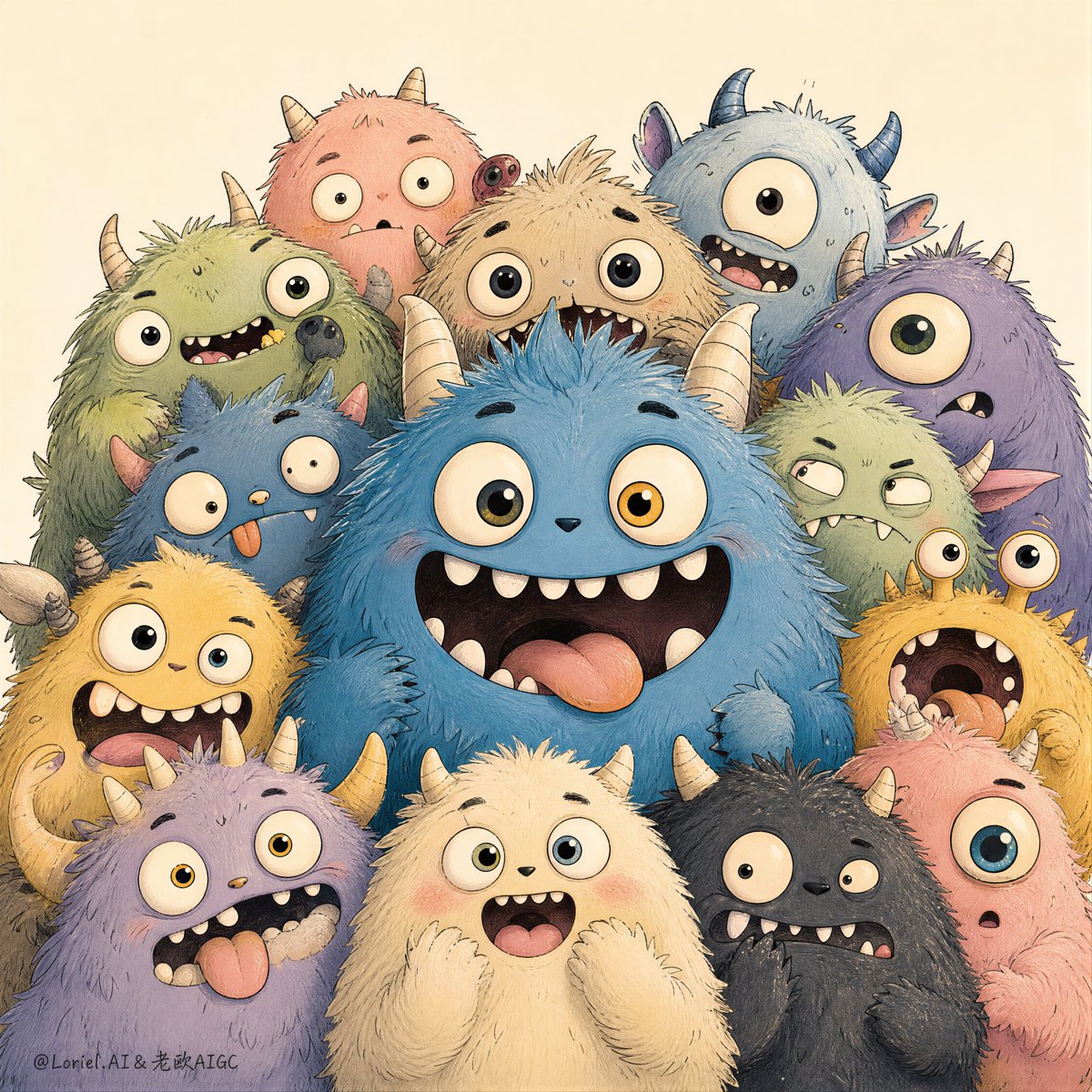
Create an ultra-premium whimsical monster-cluster poster in a dense hand-drawn storybook illustration style, preserving the exact core visual logic of a tightly packed group portrait of odd little creatures while pushing the composition into a more iconic, more centralized, more collectible Orbit-level version: a crowd of 12 to 15 fluffy mini monsters with wildly different eyes, horns, teeth, fur textures, and expressions are stacked tightly together from the bottom upward, filling nearly the entire vertical frame like a compressed living tower of cute chaos, with one dominant central monster acting as the emotional and visual leader of the whole cluster. The final image must feel mischievous, adorable, weird, emotionally magnetic, and instantly memorable, combining boutique indie picture-book illustration, clean cartoon linework, soft matte color fields, and luxury art-print charm. No readable text, no logo, no watermark. Core composition: Use a strict vertical close-up composition with almost no environmental background. Fill 90 to 96 percent of the frame with overlapping monster heads and upper shoulders, arranged in a dense rounded pyramid cluster rising from the bottom edge to the upper middle. The central area must feel strongest and most compressed, with one large dominant monster placed near the exact center as the anchor, surrounded by smaller creatures pressing inward from both sides and above. The surrounding monsters should visually support the central creature through gaze direction, mouth rhythm, horn shapes, and clustering tension. Keep only a thin clean pale background field near the top for breathing room and poster elegance. The image must feel tightly packed, frontal, intimate, and strongly centered. Orbit emphasis: This version must amplify the central star-power of the main creature. The largest central monster should have the most commanding eyes, strongest mouth shape, and clearest facial silhouette, becoming the immediate focal point. Surrounding monsters must subtly frame it through converging eye direction, tooth rhythms, and face angles, creating a visual orbit around the center. The entire cluster should feel like a chorus of eccentric personalities revolving around one unforgettable mascot-like leader. The viewer's eye should land on the center instantly, then travel outward through smaller creatures and return again. Monster system: Create 12 to 15 original tiny monsters, each with a distinct silhouette, facial identity, and texture logic. Mix fluffy, fuzzy, squishy, slightly spiky, and woolly body types. Include variation such as short blunt horns, tiny spikes, asymmetrical ears, oversized circular eyes, mismatched pupils, droopy lids, giant mouths, crooked fangs, stubby arms, tiny claws, puffball cheeks, and comic tongues. The central monster should feel especially iconic, with a broad expressive mouth, huge readable eyes, and a memorable fur silhouette. All creatures must remain cute rather than scary. Anatomy should be simple, head-dominant, coherent, and stable, with no broken forms. Expression design: The emotional engine is organized chaos and collective personality contrast. Give each creature a distinct micro-expression: blank stare, goofy shock, sleepy boredom, feral delight, nervous freeze, side-eye suspicion, tongue-out confusion, proud grin, tiny panic, soft bewilderment. The central monster should feel like the loudest emotional note, while nearby creatures amplify the rhythm with contrasting reactions. Eyes must remain extremely readable, varied in spacing and size, and compositionally balanced. Teeth should feel irregular, playful, and collectible, never realistic horror teeth. Line art and drawing style: Use clean, confident, slightly rough hand-drawn outlines with premium human charm. Outer contours should be moderately bold, with lighter controlled interior lines for fur tufts, eyelids, teeth, gums, and small texture accents. Preserve a boutique flat-illustration style with subtle analog wobble. The result should feel like a high-end indie picture-book poster or collectible character print, not anime shading, not glossy vector art, not 3D rendering. Color system: Use a creamy pastel palette with soft, modern monster colors distributed rhythmically across the cluster: dusty sky blue, sage green, butter yellow, pale lavender, charcoal black, blush pink, warm gray-beige, powder cream, and smoky blue-gray. Add selective eye accents in amber orange, icy blue, muted chartreuse, pale lemon, and ink black. Keep saturation moderate and elegant, with the strongest contrast reserved for the central monster's eyes and mouth, plus a few surrounding accent creatures to create circulation. The overall palette must feel soft, playful, slightly strange, and premium. Lighting: Use very soft diffuse frontal lighting with almost no harsh shadow direction. The light should feel like bright overcast daylight or a soft studio bounce, keeping every creature readable and preserving the flat-cartoon charm. Add only gentle feathered shading under chins, around eye sockets, within mouth interiors, and where monsters overlap. The central monster may receive a subtly clearer tonal separation to reinforce focus. No harsh rim light, no cinematic darkness, no crushed black blocks. Material and texture: All monsters should feel matte, soft, and tactile. Fur should be described with sparse controlled line tufts, fuzzy edge breakup, and plush-like softness rather than realistic hair simulation. Horns and teeth should feel smooth, slightly chalky, and stylized. Tongues may appear soft and gently moist in a cartoon way. Surfaces should maintain a velvety paper-friendly finish throughout. Apply a faint fine-art print grain or subtle paper tooth over the whole piece for luxury illustrated poster quality. Spatial logic: Compress depth strongly so the monsters feel squeezed together in shallow space. Use slight scale differences to indicate front-to-back order, with the central and lower-middle creatures slightly larger, upper monsters more cropped, and side monsters pushing inward from the edges. Maintain excellent silhouette clarity so each face remains readable despite the crowding. The image should feel full, dense, and rhythmically controlled rather than messy. Background: Keep the background extremely minimal: a pale warm cream, blush-tinted ivory, or soft off-white field with no scenery, no props, and no distractions. The negative space at the very top should remain clean and elegant to contrast with the dense creature mass below. Image quality and physical rules: extreme facial clarity, strong central focal pull, clean line integrity, consistent stylized anatomy, readable eye direction, charming tooth shapes, no duplicated monsters, no muddy colors, no dirty texture buildup, no excessive empty space, no broken limbs, no warped mouths, no malformed eyes, no horror realism, no plastic 3d look, premium illustrated poster quality, 8k Negative prompt: readable text, logo, watermark, duplicate monsters, malformed eyes, crossed eyes, deformed mouth, broken teeth, horror creature realism, gore, slime overload, extra limbs, fused limbs, distorted anatomy, messy composition, muddy palette, neon oversaturation, dirty stains, harsh shadows, black blotches, low resolution, blurry faces, plastic texture, glossy 3d rendering, random background objects, scary horror mood, visual clutter, inconsistent line style