
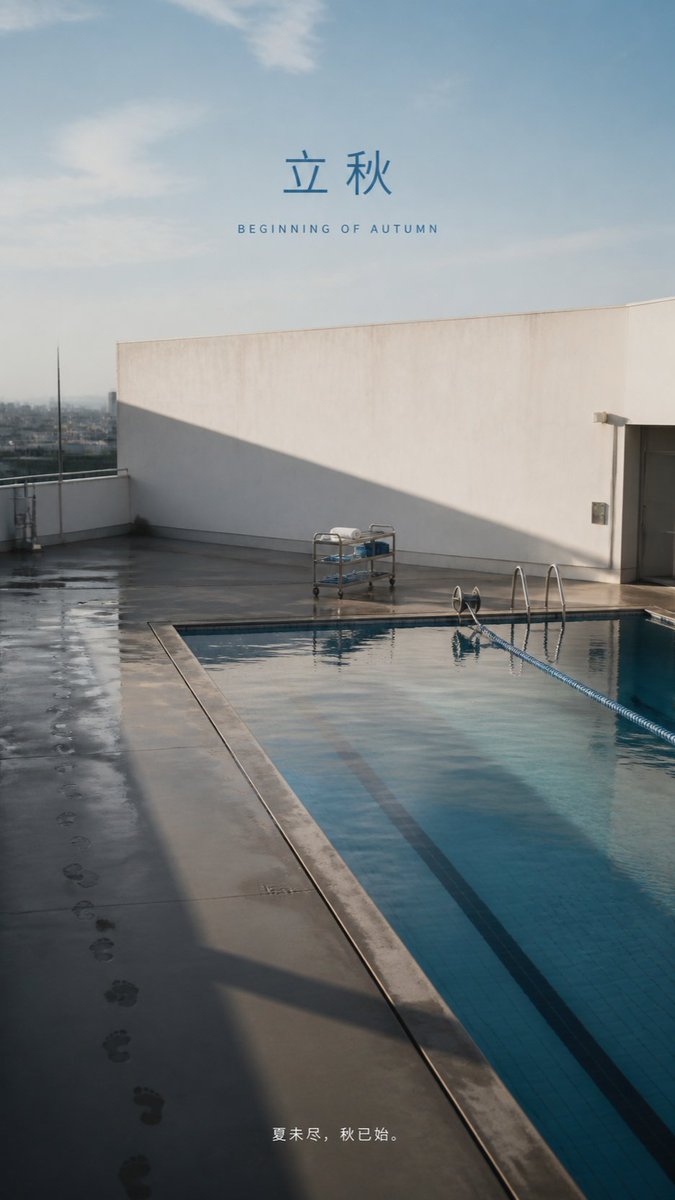
{ "task": "create_liqiu_editorial_poster_series", "theme": { "name": "Beginning of Autumn", "english": "BEGINNING OF AUTUMN", "core_idea": "Summer is not yet over, autumn has already begun. (This is only a direction; you must expand more main and subtitles yourself and have them appear randomly on the poster)", "interpretation": "The Beginning of Autumn is not the arrival of a mature autumn landscape, but the first time the direction of the season's movement changes. What lies before the eyes may still be the brightness, greenery, and warmth of summer, yet the light, wind, plants, space, and human states have already shown a slight contraction. The image portrays not autumn itself, but the moment the sense of autumn has just occurred.", "emotional_sentence": "What you see is still summer, but the world has already gently turned. (This is only a direction; expand more main and subtitles and have them appear randomly on the poster)" }, "generation": { "count": "Generate any number of independent works as requested by the user", "aspect_ratio": "9:16", "output_rule": "Each work is a complete vertical poster usable on its own, no collage, no nine-grid, no storyboard.", "variation_rule": "All works share the same spirit of the Beginning of Autumn and the same high-end visual aesthetic, but do not share a fixed scene template. Before each generation, internally form clearly distinct spatial relationships, viewing distances, seasonal cues, character states, lighting changes, and layout rhythms, then complete each work separately." }, "creative_principle": { "core": "What is fixed is the spirit of the season's turning, not where the turning takes place.", "method": "Do not directly look for traditional objects representing the Beginning of Autumn, but seek a visual relationship that still belongs to summer yet has already begun to change.", "visual_question": "How can the viewer still feel the season turning from high summer toward early autumn without seeing fallen leaves, rice fields, and harvest symbols?" }, "art_direction": { "subject": "The moment high summer begins to quiet down", "mood": [ "quiet", "relaxed", "clear and translucent", "restrained", "slight coolness", "life settling back into place", "time slowly turning" ], "visual_character": [ "high-end but not distant", "minimal but not empty", "natural but not rustic", "oriental but not archaic", "fashionable but not overly posed", "with traces of life but not trivial" ] }, "scene_generation": { "principle": "Do not preset a specific location, and do not require the appearance of a courtyard, waterside, window, roof, mountains, or interior. The model should, based on the spirit of the Beginning of Autumn, create a real space carrying a sense of seasonal transition.", "space_direction": [ "The space should simultaneously contain evidence that high summer has not yet left, and some change of contraction, cooling, tidying, or pause.", "The scene may come from modern life, natural environments, architectural spaces, living spaces, urban edges, or unnameable fragments of life.", "Architecture, plants, fabrics, objects, food, shadows, sky, ground, or traces of human activity may appear, but they must serve the overall mood, not become a checklist of solar-term symbols.", "The scene needs clear spatial order and a visual memory point, feeling unexpected yet naturally belonging to the Beginning of Autumn.", "The image should look like a seasonal moment glimpsed by chance in the real world, not a set built to explain the Beginning of Autumn." ], "randomness_rule": "Each generation may choose entirely different spatial vessels and life perspectives, without repeatedly relying on the same kind of architecture, plant, water surface, windowside, courtyard, or character action." }, "seasonal_expression": { "principle": "Express the Beginning of Autumn through relationships, not through symbols.", "possible_relations": [ "the change between intense and gentle", "the change between outward release and contraction", "the change between growth and storing away", "the change between heat and light coolness", "the change between clamor and pause", "the change between fullness and empty space", "the change between summer's inertia and autumn's order" ], "usage_rule": "The above relationships are neither mandatory objects to appear one by one nor fixed picture schemes. Each work needs to choose only one or two of these relationships, expressed naturally through light, space, material, character state, or traces of life." }, "human_presence": { "optional": true, "role": "The figure serves only as an emotional anchor within the seasonal change and as a scale for the space, not as the subject of a fashion display.", "description": "If a figure appears, it may be a young, beautiful Asian Korean woman, in a natural, unperformed state of life, with facial features not needing to be the visual center.", "styling_rule": "The clothing is freely designed by the model according to the specific space, temperature, and seasonal-boundary state. It is only required to be real, relaxed, and textured, and to reflect the not-yet-fully-defined layering of dress between late summer and early autumn, without limiting color, fabric, cut, or combination.", "action_rule": "Do not preset fixed actions such as reading, drinking tea, looking out the window, walking, or tidying. The figure's behavior should grow naturally from the scene, as if captured by chance, not posed for the poster.", "absence_rule": "The image may also have no figure at all, establishing human presence through space and traces of life." }, "composition": { "core": "Let space, empty room, and visual relationships carry the narrative, without relying on the piling up of elements.", "guidelines": [ "maintain ample empty space and a sense of breathing", "allow the subject to be very small, with the environment becoming the main narrative", "allow an extremely minimal image, but there must exist a visual relationship that makes the gaze linger", "geometric order, natural growth, occlusion, repetition, cropping, near-far layering, or large empty zones may be used", "composition does not fix centering, symmetry, or figure position; each work should have its own rhythm", "the image is first a photograph that stands on its own, and only secondly a solar-term poster" ] }, "light_and_time": { "principle": "Light is one of the most important seasonal pieces of evidence of the Beginning of Autumn.", "direction": "The light still carries the warmth of summer, but has already lost the aggressiveness of high summer's noon. It may be bright, low and slanting, diffused, obstructed, or leave long, light shadows, giving the space a sense of time beginning to quiet down.", "freedom": "Do not limit it to early morning, afternoon, dusk, clear day, overcast, or indoor/outdoor; the model decides freely according to the spatial logic of each image." }, "color_system": { "principle": "Do not apply a fixed palette to all works; retain the colors of late summer while letting a slight cooling, fading, or calming appear within them.", "direction": [ "overall low to medium saturation", "colors natural, clean, and translucent", "green, white, blue, earth tones, or other colors still belonging to summer may be retained", "allow a minimal amount of warm colors as heat not yet withdrawn", "avoid directly equating the Beginning of Autumn with golden yellow, orange-red, dark brown, and mature autumn scenery" ] }, "material_and_image_quality": { "style": "editorial photography, high-end lifestyle campaign, Pinterest collectible visual", "qualities": [ "real natural light", "real architecture and life materials", "natural fabric and plant textures", "slight film grain", "restrained print texture", "slight paper feel", "not over-sharpened", "not over-smoothed skin", "avoid smooth plastic-like AI texture" ] }, "typography": { "main_title": "Beginning of Autumn", "subtitle_options": [ "Summer is not yet over, autumn has already begun.", "The world begins to gently turn.", "The season begins to turn." ], "rule": "Text serves only as an emotional signature and does not take on the task of explaining the image. The typography is minimal and restrained, integrating naturally with the empty space and spatial structure. It may change position, scale, direction, and the combination of Chinese and English according to each image, without using traditional calligraphic solar-term templates." }, "diversity_contract": { "rule": "Whether generating 3, 6, or 9 images, one must not merely change the figure's pose, plant species, or lens angle.", "each_image_should_vary": [ "type of space", "the open-and-close relationship of space", "the distance between the person and the environment", "presence or absence of a figure", "the way the seasonal turning is expressed", "the state of light and time", "the main material", "the visual center of gravity", "the position of empty space", "the layout structure" ], "consistency": "Difference comes from spatial imagination; unity comes from the spirit of the Beginning of Autumn, photographic texture, and aesthetic restraint." }, "negative_constraints": [ "Do not use fallen leaves as the main visual symbol", "Do not use large golden rice fields or harvest scenes", "Do not repeatedly reuse fixed spatial templates such as waterside, white walls, windowside, courtyard", "Do not repeatedly use curtains, long hair, and fluttering garments to represent wind", "Do not equate lifestyle with drinking tea, reading, meditating, or standing before a window", "No archaic solar-term templates", "No large calligraphy pressing over the image", "No piling up of folk ornaments", "No autumn tourism promotional photos", "No cheap warm-yellow filters", "Do not abstract so much that the season cannot be felt", "Do not create incomprehensible conceptual installations in the name of being high-end", "Do not let multiple works share the same scene skeleton" ], "final_intent": "Each work should first draw people in by the image itself, and only afterward make them faintly realize: summer has not ended, but some change has already occurred. The Beginning of Autumn is not the autumn that is seen, but the turning first felt by the body." }