
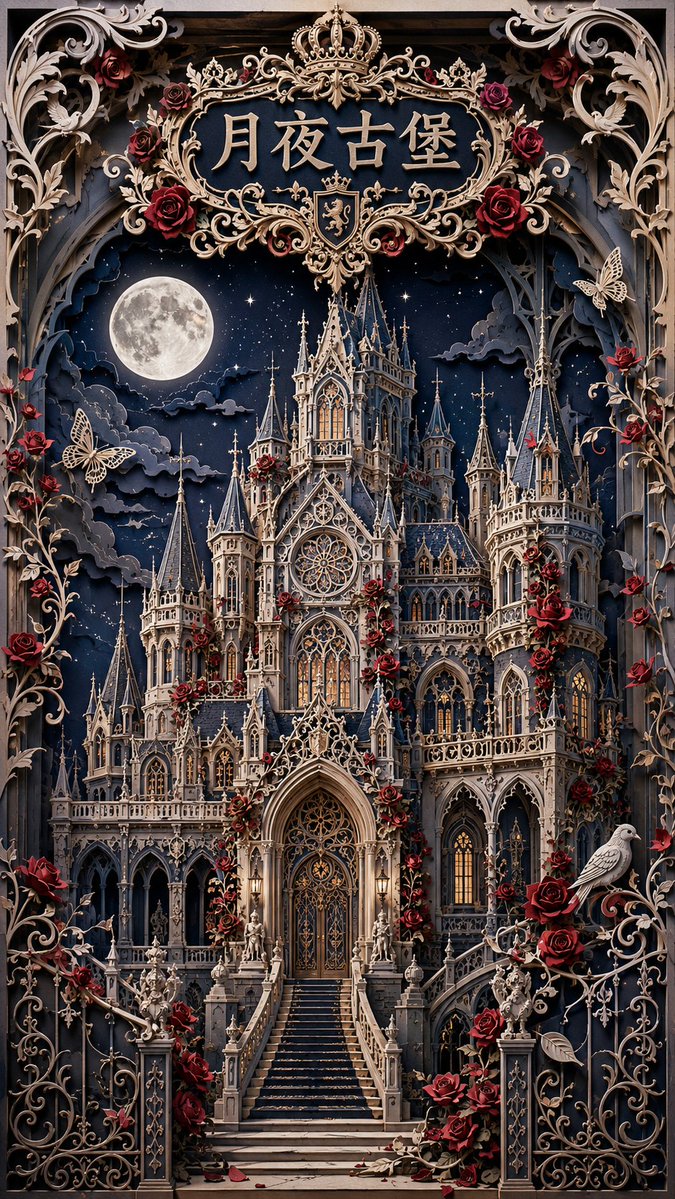
Using the【European architectural subject】as the core, create an exquisite, romantic, dreamy, richly layered classical European three-dimensional paper-cut artwork. The whole integrates traditional European paper-cutting art, Scherenschnitte openwork silhouettes, lace paper sculpture, multilayer stacked-paper art, Gothic ornamentation, Baroque and Rococo aesthetics, and classical European architectural art. The image must present a realistic, delicate, high-end paper-art texture: clearly visible paper fibers, hand-cut edges, openwork patterns, embossed thickness, the curl of paper strips, a layered spatial structure, and diorama-like three-dimensional depth. The overall effect must look like a genuine, finished museum-grade three-dimensional paper-cut artwork, avoiding the look of an ordinary castle illustration, a flat silhouette, a plastic model, cheap 3D, or crude ornamentation. The【European architectural subject】sits at the absolute visual center, in a 9:16 vertical composition, showing the building's most complete, most gorgeous, and most recognizable main outline in a frontal, semi-frontal, or slightly upward-looking angle. The building is staggered in height, with clear hierarchy and an elegant outline, both solemn and grand yet dreamy and romantic, with strong classical European architectural beauty and visual impact. The building is originally designed according to the【building type】and【historical period】, and may blend elements of medieval castles, Gothic churches, Baroque palaces, Rococo manors, Renaissance residences, Victorian houses, ancient Greek temples, ancient Roman architecture, Nordic castles, or fantasy elf palaces. The structure should emphasize spires, towers, domes, arches, columns, flying buttresses, bell towers, terraces, porticos, cloisters, carved window frames, stone steps, railings, roof levels, and symmetrical facades, forming a rich, elegant, gorgeous, and stable architectural structure. Parts of the building must incorporate fine, orderly classical European openwork patterns, such as Gothic pointed-arch motifs, rose-window motifs, Baroque scroll-foliage, Rococo shell motifs, fleur-de-lis, climbing-rose vines, crown motifs, shield emblems, family crests, and classical lace. The patterns must be slender, refined, symmetrical, and well spaced—complex but not messy, gorgeous but not heavy—presenting a collectible-grade craftsmanship like fine lace paper sculpture. Emphasize the【representative architectural details】, such as rose windows, stained-glass windows, carved gates, arched galleries, spired bell towers, domed skylights, wrought-iron balconies, columned facades, sculpture niches, stone-step porticos, floral railings, roof decorations, and family crests. All details are uniformly transformed into multilayer openwork paper structures, emphasizing the beauty of the architectural outline, of decorative order, and of layered relief. The foreground may add a small amount of exquisite decoration as framing, such as vines, flowering branches, iron railings, candlesticks, butterflies, birds, petals, snowflakes, laurel leaves, or heraldic ornaments, distributed naturally along the edges in delicate paper-sculpture form to enhance spatial layering, dreamy atmosphere, and splendor. The decorative elements must be refined and restrained, serving only as accents, never overshadowing the subject or obscuring the building's main outline. Use the【main flower】as the primary decorative element, elegantly placing flowers and vines around towers, window frames, porticos, railings, the plaque, and the building's edges. The flowers should be rendered in light, translucent openwork paper sculpture, with beautiful forms and natural arrangement, enhancing romantic temperament and visual guidance, but at moderate density, always ensuring the main building remains clear, complete, and prominent. The whole takes the【main color tone】as the core, combined with ivory white, parchment beige, champagne gold, classic silver, wine red, rose pink, gray-purple, hazy blue, dark green, peacock green, navy blue, obsidian, and other low-saturation classical European colors. The colors must be soft, unified, retro, and refined, with the recommended scheme of "one main color + one auxiliary color + a few metallic accents." Parts may include delicate gilding, silver-foil embossing, pearlescent paper surfaces, and slight aging effects to raise the collectible artistic quality, avoiding highly saturated garish combinations, cheap shiny gold, and a fluorescent look. Lighting uses soft moonlight, warm candlelight, light passing through stained glass, and subtle ambient light, letting light softly filter through the openwork gaps and between the layers of paper, forming natural shadows, soft halos, clear embossed thickness, and elegant spatial layering. Emphasize the paper texture, cut edges, curled paper strips, carved undulations, architectural outline, and multilayer paper-sculpture structure, giving the image a quiet, mysterious, romantic, and gorgeous high-end atmosphere. At the top of the image there must be an exquisite, complete classical European openwork plaque clearly inscribing the【work title】. The plaque must never be blank, without text, or blurred and illegible. The title text must be clear, complete, accurate, centered, prominent, and naturally integrated into the overall image. The plaque may combine Gothic pointed arches, Baroque foliage scrolls, Rococo carvings, rose vines, crowns, and family crests. An elegant, legible classical decorative font is recommended, accurately displaying the【work title】; a blank plaque and garbled text are strictly forbidden. The overall composition should be gorgeous and full but not crowded, with the building always the sole absolute visual center. The image should be exquisite, dreamy, elegant, mysterious, gorgeous, and romantic, with complex yet orderly details and rich yet clearly hierarchical decoration, ultimately presenting a high-end art-poster quality, museum-exhibition-grade, collectible classical European three-dimensional architectural paper-cut art effect. Replaceable parameters: European architectural subject:【Gothic castle / Baroque palace / Rococo manor / medieval church / Renaissance residence / Victorian house / ancient Greek temple / ancient Roman architecture / Nordic castle / elf palace / royal opera house / bell tower / European greenhouse / palace gate / stone-bridge gatehouse】 Building type:【castle / palace / church / manor / residence / temple / tower / bell tower / gate / greenhouse / opera house / monastery / ancient bridge / fortress】 Historical period:【medieval / Renaissance / Baroque period / Rococo period / Victorian era / ancient Greek period / ancient Roman period / Gothic fantasy age】 Architectural theme:【moonlit castle / snowy-night palace / rose manor / exterior of a royal ballroom / vampire family castle / temple church / elf royal palace / lakeside palace / star-and-moon high tower / Nordic ice-and-snow castle】 Representative architectural details:【rose window / stained-glass window / spired tower / dome / arched gallery / carved gate / columned facade / flying buttress / bell tower / wrought-iron balcony / garden terrace / family crest / sculpture niche / stone-step portico】 Main flower:【red rose / white rose / wild rose / iris / lily / tulip / lily of the valley / violet / lavender / camellia】 Main color tone:【wine red and classic gold / dark green and champagne gold / indigo and classic silver / obsidian and dark red / ivory white and rose pink / gray-purple and pearl white / moonlight blue and silver white / deep purple and antique gold】 Work title:【custom title】 Special requirement: the top plaque must clearly show the【work title】, with complete, clear, highly legible text, never blank, omitted, or garbled, and the plaque itself must also be exquisite and gorgeous.