
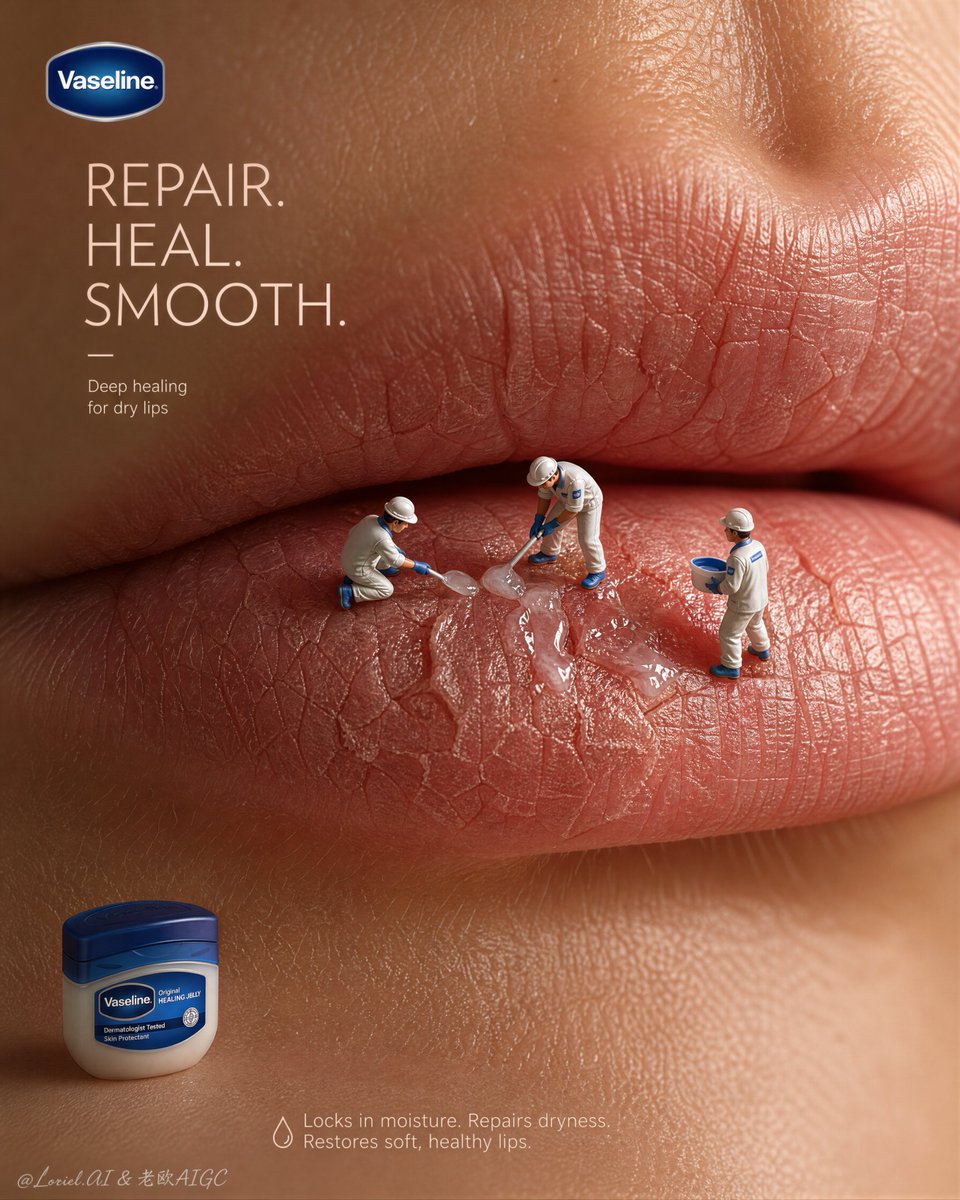
Create an ultra-premium skincare advertising poster for Vaseline, built around an extreme macro close-up of slightly dry but clearly cracked lips, presented as a miniature repair scene. The image must feel hyper-real, clean, clever, elegant, and highly premium, like a world-class skincare campaign. The central idea is a believable micro-scale restoration operation: only two or three tiny workers are carefully repairing the lip surface using Vaseline as the healing solution, while the actual Vaseline product appears much smaller than before, reduced to roughly 60-70 percent of its previous visual importance, placed off the lips in the surrounding facial area or lower edge of the frame as a subtle source object rather than a competing hero. The lips must now dominate the composition much more strongly, becoming the overwhelming visual center. Core composition: Use a tall vertical composition with an extreme close-up of the mouth and surrounding skin. The lips must dominate the center of the frame more aggressively than before, occupying the strongest visual weight. The upper lip and lower lip should both be clearly visible, with the main crack zone near the center of the lower lip or lip meeting area. The miniature repair scene must happen directly on the lips, but all secondary elements should remain visually subordinate. Keep the workers readable but small. Keep the product jar noticeably reduced in scale and visual dominance so the lips remain the true hero surface. Miniature repair scene: Use only two or three tiny repair workers. They should wear clean coordinated uniforms, helmets, gloves, and subtle utility gear. Their gestures must feel precise and caring: one worker may be gently applying jelly into a crack, one may be smoothing or sealing a rough area, and one may be inspecting or carrying a tiny amount of product. Avoid exaggerated construction-site clutter. The scene should feel like an elegant micro-care operation rather than a busy worksite. Product placement and scale: The Vaseline product must be clearly visible but significantly smaller in the composition, reduced to about 60-70 percent of its prior visual prominence. It must not sit directly on the lips. Place the jar nearby on the surrounding skin area, at the lower edge of the frame, or on a small implied adjacent surface, so it still reads as the source of the healing material without competing with the lips. The jar should feel secondary, subtle, and supportive. Lip realism: Render the lips with exceptional macro realism and dermatological delicacy. Make the lips more visually prominent and central. Increase the visible crack pattern moderately so the dryness reads clearly: show fine fissures, dry ridges, subtle flaking, and rougher texture concentrated in the central zones. The lips must still feel believable and human, not painful or extreme. The surrounding skin must remain smooth and highly detailed, showing pores, soft facial texture, and natural tonal variation that contrasts beautifully with the drier lips. Healing jelly logic: Render the Vaseline jelly with exquisite realism: soft glossy translucency, clean viscosity, smooth edges, subtle thickness, and premium light behavior. The jelly should appear in small controlled amounts being applied directly into the crack zones, creating a visual contrast between dry matte texture and repaired glossy smoothness. The effect must feel soothing, restorative, and precise, never messy or overly wet. Lighting: Use extremely delicate soft cinematic beauty lighting. The light should reveal the dry texture of the lips, the smoothness of surrounding skin, the glossy healing jelly, and the tiny workers with precision and elegance. Keep the lighting soft, warm-neutral, and premium, with controlled highlights and gentle shadow transitions. The image should feel clean, expensive, and tactile, never clinical in a cold way and never harsh. Skin detail: Render the surrounding face with hyper-real skin detail: pores, soft texture, natural tonal transitions, and subtle facial texture where appropriate. The realism of the surrounding skin is essential because it increases the credibility of the macro lip scene. The contrast between healthy skin and the slightly more visibly cracked lip texture should be clear and beautiful. Background and cleanliness: Keep the entire scene visually clean and simplified. Avoid extra clutter, over-decoration, or unnecessary miniature elements. Let the macro face and lip surface provide the environment naturally. The negative space around the lips and the softness of skin transitions should help the image breathe. The overall impression should be premium minimalism inside a hyper-detailed concept. Typography and branding: Add a refined English main title and very short support line in a clean premium skincare advertising layout. Include subtle official-feeling Vaseline logo placement and restrained English copy emphasizing repair, healing, and smoothness. Typography must be clean, modern, and spatially balanced, never bulky or noisy. The text must support the visual idea without overwhelming it. Mood: healing, precise, clean, premium, clever, restorative, soft, tactile, reassuring, hyper-real, elevated, minimal Rendering style: ultra-premium Vaseline skincare campaign, extreme macro close-up with lips as dominant focal point, visibly dry cracked lips, only 2-3 miniature repair workers, smaller Vaseline jar placed off the lips, hyper-real skin and lip detail, elegant beauty lighting, premium English typography, official logo placement, world-class skincare advertising aesthetic, 8k, collector-grade image quality Negative prompt: grotesque cracked lips, bleeding lips, horror body detail, cartoon workers, messy jelly, oversized product, product jar sitting on lips, too many workers, too many tools, low-detail skin, plastic lips, comedic slapstick scene, cheap ad style, cluttered layout, noisy typography, low-resolution texture, exaggerated medical damage, artificial CGI skin