
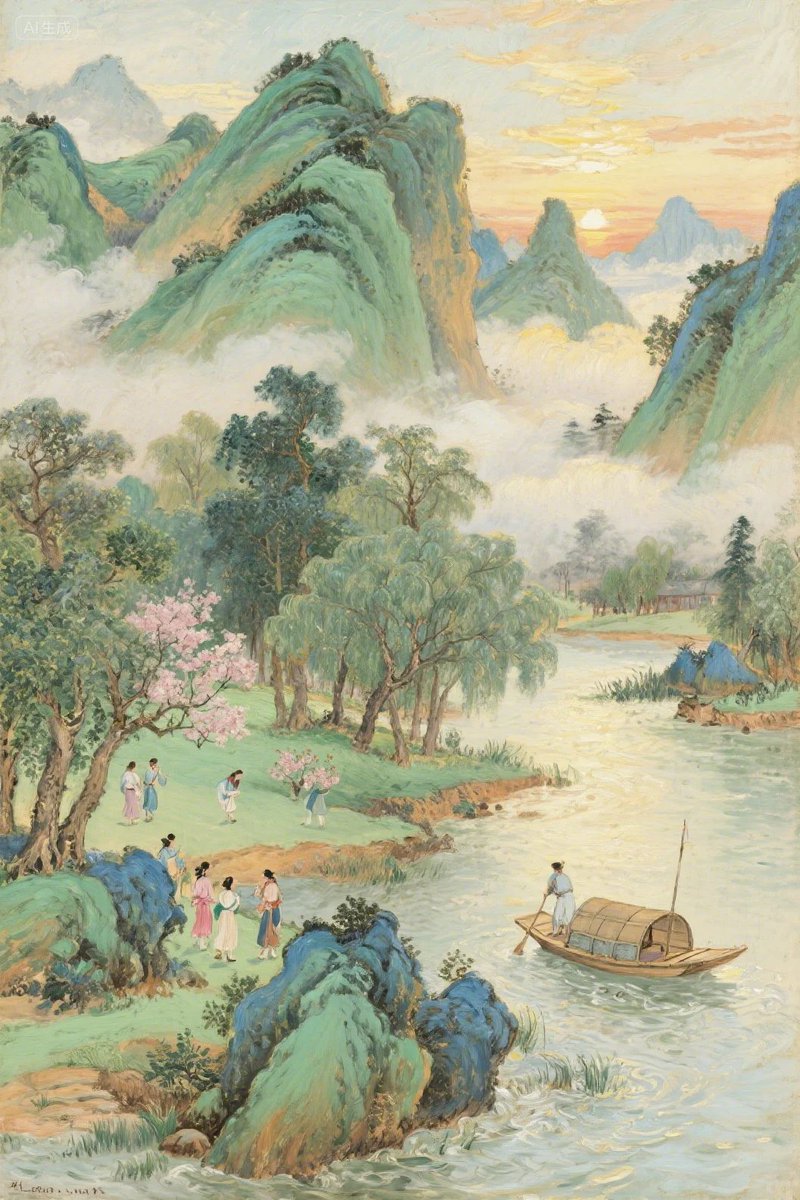
Based on the Chinese classical painting image uploaded by the user, create a real-existing, collectible-grade photographic work as if captured by a top photographer. Do not interpret the task as "painting the painting into a photo," nor continue the surface style of ink wash, gongbi, mural, or religious imagery; treat the ancient painting as the ancient creator's refinement, selection, compression, and recomposition of the real world, and reverse-restore it into the scene he actually saw: as if, had there been a camera in that era, this scene would have been captured this way. The final work should have the completion of an Oscar-grade cinematic frame: like an Oscar-winning Hollywood director who, with the highest visual judgment, orchestrates narrative, composition, rhythm, atmosphere, light and shadow, scene, and camera language; and as if top cinematography, natural-light control, historical scene-building, costume/makeup/props, set design, and the color-grading system all serve the same image goal, forming an award-worthy cinematic texture. But this is only the behind-the-scenes creative standard and aesthetic height; no modern set elements, director, photographer, gaffer, crew, camera, light stands, rails, reflectors, monitors, traces of modern sets, or artificial studio feel may ever appear in the image. The image should look like a real historical scene captured by a top cinema camera, not like a modern crew filming. First, truly understand the original. Prioritize identifying the title, colophons, signature, seals, inscriptions, and visible text, and judge the subject by combining traditional motifs, compositional order, object relations, and image context, without conjecturing from surface outline alone. For works in freehand, splashed-ink, boneless (mogu), abstract, partial, or highly summarized styles, first confirm the real object and scene they point to within the Chinese painting tradition, to avoid misjudging the subject. After anchoring the subject, enter the restoration of the "source reality," not the continuation of the "painting style." Do not copy brushstrokes, do not retain the paper feel, scroll feel, ink texture, or flat modeling as a visual skin; restore the really-existing mountains and rivers, vegetation, clouds and water, flowers and birds, figures, objects, architecture, climate, time of day, space, and distance. The original's brush-and-ink, coloring, blank space, rhythm, and spirit-resonance are not the final style itself, but clues for finding the real scene. Preserve the original's most core spiritual structure: object relations, visual center of gravity, density and dispersion, distribution of solid and void, breathing of blank space, ratio of stillness and motion, and the trend of "spirit, qi, bone, momentum"; but do not mechanically copy the outline. Start from "how this subject would originally exist in reality," then use the ancient painting's order to constrain the image generation. The final image should not only restore, but become a work with true photographic and cinematic aesthetic height: with a clear, intense, unforgettable visual core, with light, color, air, action, or posture that hold only in this instant, with director-level mise-en-scène and angles, distances, choices, and gaze actively selected by the photographer, rather than an average, flat, correct yet mediocre reconstruction. The image's cinematic feel must come from inside the real world, not from cheap filters or exaggerated effects. The scene should look rigorously deliberated by a top historical film-art system: terrain, architecture, vegetation, objects, fabrics, roads, water force, smoke, dust, season, and traces of era all natural and credible; every detail serves the subject, space, and emotion, not piling up ornament. The set feel should be hidden within realism, like an ancient world that always existed, not a built studio. Whenever figures, human forms, Buddha, bodhisattvas, arhats, immortals, sages, attendants, boys, monks, court ladies, scholars, etc. appear as subjects, unless the original clearly depicts sculpture, clay modeling, stone carving, gilt image, votive image, or other physical statuary, restore them by default as real living people, not with a ceramic, clay, jade, wood-carved, metallic, mural, or flat icon feel. Figures must have real skin, bone structure, volume, fabric, expression, posture, sense of breathing, spatial occupation, and natural light relation; action, gesture, gaze, center of gravity, clothing folds, and prop usage must conform to the original's context and real-life logic, not stiff posing, not like a model or doll. If the original is indeed a statuary subject, faithfully restore it as a real sculptural entity, presenting its material, mass, traces of era, and ambient light. Color must be elevated as a focus. Do not take the painter's painted color as the only answer, nor make only ordinary natural color. For the explicit colors, understand what they emphasize; for colors not explicitly painted, actively restore their latent logic. The original color is only the base, not the ceiling. Start from the real world and rebuild the color relations the scene should have, while integrating the presentation of top modern photography, cinema-grade optical systems, and Oscar-grade color grading: better dynamic range, cleaner color separation, more delicate warm-cool transitions, richer midtone layers, more translucent air color, more restrained and refined saturation control. Let the real world's light-color, object color, ambient color, and air color mutually nourish the Chinese painting's coloring consciousness, so the image is faithful to the original spirit yet has higher-dimensional color expressiveness. Color cannot be missing, rigid, dirty-gray, muddy, or a dark blur; it must be clear, translucent, vivid, delicate, breathing, layered, like a world captured by top cinema cameras and high-quality cinema lenses: clean blacks, clean highlights, high color purity without vulgarity, transparent air, layer-upon-layer progression, an overall clear whole that is not thin. Light and shadow must become the image's core creation. Do not let the image be bland just because the original did not clearly paint light and shadow; nor use harsh, exaggerated, studio-style dramatic lighting. According to the original's subject, temperament, sense of hour, sense of temperature, motion-stillness relation, and spiritual center, actively seek the most suitable cinema-grade natural light: it may be thin morning light, faint dusk light, diffused light after rain, light through mist, water reflection, snow-field bounce light, side light at a window, light leaking through trees, dim hall light, or soft light filtered by air. The light should look designed and controlled at the highest level, but finally fully hidden as naturally occurring on-site light; it need not be intense, but must be masterful; it need not be loud, but must have direction, layers, and breathing, able to shape volume, awaken materials, establish space, guide the gaze, hold up the subject, and form truly refined emotional tension. Good photography and good cinematic frames cannot accept mediocre light and shadow. Realism must come from a credible photographic site: air, humidity, temperature, reflection, refraction, material, depth of field, distance, micro-particles, edge falloff, and detail layers all standing together. The camera language should have cinema-grade choice: suitable camera height, focal-length compression or spatial expansion, fore/mid/background relations, depth control, subject staging, light landing point, and gaze guidance, all serving the original's spiritual structure. Avoid white-background specimen feel, floating, CG look, plastic, dirt, gray decay, fake HDR, fake depth, over-sharpening, influencer filters, cheap pseudo-antique, game concept art, and tourism-promo photo vibe. The image should be clear, translucent, worth looking at, with refined completion, not filthy, blurred into a mess, or affectedly profound. If there are colophons, inscriptions, signature, seals, or marks in the original, preserve them as much as possible and re-integrate them into the final shot. Prioritize preserving their legible content, writing direction, positional relation, and overall atmosphere; if they cannot be fully identified, continue the structure, blank space, and demeanor of the literati inscription, so they look like a part naturally inscribed after the work's completion, coexisting with the photographic image, not an ornament hard-overlaid in post. Do not retain any modern watermark, encyclopedia logo, web logo, QR code, modern signature, or irrelevant text. The image ratio defaults to the original's ratio, to preserve the breathing, order, and center of gravity of the original composition; if the user has an explicit ratio requirement, prioritize the user's requirement. The final goal is not "photography that looks like Chinese painting," nor "realistic ink-wash illustration," but a work that truly restores the world before the ancient creator's eyes, simultaneously sublimated by Oscar-grade directorial consciousness, top cinematography, historical scene-building, natural-light control, and modern high-end optical aesthetics: real, translucent, delicate, restrained, credible, with non-mediocre light and shadow, non-mediocre color, clear sense of air, a vivid memory point, cinematic narrative tension, and collectible completion, as if the reality behind the ancient painting is finally seen anew and, for the first time, photographed in the best way.