
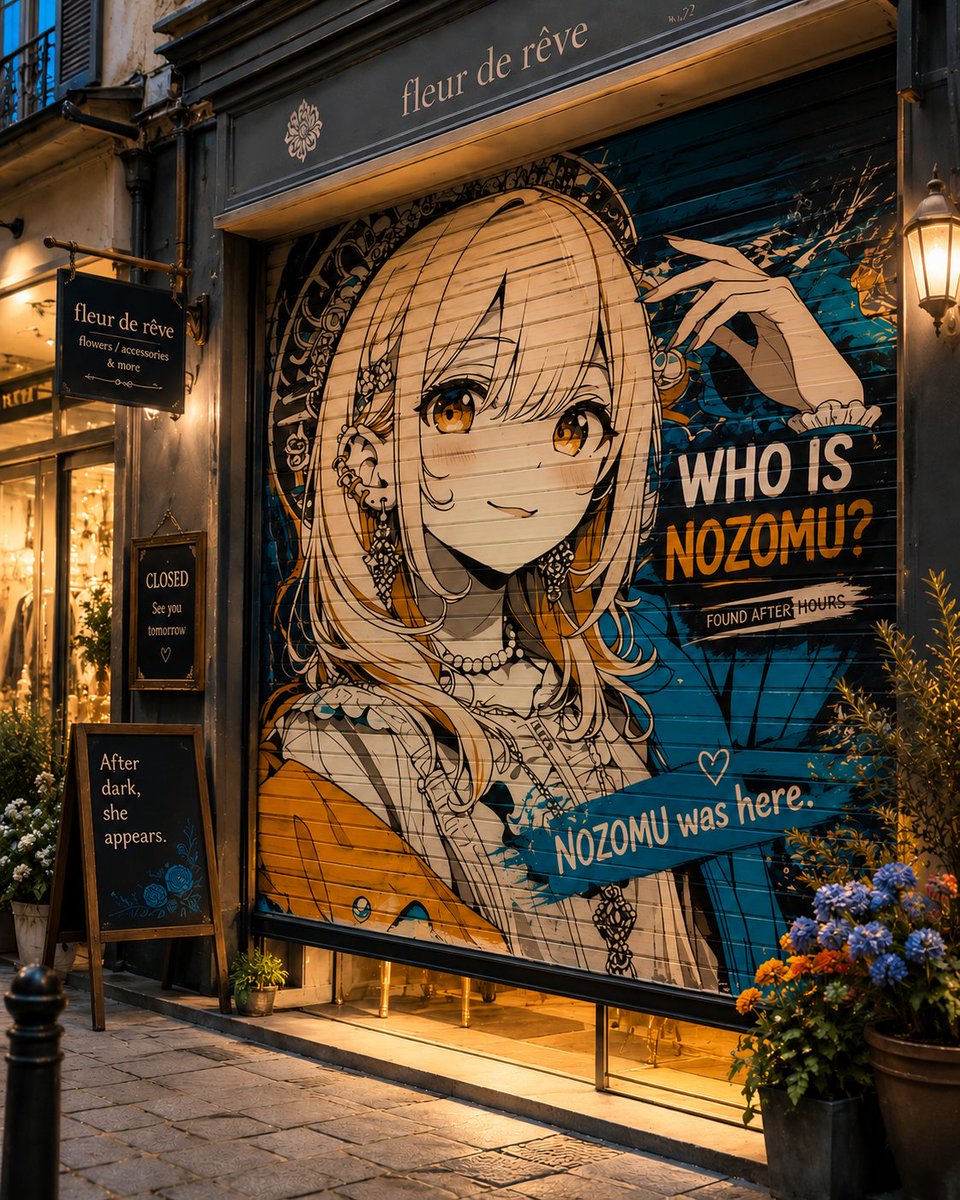
While fully preserving the character from the original image, reconstruct it as a "mysterious shutter art discovered on a stylish street corner that went viral on social media." Character name: [enter name]. Image ratio 4:5 vertical. It should catch the eye instantly in the X timeline and carry the realism of "a photo someone happened to find and snap in front of a sophisticated shop or alley and posted on social media." Most important: never turn the character into a different person. Preserve, with top priority, the face, eyes, hairstyle, hair color, expression, outfit, color scheme, atmosphere, and the character's unique charm. Face and eyes are the absolute priority; keep the cuteness, beauty, and presence that make it recognizable at a glance as the original character. Concept: this is not merely "a drawing of the character on a shutter." It's essential that it looks like "a trace of her that appears only after closing time, on a stylish street." Create a sense of discovery, photogenic appeal, refinement, and room that makes people want to join in, so viewers think "What's this shop?", "It's like she was in this town," "Too cute, she suits this corner," "What kind of shop would my OC become?", "I want to do this with mine too." World: the setting is not a run-down shopping arcade, but a tasteful, stylish street corner or boutique district, a refined street lined with small cafés and flower shops. Examples: charming back alleys, streets lined with select shops, near small flower shops and cafés, elegant seaside shop streets, the air of a foreign boutique street, a tidy townscape that makes you want to take photos. But not an overly luxurious high-brand street—keep it to an "within-reach" stylishness. Brightness and time of day: for virality, the whole should not be too dark. Recommended is one of: evening to blue hour (some surrounding brightness still remains, the air is beautifully blue, a special after-closing feel, the shutter and character clearly visible, stylish and emotive) or early morning (soft light, the quiet of being closed, easy to view in the timeline, clean, cuteness well conveyed). Do not make it the complete darkness of deep night. Keep the character and shutter art bright enough to be recognizable at a glance even on a smartphone display. Direction of the shutter art: express it as a refined, believable street-art work that looks left by an anonymous artist or shopkeeper. Not mere graffiti—naturally include the horizontal lines characteristic of a metal shutter, paint scuffing, blurring of spray or paint, subtle fading, a touch of remaining age, the tidy lived-in feel of the storefront, and a design quality that blends naturally into a stylish street—achieving a realistic yet beautiful, photogenic finish. Don't dirty it too much; balance cleanliness with the realism of the street. Composition: the lead is the character drawn on the shutter. Show the character large enough within the frame that the face, eyes, and expression read instantly even on a smartphone display. The composition should not be a head-on documentary shot, but give the natural street-snap feel of "I stopped in my tracks while passing by and took the shot." Desired elements: a natural slightly angled perspective, the character drawn large across the whole shutter, a bit of the sidewalk or curb in front of the shop, parts of a streetlight, signboard, wall, window, and greenery entering naturally, holding together as a corner of a stylish street, with a sense of "really existing there." Shop atmosphere: don't over-explain the shop, but leave room to imagine "maybe it's a shop that suits her." For example: a small flower shop, a seaside general store, a select shop, an accessory shop, a tearoom, a bakery, a lifestyle shop, a small boutique. But don't make it look like the shop's advertising poster; the lead remains "my OC's shutter art." Half-open shutter staging (recommended): if possible, you may include staging where the shutter is slightly half-open and through the gap you can faintly see soft interior light or a hint of small items. For example: warm interior lighting, the outlines of small shelves and goods, a hint of flowers, books, or glass items, an air that matches her colors. This strongly invites the imagination of "there seems to be a story inside this shop," "it's like she was really here," "what kind of shop would my OC become." But don't show too much of the interior; keep it to a level of "hint." Surrounding elements: you may modestly include elements befitting a stylish street. For example: a tasteful small signboard, a streetlight, potted plants by the wall, a small bouquet, a glass window, a tiled sidewalk, a café-style sign, a simple shop-name plate, modest notices or memos, the elegant light of an exterior lamp. But don't make the information volume too much. Don't let the lead get buried. How the character is drawn: while fully leveraging the charm of the original image, draw the character as a striking trace left in the town. What matters: don't deconstruct it too roughly, don't make it so graffiti-like that the cuteness is lost, don't turn it into horror, don't dirty it so much that the face becomes unreadable, don't make it look like a pasted-on poster, keep refinement and cuteness. Cuteness, beauty, sophistication, realistic street feel, and mysteriousness should all hold true at once. Text elements: keep the text to a few words, placed naturally at a size readable in the timeline. Around 1 to 3 is recommended. Examples: WHO IS [name]? / [name] was here. / FOUND AFTER HOURS / CLOSED, BUT SHE WAS HERE / "[name], who appears only after closing" / "the trace of [name] left in the town." The text should function not as an explanatory caption but as a "hook that makes you want to speculate." Make it stylish, short, and memorable. Color and appearance: prioritize an overall look that is bright and easy to view, has transparency, the refinement of a stylish street, a slightly extraordinary sense of discovery, and a beauty that makes people want to save it on social media. Keep the character's original color scheme firmly intact, while making the background townscape a slightly calmer tone, so that the character and shutter art are recognized at a glance as the lead. Prohibitions: too dark to be seen in the timeline; a composition that merely uses the shutter as background; an expression like a pasted-on poster; ending up as too-generic graffiti; so stylish it looks like an advertising photo; insufficient reproduction of the character's face or eyes; information overload that buries the lead; so dirtied that the cuteness disappears; leaning toward horror or eeriness; becoming too much like an explanatory shop image. Ideal finish: ultimately, make a single image that makes people think "Whoa, I want to find this in a town like this," "This shop intrigues me," "It's like she was really here," "What kind of shop would my OC become," "I want to do this with mine too"—combining realistic street-corner snap × bright, easy-to-view shutter art × proof of the OC's existence × a stylish atmosphere that makes you want to join in.