
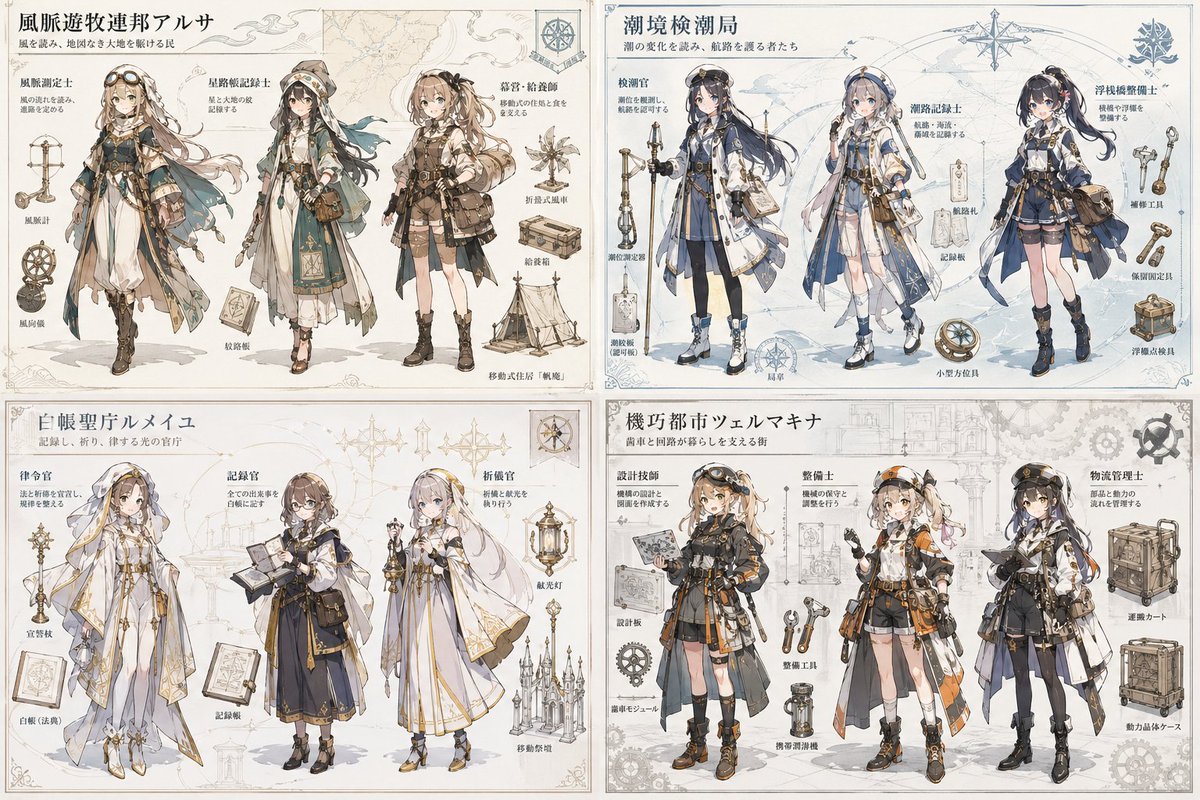
【World/Setting】 enter here 【Number of characters】 enter here 【Role/Function】 enter here 【Overall mood】 enter here 【Features of that world】 enter here 【What to prioritize】 enter here 【What to avoid】 enter here 【Differentiation instructions】 enter here 【Drawing tone】 Smooth line art, flat anime coloring, restrained cel shading, shadow in one step only, no gradients, no impasto, no realistic texture rendering, no strong light-shadow effects, a flat look that is easy to animate 【Anime-conversion instructions】 Keep the structure, motifs, color scheme, and role of the original design, but simplify the drawing for an anime series. Use flat anime coloring and only one level of shadow. Avoid gradients, soft shading, an impasto feel, and overly fine material rendering. Render semi-transparent materials and thin fabrics in a plane-organized cel-anime style rather than with realistic texture. Based on the inputs above, create a design-sheet-style image of an original anime character. Purpose: Create a costume-driven character rooted in the setting. Express the character's individuality not through the face or hairstyle, but through costume, equipment, materials, structure, color scheme, and cultural symbols. Most important: Extract the visual rules unique to that world and reflect them in both the costume and the layout. Not generic fantasy, but "clothing born in this world." Differentiation rules: For each character and each world proposal, the following must not repeat: 1. Silhouette 2. Main material 3. Color rule 4. Equipment structure 5. Cultural symbols 6. Purpose of the costume 7. Mood of the page design Design conditions: - Function and standing should be conveyed by appearance - Reflect the world's culture, environment, institutions, beliefs, and technology in the costume - Ornaments should be meaningful - A silhouette identifiable even from afar - Do not differentiate by face or hairstyle alone - Keep a unity as residents of the same world while making role differences clear Costume-design focus: - Give the silhouette clear features - Give the material the flavor of the world - Give meaning to the colors - Give character to fastenings, layering, storage, auxiliary tools, and movable parts - Provide practical items that show post and purpose - Include cultural symbols unique to the world Avoid: - generic fantasy armor - generic mage robe - generic RPG hero design - too many belts - random accessories - overused capes - standard medieval fantasy template - an appearance resembling existing anime IPs - the same multi-layered clothing in any world - the same color scheme or hanging ornaments in any world Image presentation: - high resolution - anime style - delicate line art - clean cel coloring - official design-book / concept-art-sheet style - standing pose with the full body visible - include small costume-detail and equipment diagrams as appropriate - keep title, numbers, and short English labels minimal - little text, visuals first Layout: Change the page design to match the setting as well. - Administrative/institutional: linear, organized, like forms or specification drawings - Sea/wind/pilgrimage: a composition with flow and white space, like tide or route charts - Underground/organic: organic diagrams with curves and layers - Travel/nomadic: carried items, back-carry structure, emphasis on the back view - Industrial/logistics: structural diagrams, exploded views, emphasis on tool details Most important: Not mass-produced fantasy, but a design that conveys the origin, material, purpose, and cultural meaning of the clothing. If the world is different, it should be clear at a glance that it belongs to a different lineage.