
Strix
Autonomous penetration testing platform for continuously finding, validating, and fixing vulnerabilities across applications, code, APIs, infrastructure, and cloud environments.
Community:


Product Overview
What is Strix?
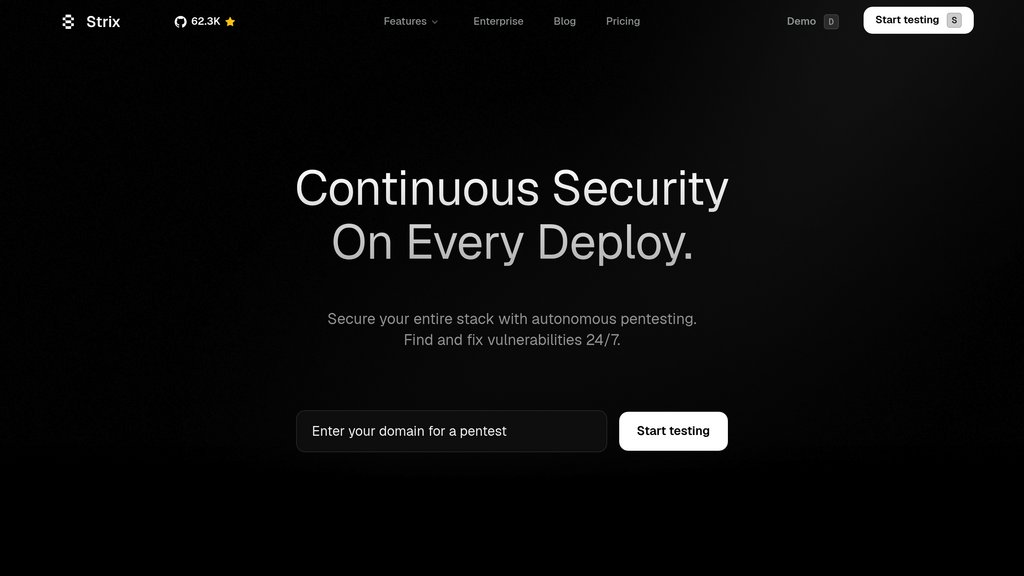
Strix is a full-stack security platform that uses autonomous penetration testing agents to investigate real attack paths across modern applications and infrastructure. It combines reconnaissance, code analysis, browser testing, exploit development, and runtime validation to produce reproducible proof-of-concepts instead of unverified alerts. Strix can integrate with CI/CD workflows, recommend or generate fixes, retest vulnerabilities, and support self-hosted or air-gapped deployments for teams that require stronger control over their code and security data.
Key Features
Autonomous Penetration Testing
Deploys specialized security agents to plan attacks, investigate targets, chain techniques, and test applications like human penetration testers.
Proof-Based Vulnerability Validation
Reproduces discovered issues with exploit evidence and proof-of-concepts to reduce false positives and clarify real-world impact.
Full-Stack Security Coverage
Tests source code, REST and GraphQL APIs, web applications, cloud environments, infrastructure, authentication flows, and business logic.
Automated Fixes and Retesting
Provides remediation guidance, generates merge-ready pull requests, and retests fixes to verify that vulnerabilities are no longer exploitable.
Developer and CI/CD Integration
Reviews code and pull requests, monitors deployments, and helps block vulnerable changes before they reach production.
Self-Hosted Security
Supports deployment in private VPCs, on-premises, or air-gapped environments with options for local models and zero data retention.
Use Cases
- Application Security Testing : Security teams can continuously test web applications and APIs for exploitable access-control, injection, authentication, and server-side vulnerabilities.
- Secure Software Development : Development teams can identify security issues during code review and receive practical fixes before changes are merged or deployed.
- Cloud and Infrastructure Auditing : Infrastructure teams can detect exposed services, risky permissions, cloud misconfigurations, and other weaknesses across their environments.
- Continuous Attack-Surface Monitoring : Organizations can monitor internet-facing assets and test newly discovered exposures or relevant vulnerabilities on an ongoing basis.
- Internal and Regulated Environments : Enterprises can run security testing inside private, on-premises, or air-gapped environments without sending sensitive source code or findings to external systems.
FAQs
Strix Alternatives

Hacktron
Autonomous security review platform that detects exploitable code vulnerabilities in pull requests and helps teams fix high-impact issues before release.

PullRequest
A scalable code review platform providing expert human reviews combined with advanced automation to ensure secure, high-quality software delivery.

Asterisk
AI-powered automated security platform that finds, verifies, and patches code vulnerabilities with near-zero false positives.

CodeRabbit
AI-powered code review assistant that provides contextual feedback, automated reviews, and interactive collaboration within GitHub and GitLab workflows.

CodeBuddy
Comprehensive coding assistant offering autonomous multi-file code generation, intelligent completion, and MCP protocol integration for enhanced developer productivity.

Windsurf
An advanced AI-native IDE designed to enhance developer productivity by anticipating coding needs and streamlining workflows.

Qodo
AI-powered coding assistant platform for writing, testing, reviewing, and improving code quality across multiple languages and IDEs.

JetBrains Air
An agentic development environment where multiple coding agents — Claude, Codex, Gemini CLI, and Junie — run independent tasks in parallel under developer control.