
OpenFang
Open-source Agent Operating System built in Rust — run autonomous agents across 40 channels, 26 LLM providers, and 38 tools from a single binary.
Community:


Product Overview
What is OpenFang?
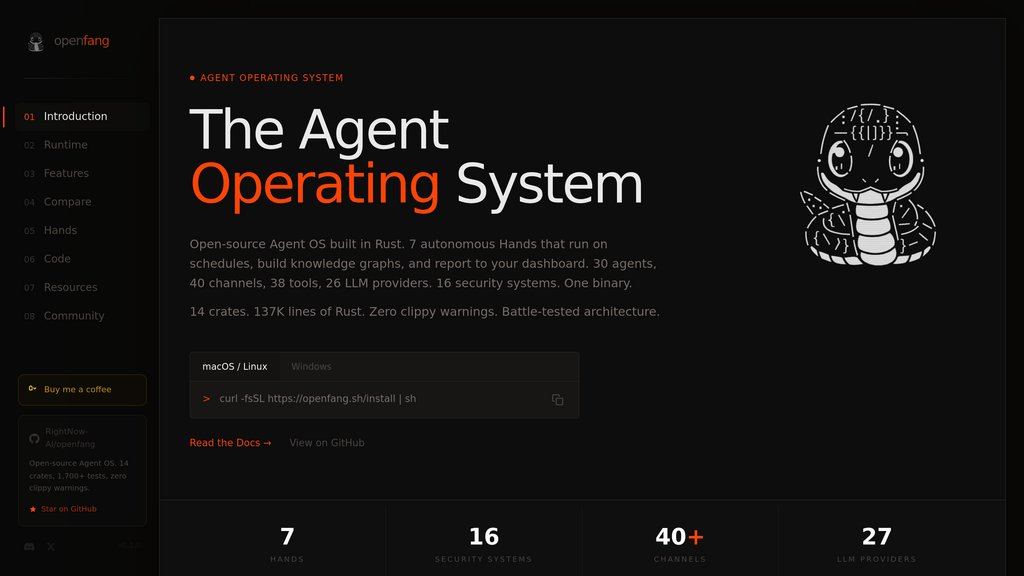
OpenFang is an open-source Agent Operating System (Agent OS) written entirely in Rust, designed to build, run, and deploy autonomous agents at a production-grade level. It ships as a single binary containing 30 pre-built agents, 7 autonomous Hands, 38 built-in tools, 40 channel adapters, and support for 26 LLM providers. OpenFang distinguishes itself through a kernel-grade security architecture with 16 layered security systems — including a WASM sandbox, Merkle audit trail, and prompt injection scanner — as well as persistent memory, multi-protocol support (MCP, A2A, OFP), and a native Tauri 2.0 desktop app. It is built for developers and teams who want real autonomous agents that work on schedules and report results, not just chatbots that wait for input.
Key Features
7 Autonomous Hands
Pre-built capability packages — Clip, Lead, Collector, Predictor, Researcher, Twitter, and Browser — that run on schedules, build knowledge graphs, and report progress to your dashboard without requiring constant user input.
16-Layer Security Architecture
Enterprise-grade security including WASM dual-metered sandbox, Ed25519 manifest signing, Merkle audit trail, taint tracking, SSRF protection, prompt injection scanner, and HMAC-SHA256 mutual authentication.
40 Channel Adapters
Deploy agents across Telegram, Discord, Slack, WhatsApp, Teams, IRC, Matrix, and 33 more platforms with per-channel model overrides, DM/group policies, and rate limiting.
26 LLM Providers & 30 Pre-Built Agents
Supports 26 LLM providers including Anthropic, Gemini, Groq, and DeepSeek, with 30 ready-to-deploy agents spanning orchestrators, code reviewers, and customer support roles across four performance tiers.
MCP, A2A & OFP Protocol Support
Native Model Context Protocol client and server, Google Agent-to-Agent task delegation, and OpenFang Protocol for peer-to-peer agent networking with mutual authentication.
Persistent Memory & Workflow Engine
SQLite-backed vector memory with automatic LLM-based compaction enables agents to retain context across sessions; a multi-agent workflow engine supports fan-out, conditional, and loop execution modes.
Use Cases
- Autonomous Lead Generation : Sales and marketing teams can activate the Lead Hand to autonomously discover, enrich, score, and deduplicate qualified leads on a daily schedule with ICP profiling and CSV/JSON export.
- Content Repurposing : Content creators can use the Clip Hand to automatically transform long-form videos into short clips with captions, thumbnails, and voice-overs, then publish directly to Telegram or WhatsApp.
- Intelligence Monitoring & OSINT : Analysts and researchers can deploy the Collector Hand for continuous OSINT-style monitoring of any target, with change detection, sentiment tracking, and automated knowledge graph construction.
- Multi-Platform Agent Deployment : Developers can deploy a single agent across 40+ messaging and collaboration platforms simultaneously, with platform-specific policies and model routing configured per channel.
- Research & Fact-Checking : Knowledge workers can run the Researcher Hand to autonomously cross-reference sources, fact-check claims using CRAAP evaluation, and generate multi-language cited reports.
FAQs
OpenFang Alternatives

Humalike
Behavioral infrastructure that gives AI agents human-like social skills — turn-taking, memory, and group awareness — via the HUMA API.

Pancake
Autonomous AI cofounder that deploys stacked agents to run growth, engineering, and operations 24/7 through your existing tools.

Donely
A cloud management platform for deploying and scaling unlimited OpenClaw AI agents from one unified dashboard — no DevOps required.

Credal.ai
Enterprise platform enabling secure, permission-aware AI assistants that integrate with internal data and systems to automate complex workflows.

NanoCorp
Platform for launching autonomous companies that build products, find customers, run ads, and generate revenue — from a single prompt, with no code or team required.

AgentSky
Managed cloud service for launching long-lived, always-on agents across any harness, model, and messaging channel.

Matrix
An agent company runtime that lets you launch and run a fully autonomous 0-person company — set objectives, coordinate agents, and ship verified results.

Polsia
Autonomous company-building platform that handles planning, coding, marketing, and operations around the clock — no employees needed.